Multifaceted regulation of thymic tolerance by pattern recognition cascades - Report - MDSpire

Multifaceted regulation of thymic tolerance by pattern recognition cascades

  • By

  • Soumyadeep Mukherjee

  • Paramita Paul

  • Arpita Kar

  • Subhasis Barik

  • June 9, 2026

  • 0 min

Share

Clinical Report: Complex Modulation of Thymic Tolerance Through PR Pathways

Overview

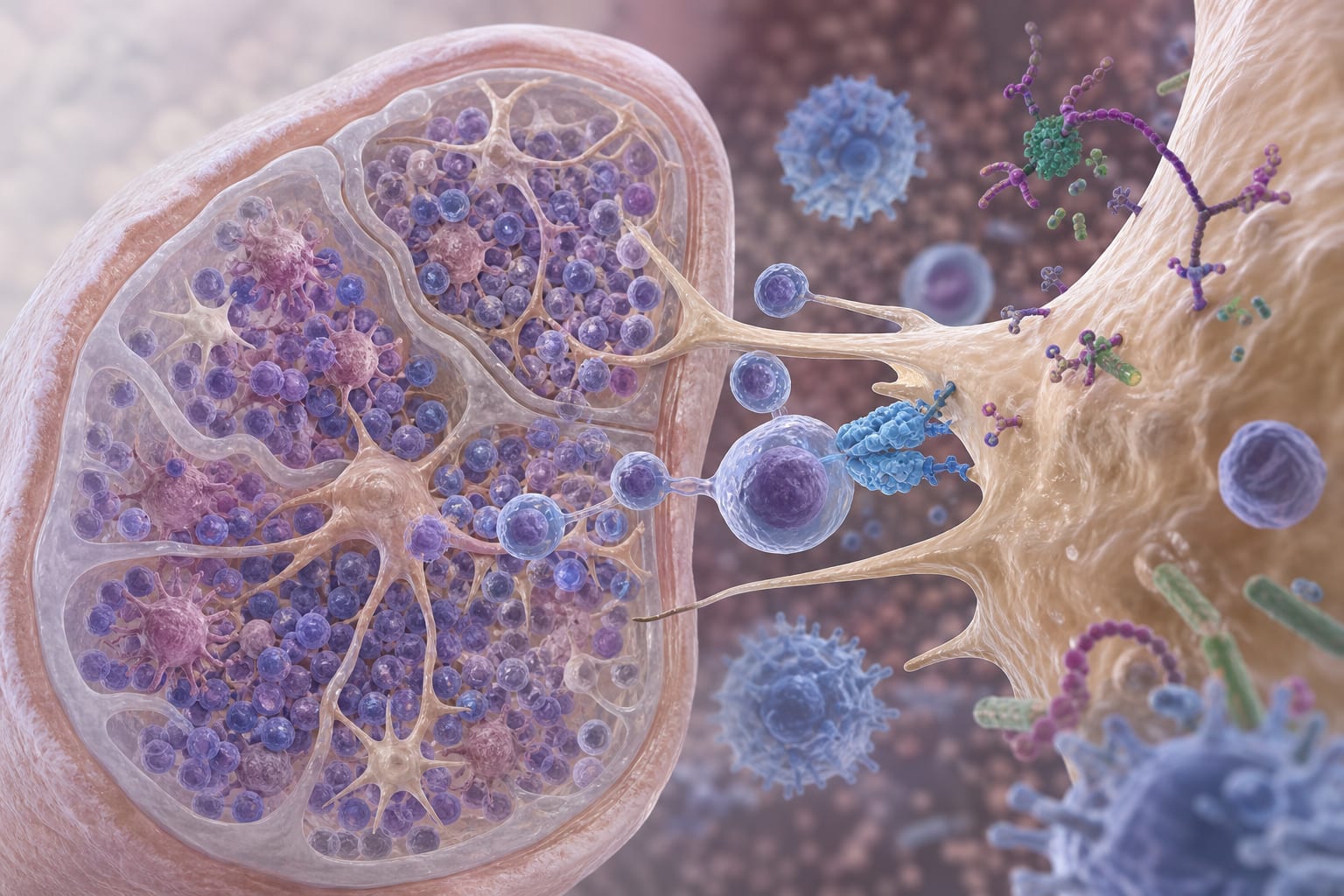
This review elucidates the role of pattern recognition receptors (PRRs) in regulating thymic tolerance, highlighting their dual role in both promoting and potentially undermining immune tolerance. The findings suggest that understanding these mechanisms could lead to improved therapeutic strategies for autoimmune diseases.

Background

Thymic tolerance is crucial for preventing autoimmunity by ensuring that T cells do not react against self-antigens. Disruption of this tolerance can lead to autoimmune diseases, which are often treated with immunosuppressive therapies. However, the impact of these therapies on central tolerance remains poorly understood, necessitating further exploration of the interplay between inflammation and immune tolerance.

Data Highlights

No numerical data or trial results were presented in the article.

Key Findings

  • PRRs play a significant role in modulating thymic tolerance through both extrinsic and intrinsic pathways.
  • Immunosuppressive therapies targeting PRR pathways may inadvertently disrupt central tolerance.
  • Understanding the crosstalk between inflammation and thymic tolerance is essential for developing better treatments for autoimmunity.
  • PRR signaling can contribute positively to thymic tolerance, contrary to the common perception of their role in promoting autoimmunity.
  • There is a need for therapeutic repurposing of immunosuppressive agents to enhance central tolerance mechanisms.

Clinical Implications

Clinicians should be aware of the complex role that PRRs play in both promoting and hindering thymic tolerance. This understanding may inform the development of more targeted immunotherapies that preserve central tolerance while managing autoimmune conditions.

Conclusion

The intricate relationship between PRR signaling and thymic tolerance underscores the importance of reevaluating immunosuppressive strategies in the context of autoimmunity. Enhanced understanding of these mechanisms could lead to more effective therapeutic approaches.

Related Resources & Content

  1. Journal of Neuro-Oncology, 2020 -- Immune Modulation in Glioma Cases
  2. Brain, 2026 -- Role of CD5 signalling for pro-inflammatory Th17 response in multiple sclerosis
  3. Acta Neuropathologica, 2021 -- Characterization of T cell signatures in myasthenia gravis through single-cell analysis
  4. Frontiers in Immunology, 2026 -- T cell decision-making decodes the dynamic antigenic landscape
  5. Human inborn errors of immunity: 2024 update on the classification from the International Union of Immunological Societies Expert Committee - PMC
  6. Society for Immunotherapy of Cancer (SITC) recommendations on intratumoral immunotherapy clinical trials (IICT)
  7. Human inborn errors of immunity: 2024 update on the classification from the International Union of Immunological Societies Expert Committee - PMC
  8. Society for Immunotherapy of Cancer (SITC) recommendations on intratumoral immunotherapy clinical trials (IICT): from premalignant to metastatic disease | Journal for ImmunoTherapy of Cancer
  9. The Role of Interferon-γ in Autoimmune Polyendocrine Syndrome Type 1 - PMC

Original Source(s)

Related Content