Pharmacological ZO-1 agonist treatment attenuates ammonia nitrogen stress-induced mucosal inflammation and intestinal barrier failure in Leiocassis longirostris - Report - MDSpire

Pharmacological ZO-1 agonist treatment attenuates ammonia nitrogen stress-induced mucosal inflammation and intestinal barrier failure in Leiocassis longirostris

  • By

  • Senyue Liu

  • Yang Feng

  • Chengyan Mou

  • Lu Zhang

  • Yuanliang Duan

  • Zhipeng Huang

  • Han Zhao

  • Jian Zhou

  • Jun Du

  • Qiang Li

  • Yongqiang Deng

  • June 8, 2026

  • 0 min

Share

Clinical Report: Treatment with ZO-1 Agonist Mitigates Mucosal Inflammation

Overview

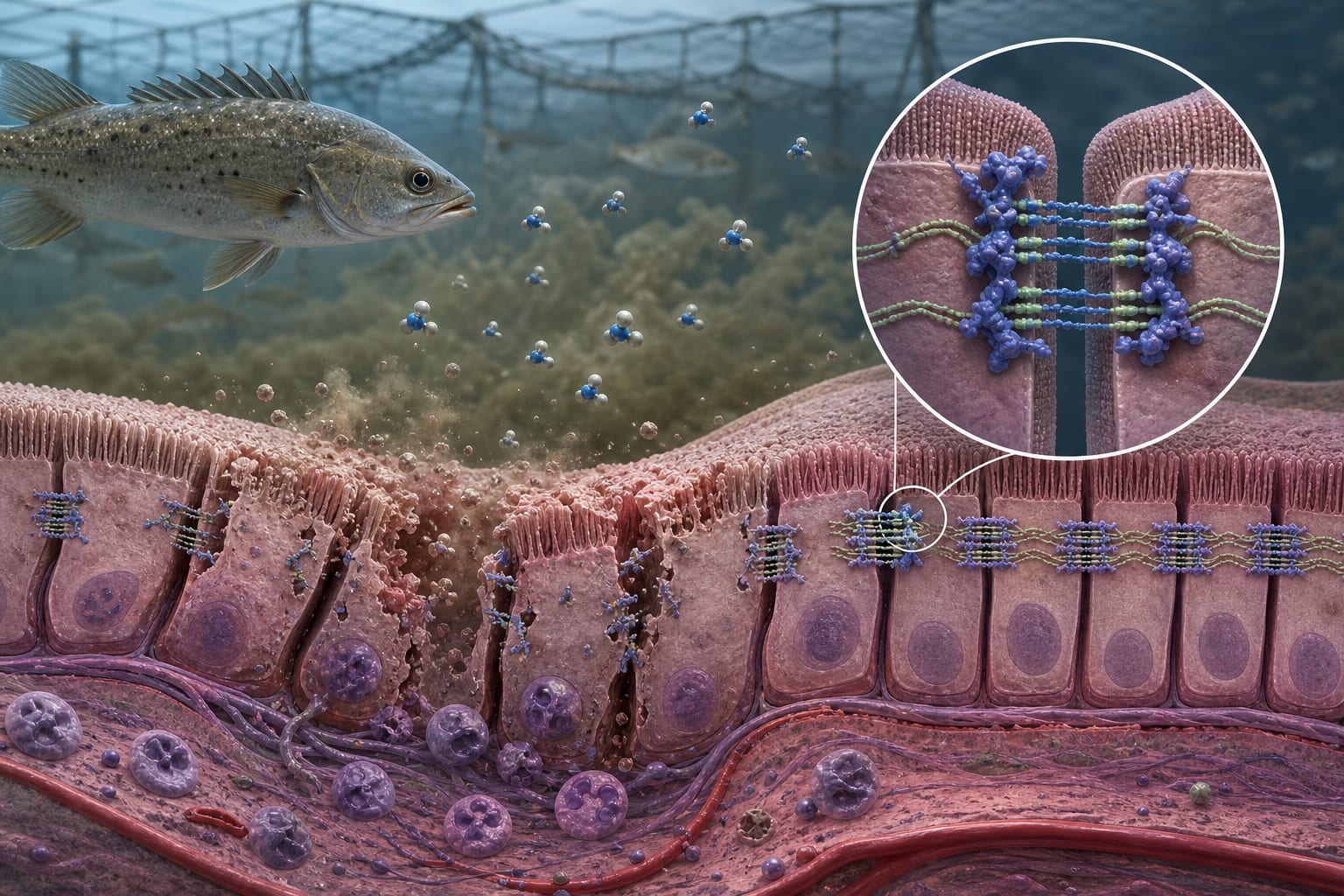
This study investigates the effects of ammonia nitrogen stress on the intestinal barrier of Leiocassis longirostris and the potential of ZO-1 stabilization to mitigate mucosal inflammation. Findings indicate that ammonia exposure leads to ineffective transcriptional compensation of tight junction proteins, resulting in barrier dysfunction.

Background

Ammonia nitrogen is a significant environmental stressor in aquaculture, impacting fish health and production efficiency. The intestinal barrier, primarily regulated by tight junctions, is crucial for nutrient absorption and immune defense. Understanding the mechanisms of ammonia-induced intestinal damage is essential for developing strategies to enhance mucosal resilience in aquaculture.

Data Highlights

No numerical data or trial data presented in the article.

Key Findings

  • Ammonia exposure caused inflammatory cell infiltration and disrupted the intestinal epithelial barrier in Leiocassis longirostris.
  • Core tight junction components, including ZO-1, were transcriptionally upregulated but failed to assemble properly at the apical membrane.
  • Transepithelial electrical resistance (TEER) measurements indicated a significant decline in barrier function following ammonia exposure.
  • Pharmacological stabilization of ZO-1 reduced mucosal inflammatory damage and restored tight junction protein localization.
  • We refer to this phenomenon as 'ineffective transcriptional compensation' in response to ammonia stress.

Clinical Implications

Understanding the mechanisms of ammonia-induced dysregulation can inform future interventions to support fish health.

Conclusion

The findings indicate that ZO-1 stabilization may mitigate intestinal barrier dysfunction caused by ammonia nitrogen stress in aquaculture.

Related Resources & Content

  1. Nature Reviews Gastroenterology & Hepatology, 2024 -- Ammonia-induced stress response in liver disease progression and hepatic encephalopathy
  2. American Journal of Physiology-Gastrointestinal and Liver Physiology -- Tools and advanced imaging technologies for assessing intestinal epithelial barrier integrity: a systematic review
  3. Journal of Crohn's and Colitis — Pharmacological Inhibition of N-Acylethanolamine Acid Amidase (NAAA) Mitigates Intestinal Fibrosis Through Modulation of Macrophage Activity
  4. Journal of Gastroenterology — Prevention of gastric mucosal damage caused by indomethacin through the use of thioredoxin derived from sake yeast
  5. Journal of Gastroenterology — Inhibition of IL-25 Signaling Mitigates Gut Inflammation in a Type-2 Colitis Model by Reducing IL-13 Production from Nuocytes and NKT Cells
  6. Increased c-fos Expression in the Central Nervous System Linked to Visceral Hypersensitivity in Irritable Bowel Syndrome: A Potential Target for Therapeutic Intervention
  7. Ammonia-induced stress response in liver disease progression and hepatic encephalopathy | Nature Reviews Gastroenterology & Hepatology
  8. Tools and advanced imaging technologies for assessing intestinal epithelial barrier integrity: a systematic review | American Journal of Physiology-Gastrointestinal and Liver Physiology | American Physiological Society
  9. ECCO Guidelines on Therapeutics in Crohn's Disease: Medical Treatment

Original Source(s)

Related Content