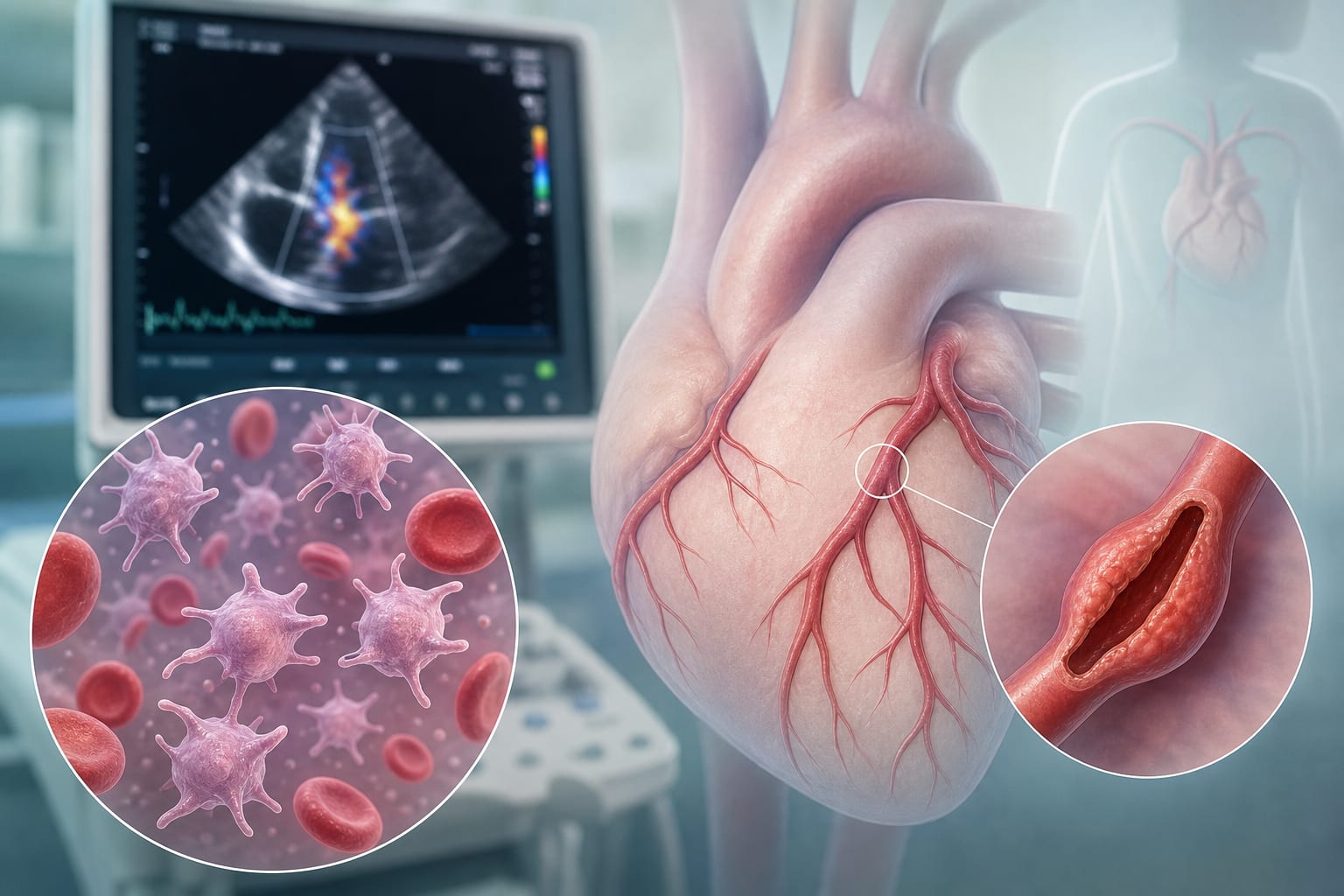
Clinical Report: Association of Platelet Metrics with Coronary Artery Lesions in Children Diagnosed with Kawasaki Disease
Overview
This study investigates the correlation between platelet levels and coronary artery lesions in children with Kawasaki disease (KD). The findings indicate that higher platelet parameters are associated with the presence of coronary artery lesions in this population.
Background
Kawasaki disease is a significant cause of acquired heart disease in children, with coronary artery lesions being a severe complication. The incidence of these lesions can lead to long-term cardiovascular issues, making it crucial to identify risk factors and potential biomarkers for early intervention.
Data Highlights
Parameter
KD Group (Mean ± SD)
Control Group (Mean ± SD)
PLT
319.56 ± 26.17
201.56 ± 12.98
MPV
8.94 ± 1.25
7.05 ± 1.13
PCT
0.30 ± 0.08
0.13 ± 0.02
PDW
20.75 ± 2.10
16.17 ± 1.89
Key Findings
Platelet parameters (PLT, MPV, PCT, PDW) were significantly higher in KD patients compared to healthy controls (all P < 0.05).
The lesion group exhibited higher platelet parameters than the non-lesion group (all P < 0.05).
The Harada score was significantly higher in the lesion group compared to the non-lesion group (P < 0.05).
Multivariate binary logistic regression analysis showed significant correlations between platelet metrics and coronary artery lesions (P < 0.05).
Coronary artery lesions can occur in 15%-25% of untreated KD cases, leading to serious cardiovascular complications.
Clinical Implications
The study suggests that platelet parameters may serve as potential biomarkers for assessing the risk of coronary artery lesions in children with Kawasaki disease. Monitoring these metrics could aid in the clinical management and risk stratification of affected patients.
Conclusion
The findings indicate a close association between platelet levels and coronary artery lesions in children with Kawasaki disease. Further research is warranted to validate these parameters as clinical tools for risk assessment.