Soluble IL-2 receptor and memory Treg profiles differentiate early rheumatoid arthritis from undifferentiated arthritis at initial presentation - Report - MDSpire

Soluble IL-2 receptor and memory Treg profiles differentiate early rheumatoid arthritis from undifferentiated arthritis at initial presentation

  • By

  • Xiaoyu Zi

  • Yifang Shi

  • Yicong Zhao

  • Chong Gao

  • Caihong Wang

  • June 9, 2026

  • 0 min

Share

Clinical Report: Profiles of Soluble IL-2 Receptor and Memory Treg in RA

Overview

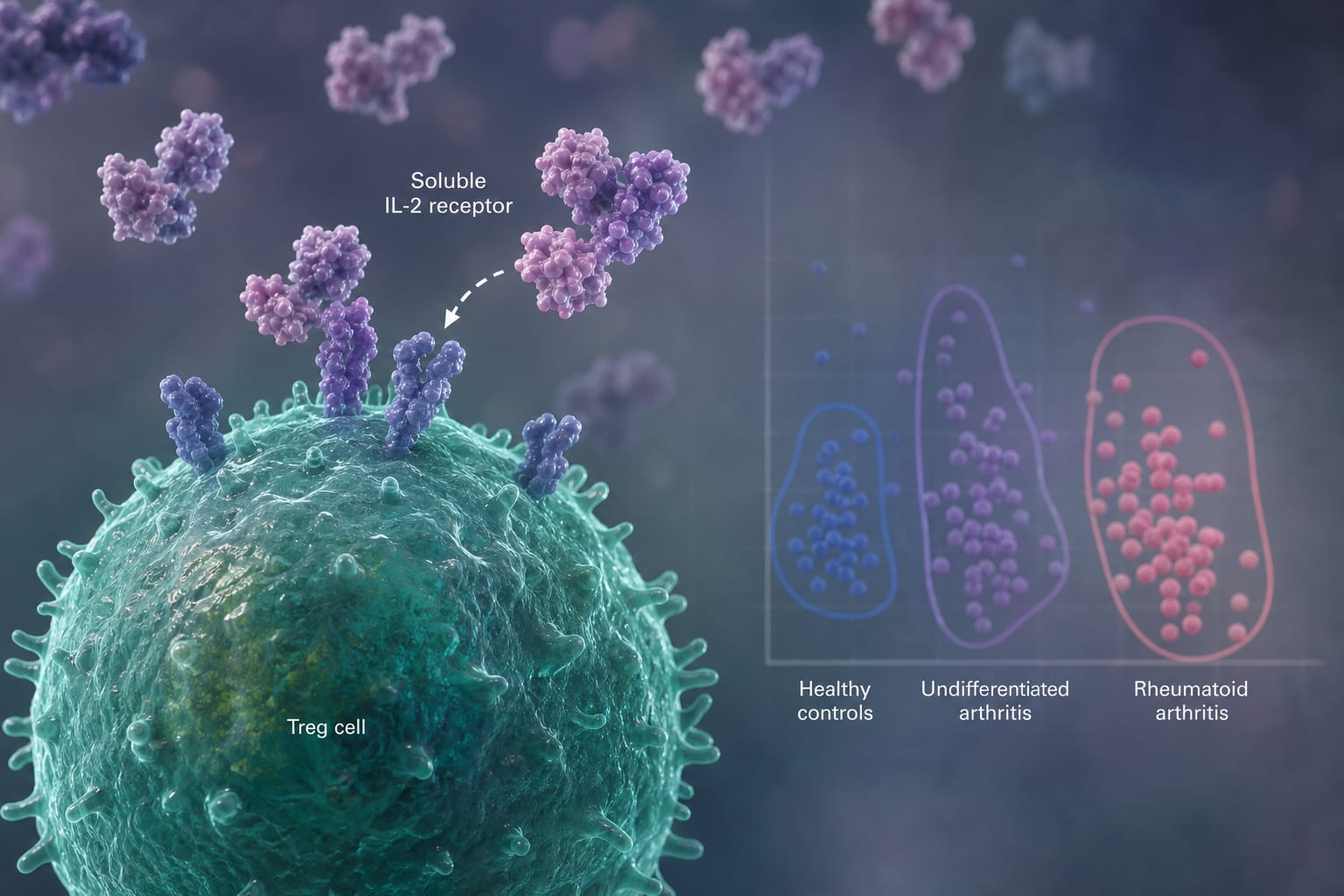
This study identifies distinct immune profiles that differentiate treatment-naïve rheumatoid arthritis (TN-RA) from undifferentiated arthritis (UA) at initial presentation. An eight-feature immune signature, including soluble IL-2 receptor (sIL-2R) and memory Tregs, demonstrates high accuracy in classification.

Background

Rheumatoid arthritis (RA) poses significant diagnostic challenges, particularly in early stages where patients may not meet established classification criteria. Identifying biomarkers that can distinguish TN-RA from UA is crucial for timely intervention and management. The study explores the role of immune profiling in enhancing diagnostic accuracy for early inflammatory arthritis.

Data Highlights

GroupKey Features
TN-RAElevated sIL-2R, decreased IL-2, increased IL-6, IFN-γ, TNF-α, increased CD45RO+ Tregs
UATh17/Treg imbalance, preserved Th2 and Th17 responses

Key Findings

  • Distinct immune profiles were identified between TN-RA and UA at initial presentation.
  • TN-RA showed IL-2 signaling exhaustion and systemic inflammation.
  • UA exhibited a Th17/Treg imbalance with preserved Th2 and Th17 responses.
  • An eight-feature immune signature discriminated TN-RA from UA with an AUC of 0.959.
  • sIL-2R and IL-6 were the strongest contributors to the immune signature.

Clinical Implications

The findings suggest that immune profiling, particularly through the assessment of sIL-2R and memory Tregs, may enhance diagnostic accuracy for early RA. This could inform clinical decision-making when conventional classification criteria are insufficient.

Conclusion

The study highlights the potential of an immune-based classifier to distinguish TN-RA from UA, emphasizing the importance of the IL-2-Treg axis in early rheumatoid arthritis diagnosis.
Related Resources & Content

  1. Frontiers | Soluble IL-2 Receptor and Memory Treg Profiles Differentiate Early Rheumatoid Arthritis from Undifferentiated Arthritis at Initial Presentation
  2. Clinical Rheumatology — Alterations in Th17, Treg, and helper innate lymphoid cell populations in the peripheral blood of individuals with rheumatoid arthritis
  3. Clinical Rheumatology — Association of Receptor Activator of Nuclear Factor Kappa-B Ligand (RANKL) with Joint Damage in Early Rheumatoid Arthritis, Excluding Sclerostin and Gene Polymorphisms
  4. npj Digital Medicine — Location and amount of joint involvement differentiates rheumatoid arthritis into different clinical subsets
  5. Clinical Rheumatology — Early Phase Hormonal, Metabolic Peptide, and Nutrient Profiles in Rheumatoid Arthritis: The Role of Free Fatty Acids in Heightened Cardiovascular Risk During Initial Disease Stages
  6. EULAR Guidelines on RA Management
  7. Frontiers | Soluble IL-2 Receptor and Memory Treg Profiles Differentiate Early Rheumatoid Arthritis from Undifferentiated Arthritis at Initial Presentation

Original Source(s)

Related Content