Clinical Report: Evaluating the Practicality and Clinical Application of Deep Learning-Generated 12-Lead ECGs for Remote Cardiac Surveillance
Overview
Expand on the limitations of TONet for critical diagnostic tasks beyond STEMI screening.
Background
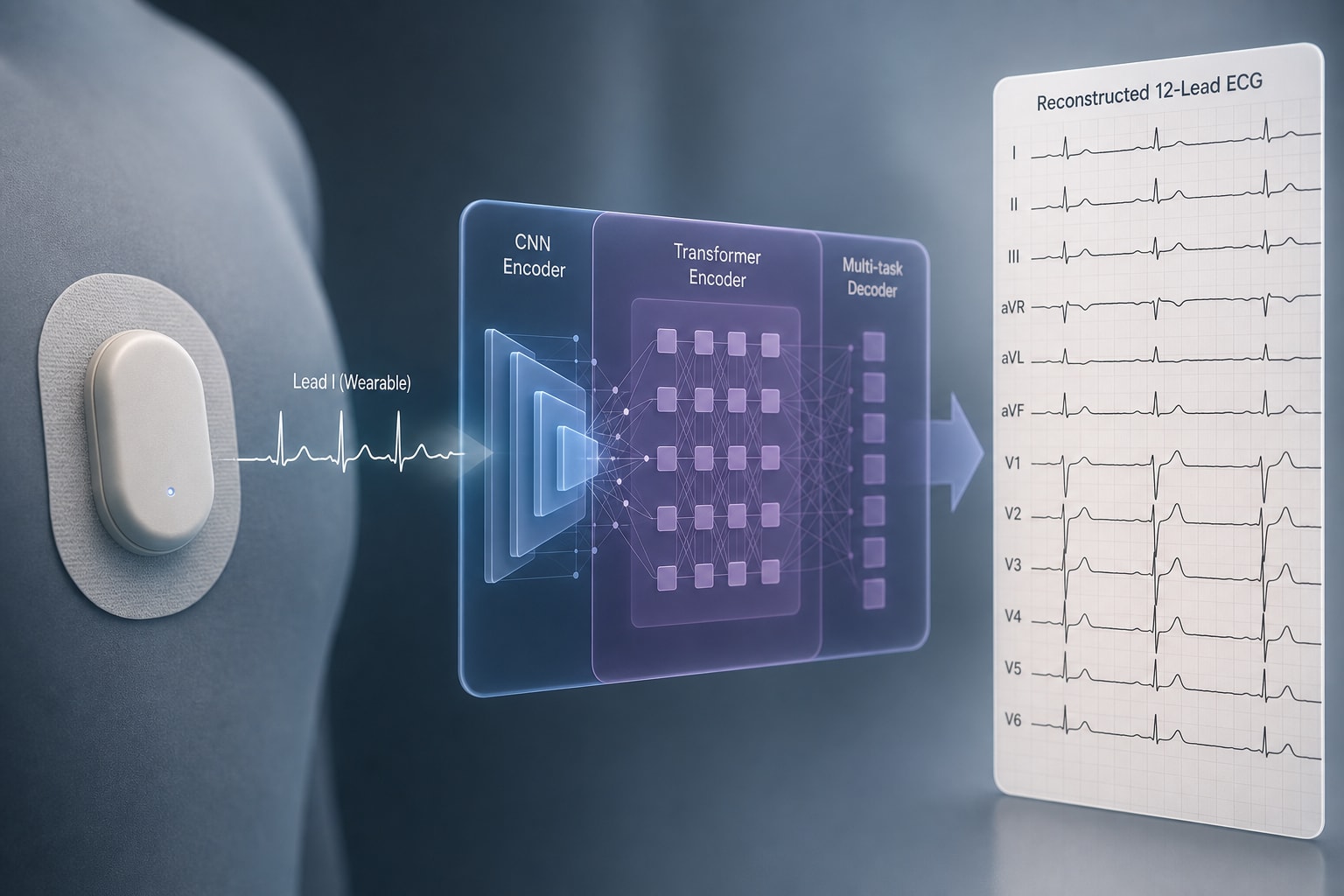
Cardiovascular diseases are the leading cause of global mortality, highlighting the importance of effective diagnostic tools. The standard 12-lead ECG provides comprehensive cardiac information, but wearable devices typically offer only single-lead monitoring, limiting their diagnostic capabilities. This study addresses the technological gap by exploring deep learning methods for reconstructing full 12-lead ECGs from single-lead data.
Data Highlights
Metric
Value
Pearson Correlation Coefficient (PCC)
0.673
Macro-averaged AUROC
0.821 (95% CI: 0.810–0.831)
PCC on Chapman-Shaoxing Database
0.612 (95% CI: 0.552–0.666)
Linear-regression Baseline PCC
0.498
Key Findings
TONet achieved a PCC of 0.673 on the independent test set, indicating strong correlation in signal reconstruction.
Bland-Altman analysis showed negligible bias across reconstructed leads, ensuring voltage integrity.
The model demonstrated a macro-averaged AUROC of 0.821 for diagnostic utility.
Independent validation on a second cohort confirmed the model's generalizability with a PCC of 0.612.
Reconstructed leads are not sufficient for fine-grained STEMI screening, necessitating further validation.
Clinical Implications
The development of TONet presents a promising advancement in remote cardiac monitoring, potentially enhancing the diagnostic capabilities of wearable devices. However, clinicians should remain cautious, as the current model is not yet validated for critical applications such as STEMI detection.
Conclusion
Reinforce the need for external validation and discuss potential clinical applications.