Endometrial receptivity characteristics in patients with repeated implantation failure: a study using LASSO regression and Bayesian generalized linear model analysis - Report - MDSpire

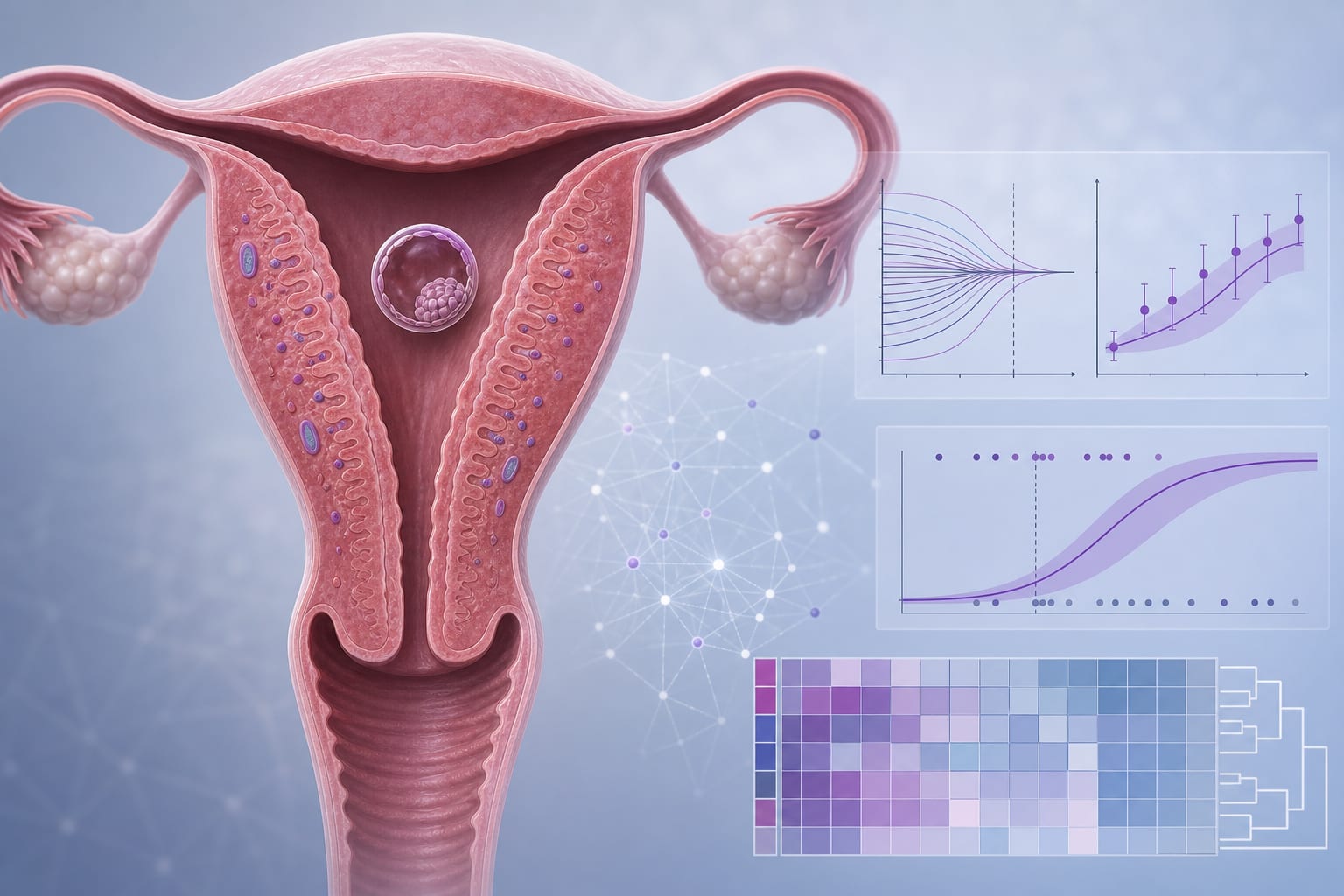
Endometrial receptivity characteristics in patients with repeated implantation failure: a study using LASSO regression and Bayesian generalized linear model analysis

  • By

  • Panpan Zhao

  • Yuexin Yu

  • June 8, 2026

  • 0 min

Share

Clinical Report: Characteristics of Endometrial Receptivity in RIF Patients

Overview

This study identifies key factors influencing endometrial receptivity in patients experiencing repeated implantation failure (RIF) using LASSO regression and Bayesian models. The findings highlight the predictive value of specific endometrial parameters and the model's strong discriminatory ability.

Background

Repeated implantation failure (RIF) poses a significant challenge in assisted reproductive technology (ART), affecting approximately 10% of patients. Understanding endometrial receptivity (ER) is crucial, as reduced compatibility accounts for about two-thirds of implantation failures. This study aims to systematically analyze multiple endometrial parameters to enhance predictive modeling for RIF.

Data Highlights

ParameterOdds Ratio (OR)95% Confidence Interval (CI)
Endometrial blood flow branches0.10.06–0.17
Endometrial arterial resistance index (RI)1.211.04–1.44
Endometrial arterial pulsatility index (PI)1.481.06–2.10
Endometrial arterial S/D ratio3.631.54–9.03
Endometrial peristaltic frequency1.931.16–3.17

Key Findings

  • The LASSO regression identified five key endometrial parameters predictive of RIF.
  • Increased endometrial blood flow branches significantly reduced RIF risk.
  • Elevated endometrial arterial RI was associated with increased RIF risk.
  • Decreased endometrial arterial PI correlated inversely with RIF risk.
  • Higher S/D ratio and increased peristaltic frequency were positively correlated with RIF risk.
  • The predictive model demonstrated excellent discriminatory ability with an AUC of 0.911.

Clinical Implications

The study provides a predictive model that can assist clinicians in identifying patients at risk for RIF based on specific endometrial parameters. This model may guide personalized interventions to improve ART outcomes.

Conclusion

The integration of LASSO and Bayesian methods offers a novel approach to understanding endometrial receptivity in RIF patients. These findings may inform future diagnostic and treatment strategies in assisted reproductive technology.

Related Resources & Content

  1. The Journal of Clinical Endocrinology & Metabolism, 2023 -- Impact of Dyslipidemia on Immune Function and Endometrial Receptivity in Women Experiencing Repeated Implantation Failure
  2. Frontiers in Endocrinology, 2026 -- Development and internal validation of a post-retrieval machine learning models for OHSS risk stratification in assisted reproductive technology: an exploratory study
  3. Frontiers in Endocrinology, 2026 -- The impact of regressed endometrial hyperplasia on reproductive outcomes following frozen embryo transfer: a propensity score-matched cohort study
  4. Frontiers in Reproductive Health, 2026 -- Research progress on non-invasive testing of endometrial receptivity
  5. OP-HROP230023, 2023 -- Definitions and guidance on recurrent implantation failure
  6. Endometrial receptivity testing | HFEA, 2023
  7. Scientific Reports, 2025 -- Endometrial receptivity profiled through transcriptomic analysis of uterine fluid extracellular vesicles using systems biology and bayesian modeling for pregnancy prediction
  8. OP-HROP230023 1..29
  9. Endometrial receptivity testing | HFEA
  10. Endometrial receptivity profiled through transcriptomic analysis of uterine fluid extracellular vesicles using systems biology and bayesian modeling for pregnancy prediction | Scientific Reports

Original Source(s)

Related Content