Prepubertal Growth Trajectory and Pubertal Onset - Report - MDSpire

Prepubertal Growth Trajectory and Pubertal Onset

  • By

  • Rui Deng

  • Weiqin Li

  • Jiali Duan

  • Tianshu Feng

  • Liumei Wei

  • Xingxiu Li

  • Junhong Leng

  • Xijie Wang

  • Bin Dong

  • Susan M. Sawyer

  • June 9, 2026

  • 0 min

Share

Clinical Report: Growth Patterns Before Puberty and the Timing of Pubertal Onset

Overview

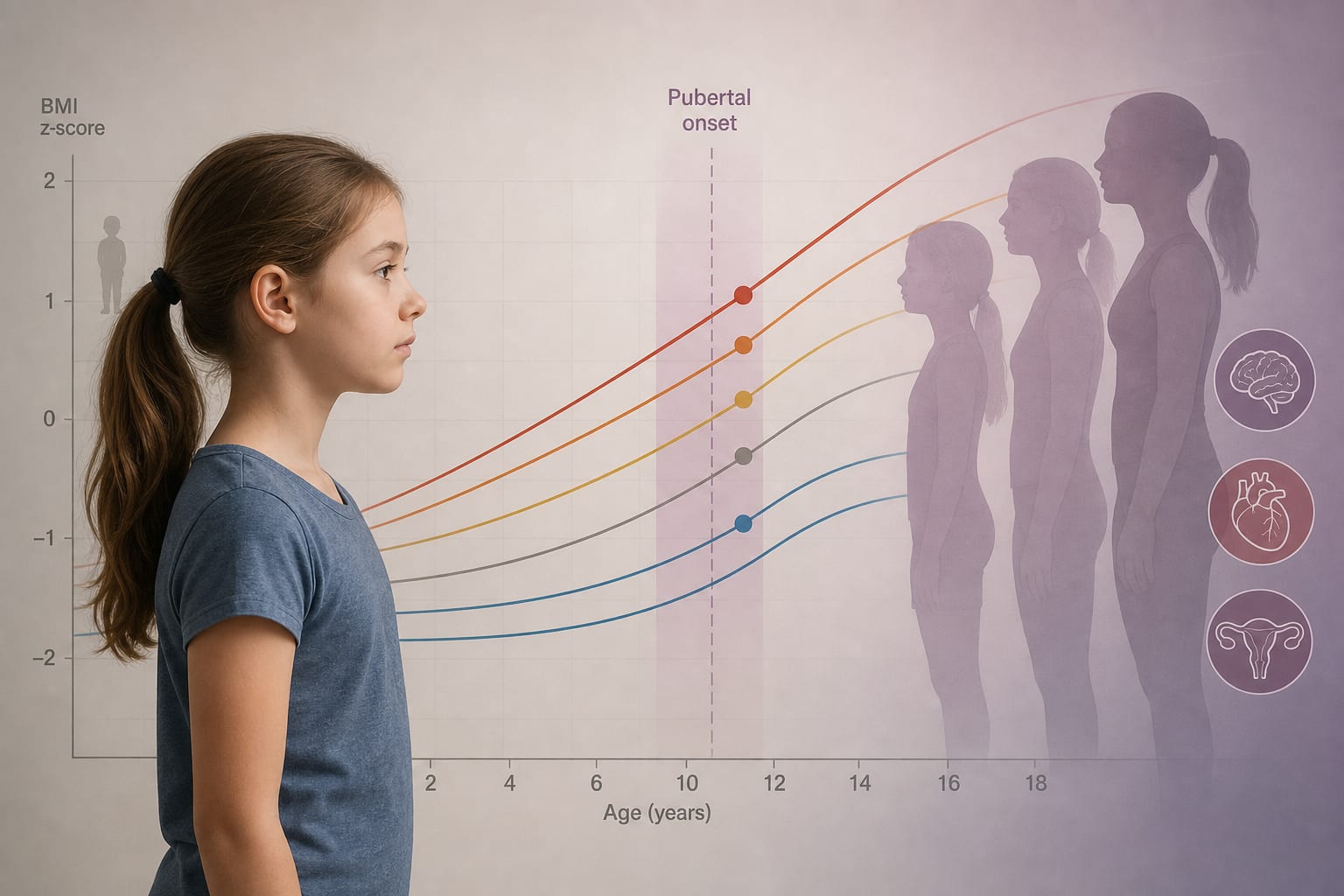
This study investigates the relationship between body mass index (BMI) trajectories and the timing of pubertal onset using data from two birth cohorts in Australia and China. It highlights the significance of cumulative exposure to adiposity and rapid BMI increases in predicting earlier pubertal onset.

Background

Understanding the timing of puberty is crucial due to its association with various health risks, including behavioral and emotional problems in adolescence and noncommunicable diseases in adulthood. Recent trends indicate a rise in early puberty onset, particularly following the COVID-19 pandemic, necessitating further research into the factors influencing this phenomenon.

Data Highlights

This study utilized data from two cohorts: the Longitudinal Study of Australian Children (LSAC) and the Tianjin Birth Cohort Study (TBCS), tracking BMI from birth to puberty.

Key Findings

  • Higher body mass index (BMI) is associated with earlier pubertal onset.
  • Cumulative exposure to different levels of adiposity (CEA) may influence pubertal timing.
  • Rapid increases in BMI could be linked to earlier onset of puberty.
  • Previous studies have primarily focused on short-term BMI measurements rather than long-term growth trajectories.
  • This study aims to identify sensitive periods for BMI increases that may affect pubertal timing.

Clinical Implications

Healthcare professionals should consider the long-term tracking of BMI and adiposity in children to better understand its impact on pubertal timing. Early identification of children at risk for early puberty may facilitate timely interventions.

Conclusion

The findings underscore the importance of longitudinal studies in understanding the relationship between growth patterns and pubertal onset, which may inform future clinical practices.

Related Resources & Content

  1. Stat News, 2026 -- Male puberty is understudied — but when it starts may predict long-term health risks
  2. American Journal of Epidemiology -- The Relationship Between Pubertal Timing, Tempo, and Body Mass Index Trajectories: Analyzing the Impact of Childhood Body Mass Index as a Confounding Factor
  3. The Journal of Clinical Endocrinology & Metabolism -- Association Between Early Onset Puberty and Mental Health Disorders: Findings from a Nationwide Cohort Analysis Utilizing Prospective Registry Data
  4. Central Precocious Puberty: A Clinical Practice Guideline Education Activity (2026004HG)-Guideline: Central Precocious Puberty
  5. Worldwide secular changes in limits for age at thelarche: an updated systematic review and meta-analysis | ECEESPE2025 | Joint Congress of the European Society for Paediatric Endocrinology (ESPE) and the European Society of Endocrinology (ESE) 2025
  6. The Journal of Clinical Endocrinology & Metabolism — Impact of GnRH Analogues and Gender-Affirming Hormone Therapy on Adult Height in Transgender Adolescents
  7. Central Precocious Puberty: A Clinical Practice Guideline Education Activity (2026004HG)-Guideline: Central Precocious Puberty
  8. Worldwide secular changes in limits for age at thelarche: an updated systematic review and meta-analysis | ECEESPE2025 | Joint Congress of the European Society for Paediatric Endocrinology (ESPE) and the European Society of Endocrinology (ESE) 2025: Connecting Endocrinology Across the Life Course | Endocrine Abstracts
  9. Long-term Safety, Efficacy, and PROs: Phase 3 Study of Leuprolide Acetate 6-month IM Depot in Central Precocious Puberty - PubMed

Original Source(s)

Related Content