Laminectomy vs. laminoplasty for treating multi-segment cervical canal stenosis combined with central cord syndrome in the absence of fracture or dislocation: a retrospective study - Report - MDSpire

Laminectomy vs. laminoplasty for treating multi-segment cervical canal stenosis combined with central cord syndrome in the absence of fracture or dislocation: a retrospective study

  • By

  • Qian Zhang

  • Rudan Guo

  • Jun Wang

  • Yuefen Wu

  • Shunyi Tong

  • Sanhua Fang

  • Xiaoling Yang

  • June 8, 2026

  • 0 min

Share

Clinical Report: Comparison of Laminectomy and Laminoplasty for CCSWOFD

Overview

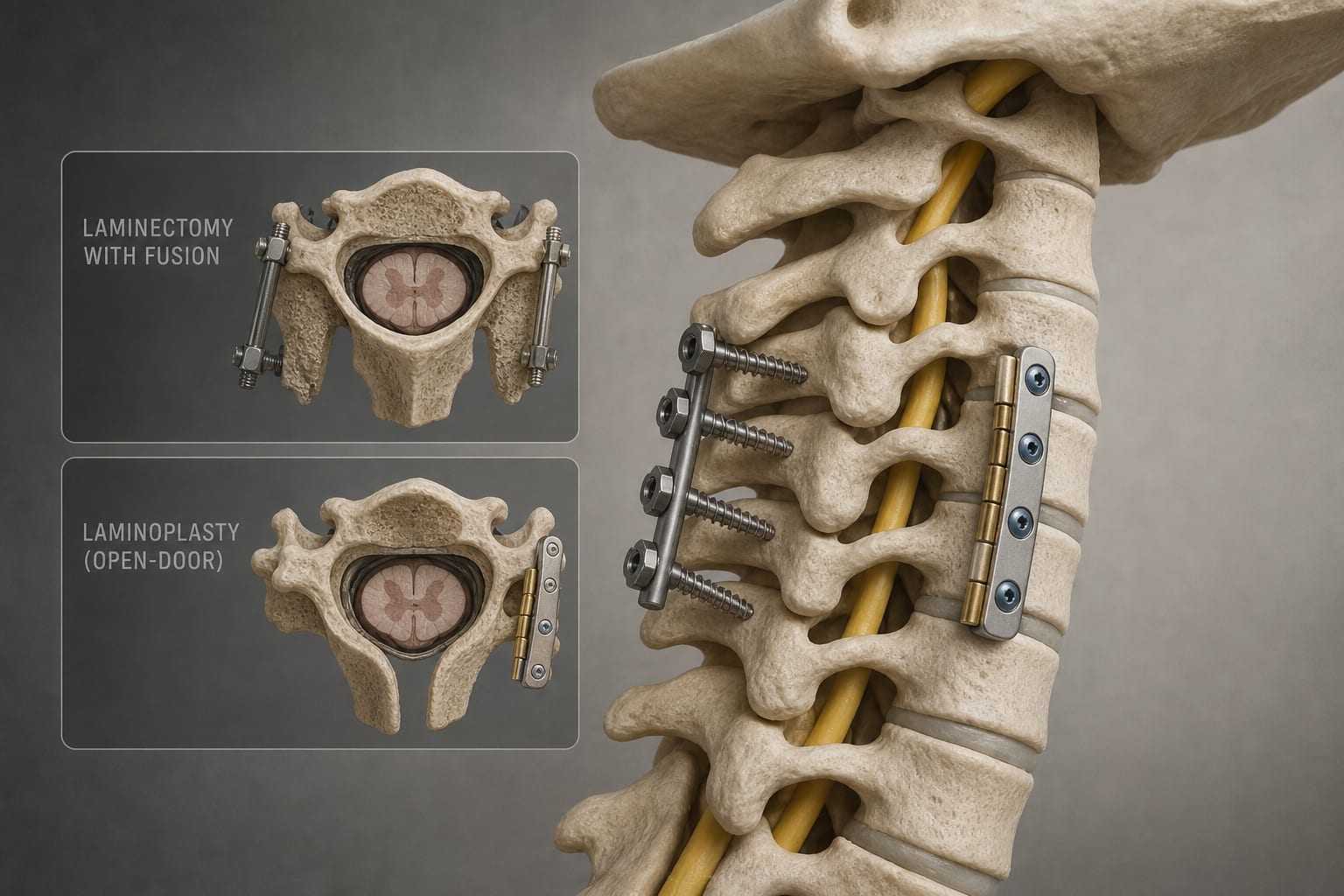
This study compares laminectomy fusion fixation (LF) and laminoplasty (LP) in patients with multi-segment cervical canal stenosis and central cord syndrome without fracture or dislocation. The study reports that LF demonstrated better neurological and radiological outcomes compared to LP, particularly in patients with coexisting ossification of the posterior longitudinal ligament.

Background

Central cord syndrome without fracture or dislocation (CCSWOFD) is a significant condition affecting older adults, characterized by neurological deficits due to cervical canal stenosis. Surgical intervention is often necessary, and the choice between LF and LP is explored in this study.

Data Highlights

Outcome MeasureLF GroupLP Group
Final JOA ScoresBetterLower
Recovery Rates (RR)BetterLower
Intrinsic Hand Muscle Strength (IHMS)BetterLower
BASIC ScoresBetterLower
Postoperative C2–7 Cobb AnglesSuperiorInferior

Key Findings

  • LF group had better final JOA scores compared to LP group (P < 0.05).
  • Recovery rates and intrinsic hand muscle strength were also better in the LF group.
  • LF achieved superior postoperative C2–7 Cobb angles despite reduced range of motion.
  • The sagittal vertical axis decreased in the LF group but increased in the LP group.
  • Complication rates did not differ significantly between LF and LP groups.

Clinical Implications

Clinicians should consider the outcomes reported in this study when selecting a surgical approach for patients with multi-segment cervical canal stenosis and CCSWOFD.

Conclusion

In summary, the study reports that LF is associated with better outcomes compared to LP for patients with multi-segment CCSWOFD.

Related Resources & Content

  1. Frontiers | Laminectomy versus laminoplasty for treating multi-segment cervical canal stenosis combined with central cord syndrome in the absence of fracture or dislocation: a retrospective study
  2. Laminoplasty Versus Laminectomy and Fusion in the Treatment of Degenerative Cervical Myelopathy: A Systematic Review and Meta-Analysis of Cost and Patient-Centered Outcomes in the United States
  3. AO Spine Clinical Practice Recommendations for the Surgical Management of Acute Traumatic Spinal Cord Injury: Contemporary Concepts
  4. Comparative Volumetric Assessment of Bilateral Spinal Canal Decompression: Hemilaminectomy Versus Laminoplasty in Patients with Cervical Spondylotic Myelopathy
  5. Epidemiology and Risk Factors for Kyphotic Deformity After Surgical Resection of Cervical Intradural Tumors in Adults: A Population-Based Analysis
  6. Utilization of Intraoperative Ultrasound During Laminectomy for Degenerative Cervical Spondylotic Myelopathy: An Assessment of Clinical and Radiological Outcomes
  7. Comparative Outcomes of Anterior Cervical Discectomy and Fusion with Plate Versus Posterior Screw Fixation in Octogenarians Following Traumatic Subaxial Fractures: A Two-Year Follow-Up on Complications and Results
  8. AO Spine Clinical Practice Recommendations for the Surgical Management of Acute Traumatic Spinal Cord Injury: Contemporary Concepts
  9. Laminoplasty Versus Laminectomy and Fusion in the Treatment of Degenerative Cervical Myelopathy: A Systematic Review and Meta-Analysis of Cost and Patient-Centered Outcomes in the United States
  10. Frontiers | Laminectomy versus laminoplasty for treating multi-segment cervical canal stenosis combined with central cord syndrome in the absence of fracture or dislocation: a retrospective study

Original Source(s)

Related Content