Personalized vs. population-based speech models for multi-dimensional mental health prediction - Report - MDSpire

Personalized vs. population-based speech models for multi-dimensional mental health prediction

  • By

  • Mashrura Tasnim

  • Jiayin He

  • Bo Cao

  • Eleni Stroulia

  • June 9, 2026

  • 0 min

Share

Clinical Report: Comparative Analysis of Individualized and Population-Level Speech Models

Overview

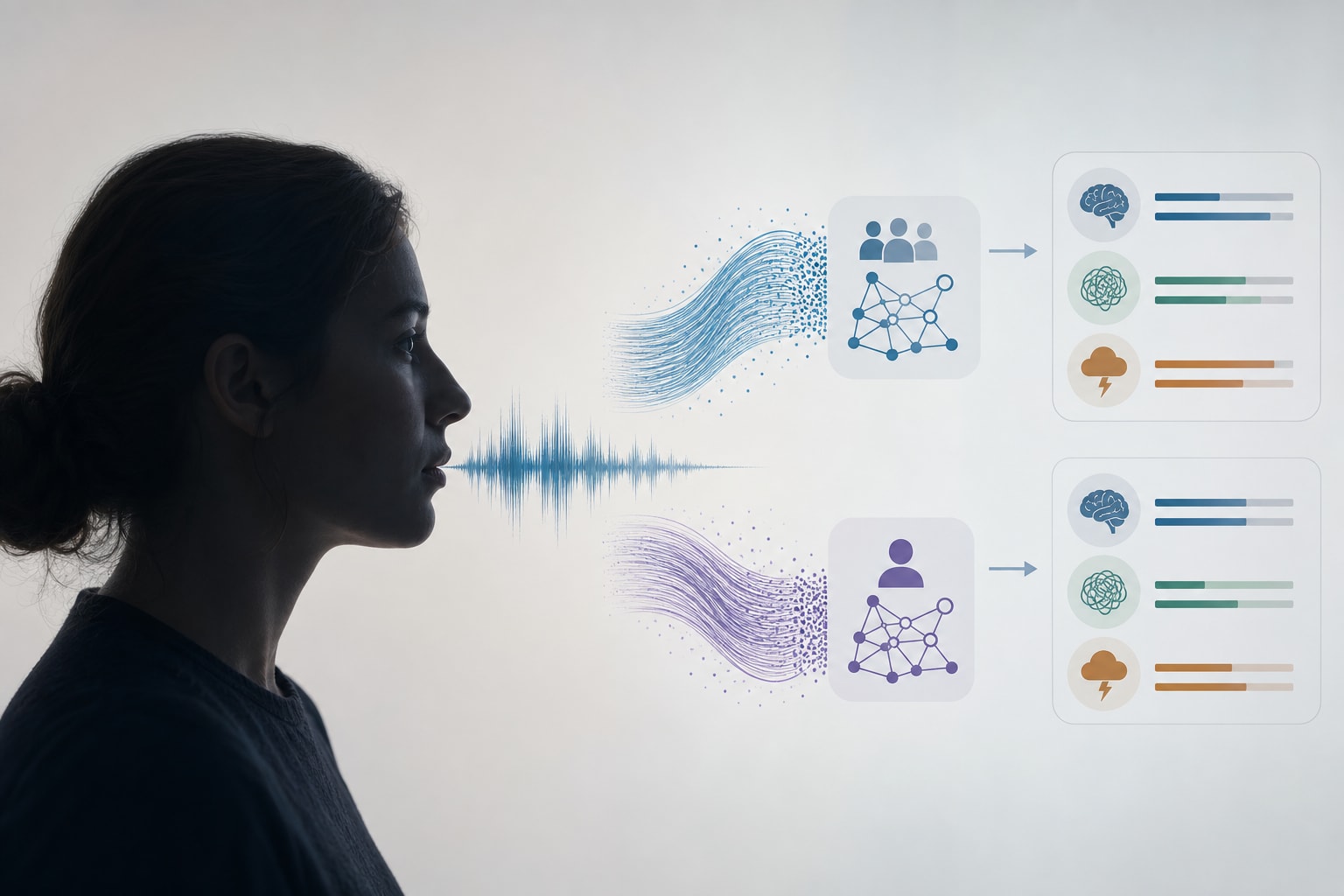
This study presents a hybrid framework that combines population-level modeling with individual-specific adaptation to enhance the prediction of mental health outcomes.

Background

Mental disorders, particularly among young adults, are a significant public health concern, with traditional assessment methods often being resource-intensive and limited in scalability. Speech-based machine learning models offer a promising alternative for non-invasive and scalable mental health monitoring.

Data Highlights

Mental Health ConditionRMSE (Hybrid Model)RMSE (Population Model)
Depression6.95Not specified
Anxiety7.15Not specified
Stress4.95Not specified

Key Findings

  • Individual-level RMSE values were 6.95 for depression, 7.15 for anxiety, and 4.95 for stress.
  • The study utilized a longitudinal dataset with over 1,000 speech samples from individuals aged 18-30.

Clinical Implications

The findings support the potential of hybrid speech-based models for personalized mental health assessment. Clinicians may consider integrating such models into routine practice to enhance monitoring and support for young adults experiencing mental health issues.

Conclusion

The study highlights the effectiveness of combining population-level knowledge with individual-specific adaptation in speech-based mental health prediction. This approach may facilitate the development of scalable mental health monitoring systems.

Related Resources & Content

  1. npj Digital Medicine, 2025 -- Modeling Variability in Multimodal Speech Analysis Throughout the Psychosis Spectrum
  2. npj Digital Medicine, 2025 -- Using a fine-tuned large language model for symptom-based depression evaluation
  3. Frontiers in Psychiatry, 2026 -- Predicting Ordinal Clinical Outcomes in At-Risk Mental States: A Multimodal Approach
  4. Recommendation: Depression and Suicide Risk in Adults: Screening | United States Preventive Services Taskforce
  5. Frontiers in Digital Health — Depression subtype classification from social media posts: few-shot prompting vs. fine-tuning of large language models
  6. Ethics and governance of artificial intelligence for health: large multi-modal models. WHO guidance
  7. Recommendation: Depression and Suicide Risk in Adults: Screening | United States Preventive Services Taskforce
  8. https://academic.oup.com/jamia/article/31/10/2394/7715014

Original Source(s)

Related Content