Discovery of a preliminary urinary metabolite panel for Parkinson’s disease: a pilot study using paired patient-spouse samples and machine learning consensus - Report - MDSpire
Advertisement
Discovery of a preliminary urinary metabolite panel for Parkinson’s disease: a pilot study using paired patient-spouse samples and machine learning consensus
Clinical Report: Identification of an Initial Urinary Metabolite Profile for Parkinson’s Disease
Overview
This pilot study identifies a preliminary five-metabolite panel as potential biomarkers for Parkinson's disease (PD) using a matched-pair cohort of PD patients and their healthy spouses. The findings suggest promising discriminative performance, warranting further validation in larger studies.
Background
Parkinson’s disease (PD) is a prevalent neurodegenerative disorder with significant diagnostic challenges due to the lack of reliable non-invasive biomarkers. Urine, as a biofluid, offers a non-invasive method for biomarker discovery, but environmental and lifestyle factors complicate the identification of true disease-specific signals. This study addresses these challenges by utilizing a matched-pair design to control for confounding variables.
Data Highlights
No numerical data available.
Key Findings
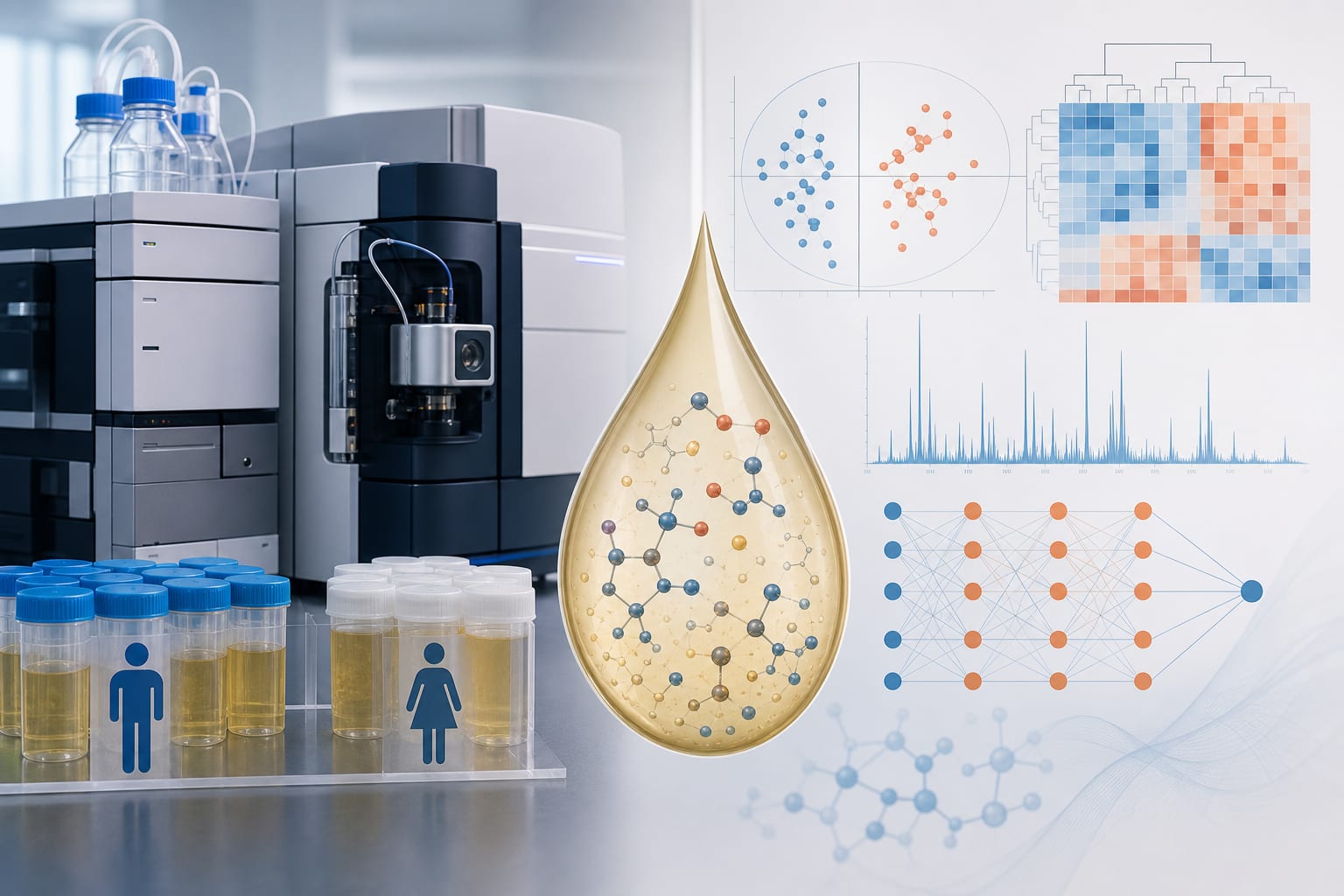
A five-metabolite panel was identified: Cyanuric acid, Benzeneacetonitrile, 3-Formylsalicylic Acid, dADP, and ent-cassa-12,15-dien-2beta-ol.
The study utilized a matched-pair cohort of PD patients and their healthy spouses to minimize confounding factors.
Untargeted LC–MS metabolomics was employed to analyze urine samples from 15 matched pairs.
The metabolite panel demonstrated internal discriminative performance with an AUC greater than 0.95.
This pilot study highlights the potential for urinary metabolomics in identifying PD-specific biomarkers.
Clinical Implications
The findings from this pilot study suggest that urinary metabolomics may provide a pathway for identifying non-invasive biomarkers for Parkinson's disease. Clinicians should consider the potential of these metabolites as targets for future validation studies to enhance diagnostic capabilities.
Conclusion
This exploratory study establishes a proof-of-concept for using urinary metabolite profiling in Parkinson's disease, emphasizing the need for further research to validate these findings in larger cohorts.