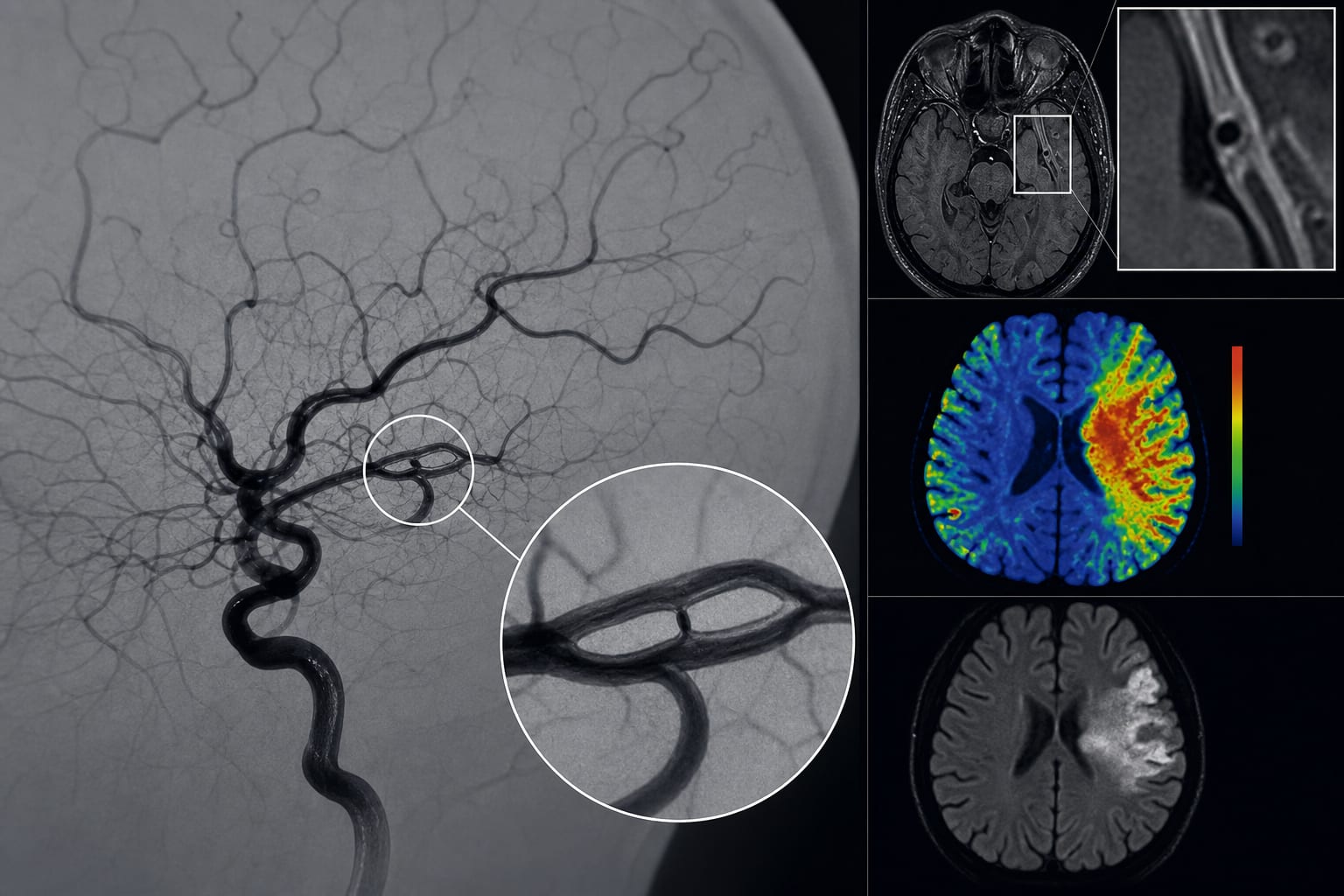
Middle cerebral artery fenestration presenting with cerebral ischemia: a case report and review of the literature
-
By
-
Ying Bi
-
Zhifang Li
-
Wenxian Sun
-
Li Zou
-
Huagang Li
-
Bin Mei
-
June 9, 2026
-
Clinical Scorecard: Cerebral Ischemia Associated with Fenestration of the Middle Cerebral Artery: A Case Study and Literature Review
At a Glance
| Category | Detail |
|---|
| Condition | Middle Cerebral Artery Fenestration |
| Key Mechanisms | Rare vascular variant that can mimic stenosis; potential for local flow disturbances leading to thrombus formation. |
| Target Population | Patients with cerebral ischemia, particularly those with M1 stenosis or occlusion. |
| Care Setting | Neuropsychology and neurology departments. |
Key Highlights
- MCA fenestration can mimic acquired vascular pathologies, complicating diagnosis.
- High-resolution vessel wall MRI (HRMR-VWI) is crucial for differentiating fenestration from stenosis or dissection.
- Perfusion-weighted imaging (PWI) is valuable for assessing hemodynamic compromise.
- A slit-like morphology in MCA fenestration is associated with a higher risk of acute ischemic stroke.
- 57.9% of patients were diagnosed via digital subtraction angiography (DSA).
Guideline-Based Recommendations
Diagnosis
- Use DSA and HRMR-VWI for definitive diagnosis of MCA fenestration.
Management
- Consider mechanical thrombectomy in cases of concurrent MCA occlusion.
Monitoring & Follow-up
- Employ PWI for hemodynamic assessment and risk stratification.
Risks
- Slit-like morphology may increase the risk of stroke.
Patient & Prescribing Data
Patients with a history of transient ischemic attacks or cerebral ischemia.
Patients may be treated with aspirin and statins for secondary stroke prevention.
Clinical Best Practices
- Multimodal imaging is essential to avoid misdiagnosis.
- Evaluate for MCA fenestration in patients presenting with cerebral ischemia and M1 stenosis.
Related Resources & Content