Efficacy and safety of Oliceridine versus Sufentanil in postoperative analgesia for burn skin grafting: a machine learning and SHAP-based cohort study - Scorecard - MDSpire
Advertisement
Efficacy and safety of Oliceridine versus Sufentanil in postoperative analgesia for burn skin grafting: a machine learning and SHAP-based cohort study
Clinical Scorecard: Comparative Analysis of Oliceridine and Sufentanil for Postoperative Pain Management in Burn Skin Grafting: Insights from a Machine Learning and SHAP-Based Cohort Study
At a Glance
Category
Detail
Condition
Postoperative pain management in burn skin grafting
Key Mechanisms
Oliceridine is a biased μ-opioid receptor agonist that selectively activates G-protein signaling, while Sufentanil is a traditional high-potency opioid.
Target Population
Adult patients aged 18-80 undergoing elective or emergency burn skin grafting surgery
Care Setting
Single-center, retrospective observational cohort study
Key Highlights
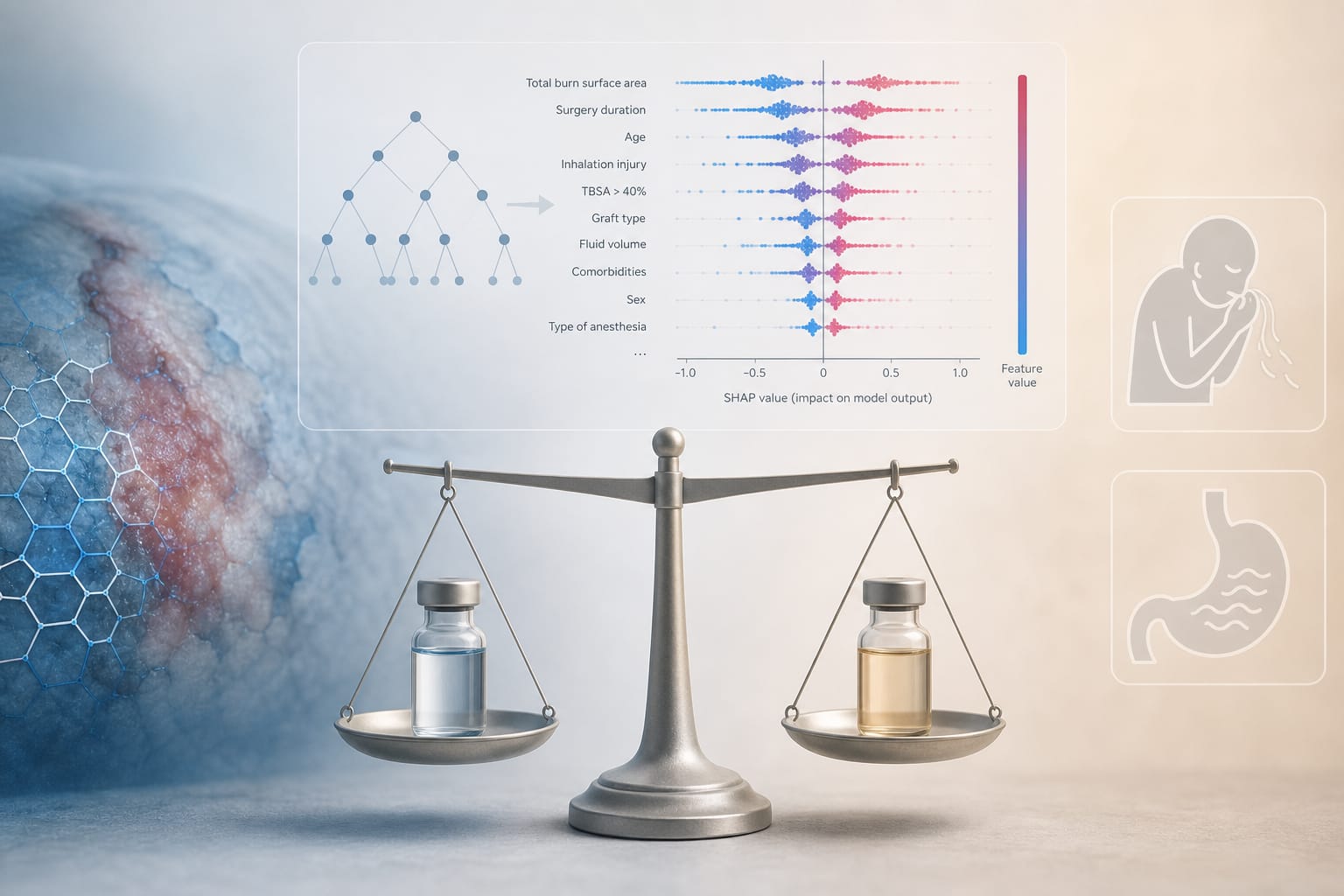
Oliceridine showed similar predicted analgesic outcomes to Sufentanil.
Oliceridine was associated with a significantly lower predicted risk of postoperative nausea and vomiting (PONV).
Machine learning models (XGBoost) demonstrated strong predictive capabilities for analgesic efficacy and safety.
Total burn surface area and surgery duration were identified as dominant predictors for analgesic efficacy.
Sufentanil administration and female gender were identified as key risk factors for PONV.
Guideline-Based Recommendations
Diagnosis
Utilize machine learning models to predict analgesic needs and PONV risk.
Management
Consider Oliceridine as an alternative to Sufentanil for postoperative analgesia in burn patients.
Monitoring & Follow-up
Monitor for PONV, especially in patients receiving Sufentanil.
Risks
Be aware of opioid-related adverse events, particularly PONV, associated with Sufentanil.
Patient & Prescribing Data
Adult patients undergoing burn skin grafting with ASA physical status I-III.
Continuous postoperative patient-controlled intravenous analgesia (PCIA) using either Oliceridine or Sufentanil.
Clinical Best Practices
Implement routine prophylactic antiemetics prior to extubation.
Utilize individualized analgesic protocols based on patient characteristics and surgical factors.