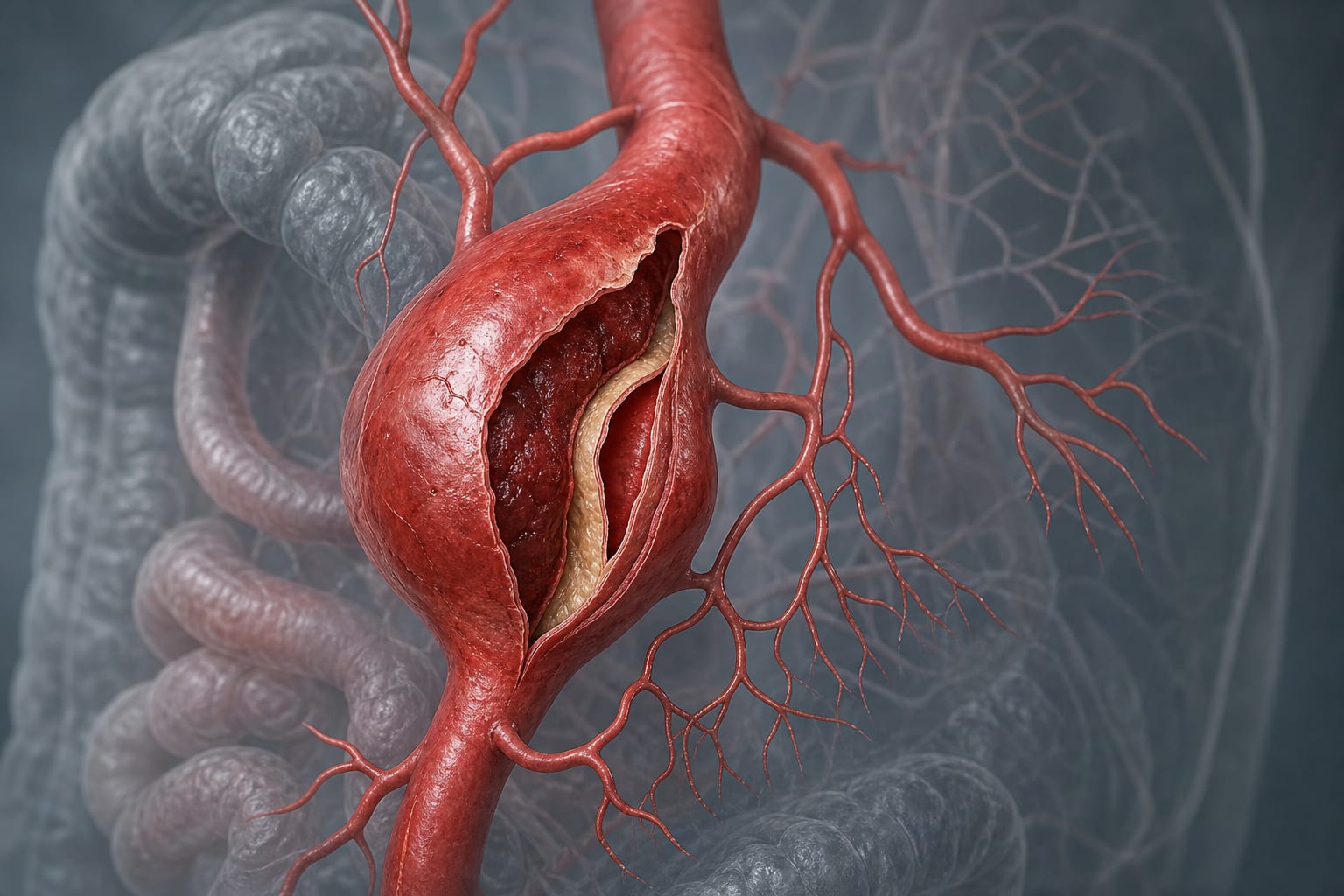
Giant dissecting aneurysm of the superior mesenteric artery with distal branch involvement and true lumen collapse: a case report
By
Chuwen Chen
Yiyuan Li
Bin Huang
Xiyang Chen
June 9, 2026
Clinical Scorecard: Giant Dissecting Aneurysm of the Superior Mesenteric Artery Involving Distal Branches and True Lumen Compromise: A Case Study
At a Glance
Category Detail
Condition Isolated Superior Mesenteric Artery Dissecting Aneurysm (ISMADA) Key Mechanisms Dissection confined to the superior mesenteric artery, potentially leading to aneurysmal degeneration and rupture. Target Population Middle-aged and elderly men, particularly from East Asia. Care Setting Emergency department and hybrid operating room.
Key Highlights
Rare condition with a prevalence of approximately 0.075%. Symptoms include abdominal pain, which may progress to ischemia or rupture. Emergency surgical management is indicated in complex cases. Conservative management is recommended for uncomplicated cases. Follow-up imaging is essential to monitor for complications. Guideline-Based Recommendations
Diagnosis
Computed tomography angiography (CTA) is essential for diagnosis. Management
Conservative management for asymptomatic or uncomplicated cases. Endovascular revascularization for patients failing medical therapy or suspected of ischemia. Emergency surgical intervention for complex cases. Monitoring & Follow-up
Follow-up imaging after conservative treatment or stent placement. Risks
Potential for intestinal ischemia, bowel necrosis, or arterial rupture. Patient & Prescribing Data
70-year-old man with a history of hypertension and smoking.
Emergency resection with prosthetic graft reconstruction was performed.
Clinical Best Practices
Early radiologic recognition and close surveillance are essential. Control of blood pressure and analgesia as part of conservative management. Related Resources & Content