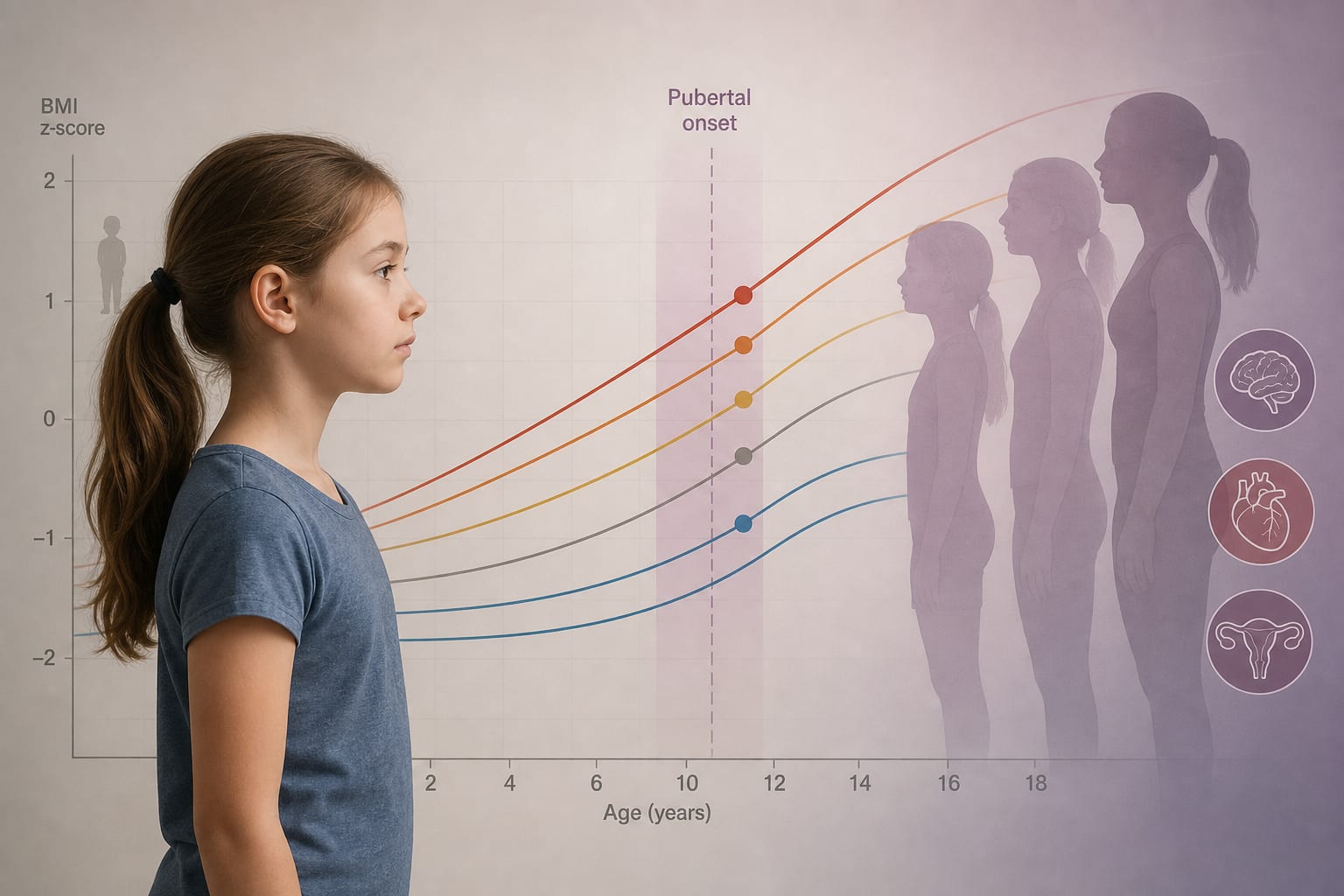
Prepubertal Growth Trajectory and Pubertal Onset
-
By
-
Rui Deng
-
Weiqin Li
-
Jiali Duan
-
Tianshu Feng
-
Liumei Wei
-
Xingxiu Li
-
Junhong Leng
-
Xijie Wang
-
Bin Dong
-
Susan M. Sawyer
-
June 9, 2026
-
Clinical Scorecard: Growth Patterns Before Puberty and the Timing of Pubertal Onset
At a Glance
| Category | Detail |
|---|
| Condition | |
| Key Mechanisms | Higher body mass index (BMI) and rapid BMI increase are associated with earlier pubertal onset. [Source needed] |
| Target Population | |
| Care Setting | |
Key Highlights
- Secular trends indicate a rise in early puberty onset, particularly post-COVID-19. [Source needed]
- Cumulative exposure to adiposity is a significant predictor of pubertal timing.
- Rapid BMI increase may influence the timing of puberty.
- The study utilized two birth cohorts for comprehensive data collection.
- The Pubertal Development Scale was used for assessing pubertal status.
Guideline-Based Recommendations
Diagnosis
- Utilize the parent-reported Pubertal Development Scale for assessing pubertal onset.
Management
- Monitor BMI trajectories from birth to identify potential early onset of puberty. [Source needed]
Monitoring & Follow-up
- Conduct biennial anthropometric measurements and pubertal assessments. [Source needed]
Risks
- Early puberty onset is linked to behavioral and emotional problems and increased risk of noncommunicable diseases. [Source needed]
Patient & Prescribing Data
Children in Australia and China, tracked from birth to puberty.
Understanding BMI trajectories can inform preventive interventions for early puberty.
Clinical Best Practices
- Implement regular monitoring of BMI and pubertal status in pediatric populations. [Source needed]
- Consider cumulative exposure to adiposity in assessments of growth and development. [Source needed]
Related Resources & Content