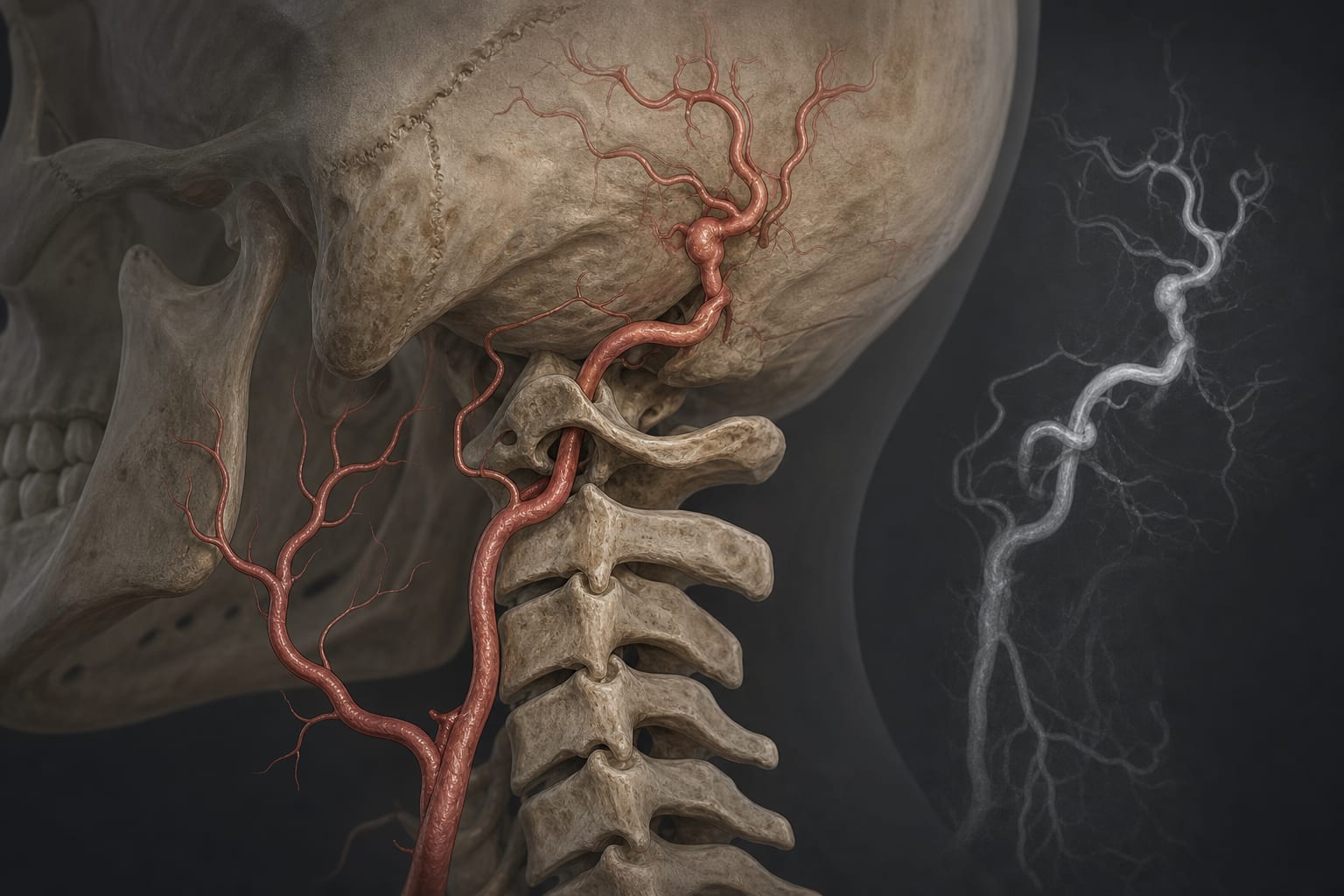
To report an unusual case of a persistent proatlantal intersegmental artery (PPIA) and its clinical implications, highlighting its rarity.
Key Findings:
The patient exhibited a mixed-type PPIA with a type II origin and type I course, which is significant due to its implications for posterior circulation.
The anomalous artery supplied the posterior circulation and joined the right vertebral artery to form the basilar artery.
The presence of PPIA may serve as a dominant or sole supply for posterior circulation, which is critical for surgical considerations.
Interpretation:
The findings support the embryological concept that the occipital artery derives from PIA components and expand the morphological spectrum of persistent proatlantal arteries, emphasizing their clinical relevance.
Limitations:
The case cannot be fully classified into the classic Lasjaunias types, which limits the applicability of existing classifications.
Further studies are needed to understand the clinical significance of mixed-type PPIA and its implications for patient management.
Conclusion:
Recognition of mixed-type PPIA is crucial for surgical and interventional planning to avoid complications, underscoring its importance in clinical practice.