An intelligent gradient-guided hybrid inpainting framework for brain MRI reconstruction and Alzheimer's disease classification in connected healthcare systems - Summary - MDSpire
Advertisement
An intelligent gradient-guided hybrid inpainting framework for brain MRI reconstruction and Alzheimer's disease classification in connected healthcare systems
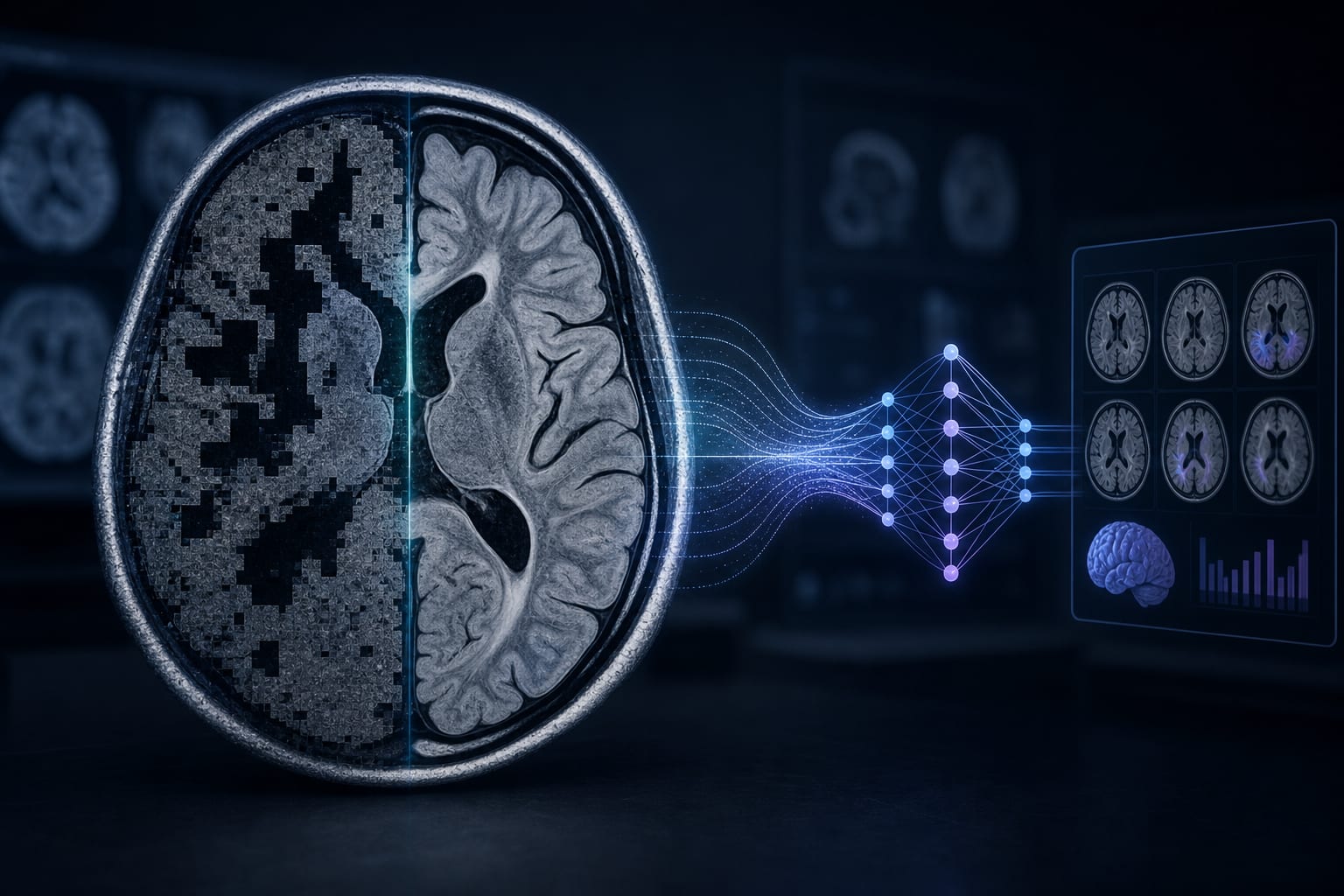
To introduce a gradient-guided hybrid inpainting framework that integrates OpenCV Telea and LaMa, leveraging their strengths for improved reconstruction of brain MRI and classification of Alzheimer's disease.
Key Findings:
Achieved an 8% reduction in mean squared error (MSE) compared to LaMa and 30% compared to OpenCV.
Maintained a structural similarity index (SSIM) of approximately 0.93 and peak signal-to-noise ratio (PSNR) of approximately 25.7 dB.
A VGG16 classifier trained on clean images achieved 94.35% accuracy on hybrid-inpainted data, showing only a 1.69 percentage point drop from the baseline accuracy of 96.04%.
Interpretation:
The proposed hybrid inpainting framework effectively balances anatomical accuracy and semantic plausibility, significantly enhancing the quality of MRI data for Alzheimer's disease classification.
Limitations:
The study may be limited by the specific dataset used and the generalizability of the findings to other imaging modalities or populations.
The computational overhead, while modest, may still pose challenges for real-time applications, necessitating further optimization.
Conclusion:
The hybrid inpainting approach demonstrates improved reconstruction and classification performance, supporting its potential use in AI-driven neuroimaging pipelines.