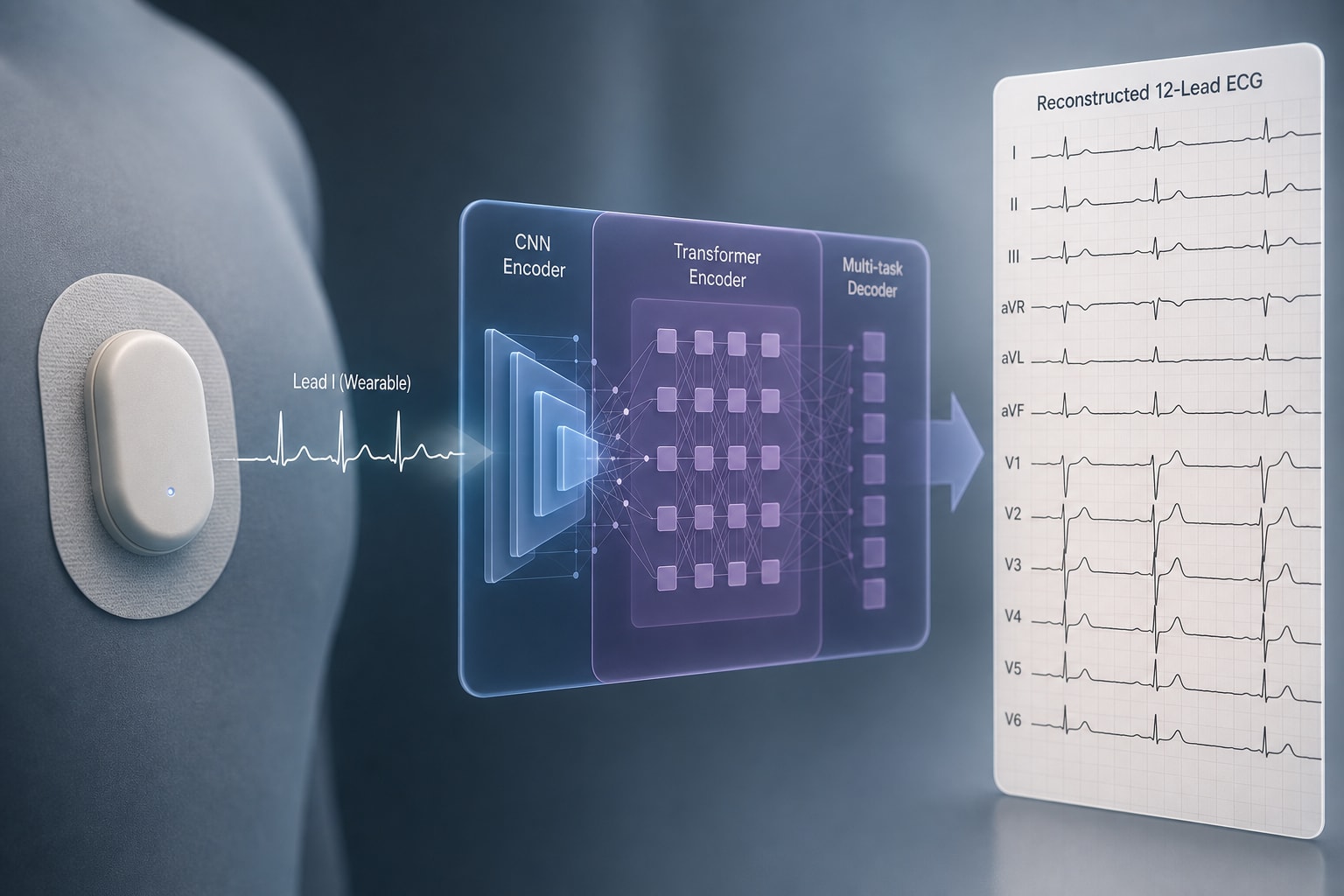
To propose a deep learning framework capable of reconstructing a full 12-lead ECG from a single-lead input while preserving diagnostic integrity, which is crucial for accurate clinical assessments.
Key Findings:
TONet achieved a Pearson Correlation Coefficient (PCC) of 0.673 (95% CI: [insert CI]) on the independent test set.
Reconstructed signals achieved a macro-averaged AUROC of 0.821 (95% CI: [insert CI]).
Independent validation on the Chapman-Shaoxing database yielded a PCC of 0.612 (95% CI: [insert CI]), outperforming a linear-regression baseline (PCC = 0.498).
Interpretation:
TONet demonstrates the ability to recover morphologically faithful 12-lead surrogates from a single Lead I input, which is significant for enhancing remote cardiac surveillance.
Limitations:
The reconstructed precordial leads are insufficient for fine-grained STEMI screening; further studies are needed to assess their diagnostic capabilities.
External validation on true wearable recordings is necessary to confirm the model's applicability in real-world settings.
Conclusion:
TONet is positioned as a regularized deep-learning framework for multi-lead reconstruction rather than a deployable clinical device, with potential future applications in enhancing remote cardiac monitoring.