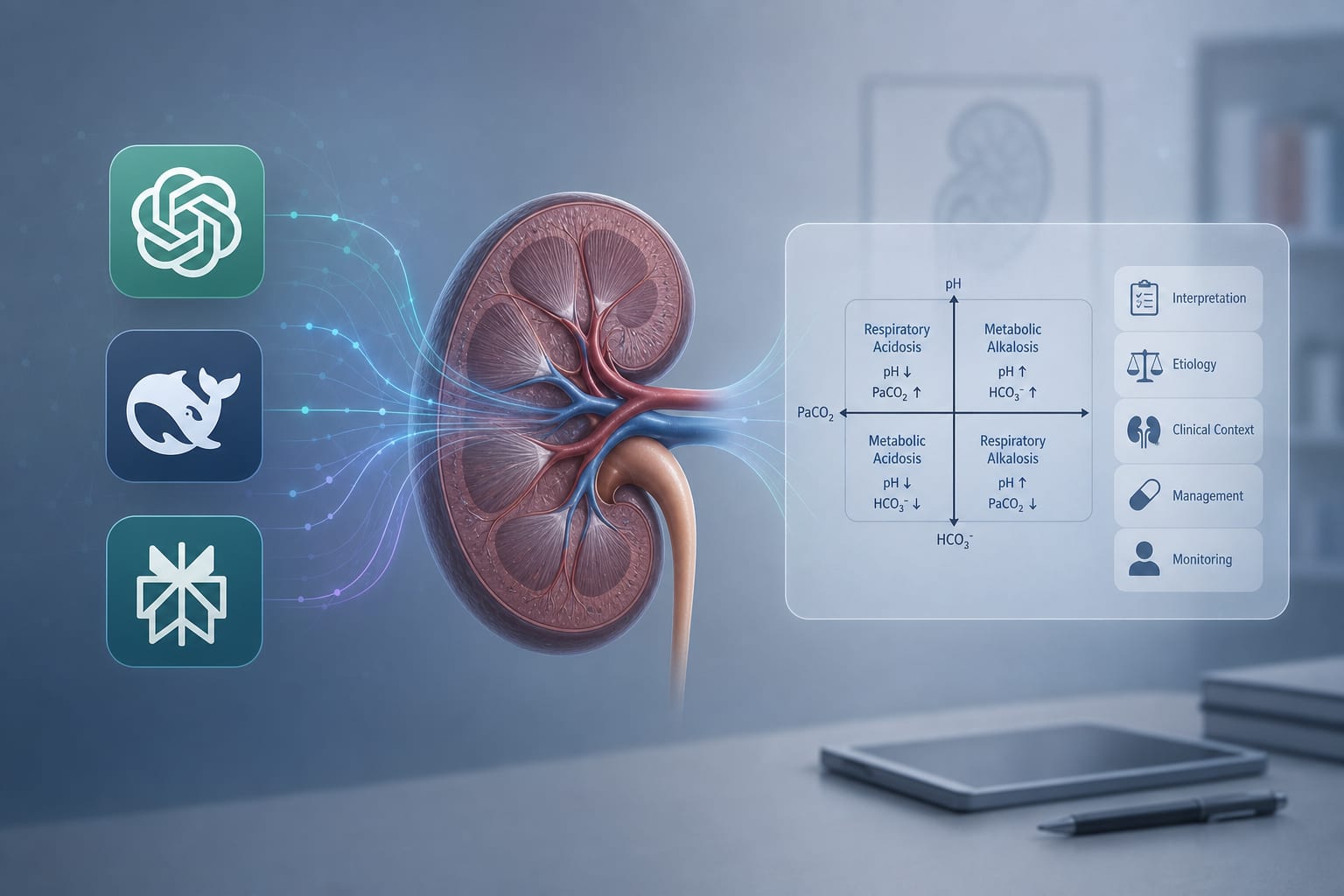
Head-to-head evaluation of ChatGPT, DeepSeek, and Perplexity on acid–base disorder case clinical management and drug treatment: Accuracy, domain performance, and response consistency assessment - Summary - MDSpire
Advertisement
Head-to-head evaluation of ChatGPT, DeepSeek, and Perplexity on acid–base disorder case clinical management and drug treatment: Accuracy, domain performance, and response consistency assessment
To evaluate the performance of ChatGPT, DeepSeek, and Perplexity on a standardized set of acid-base disturbance cases, focusing on accuracy, domain-specific performance, and consistency of responses, highlighting the significance of these evaluations in medical education.
Key Findings:
Performance of LLMs varied across different acid-base disturbance cases, with specific metrics indicating varying levels of accuracy.
Accuracy and consistency of responses were evaluated across 510 multiple-choice questions, revealing distinct performance patterns.
Subgroup analysis classified cases into metabolic, respiratory, or mixed acid-base disorders, providing insights into model strengths and weaknesses.
Interpretation:
The study highlights the need for context-specific benchmarking of LLMs in medical education, particularly in complex domains like acid-base disorders, and suggests that improved accuracy could enhance learner outcomes.
Limitations:
The dataset was derived from a single source, which may limit generalizability and introduce bias.
Original clinical case vignettes were not reproduced verbatim due to copyright restrictions, potentially affecting the authenticity of the assessment.
Conclusion:
The study provides insights into the comparative performance of LLMs in managing acid-base disorders, emphasizing the importance of accuracy and consistency in clinical contexts.
Phase 3 ENHANCE-1 results showed higher composite clinical cure and microbiologic response rates with cefepime-zidebactam vs meropenem in hospitalized adults with complicated urinary tract infection or acute pyelonephritis.