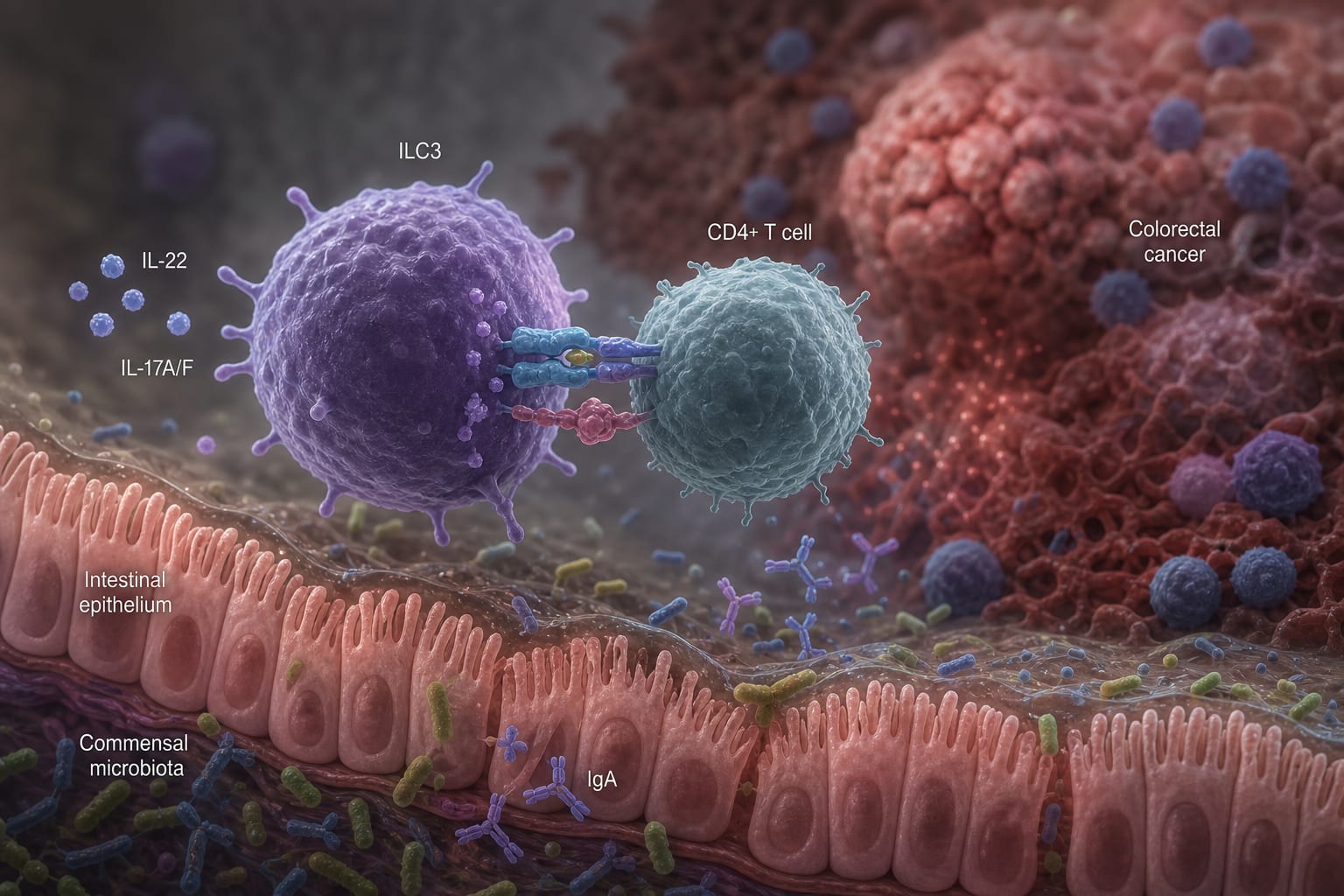
Plasticity and antigen presentation by group 3 innate lymphoid cells in colorectal cancer - Summary - MDSpire

Plasticity and antigen presentation by group 3 innate lymphoid cells in colorectal cancer

  • By

  • Lu Qiao

  • Jingwen Zhang

  • Jiaxi Li

  • Xia Li

  • Xiaoxia He

  • Mingyu Zhang

  • Jingkun Lu

  • Xuan Zhang

  • Jing Dong

  • Gesi Tao

  • Yue Wang

  • Jiaxian Cui

  • Lili Bao

  • Pengwei Zhao

  • June 9, 2026

  • 0 min

Share

Objective:

To explore the role of group 3 innate lymphoid cells (ILC3) in colorectal cancer (CRC) and their plasticity in relation to the tumor microenvironment.

Key Findings:
  • ILC3 plasticity is influenced by cytokine milieu, microbial composition, and stromal signals.
  • MHC II expression in ILC3 correlates with effective type 1 immunity and microbiota-specific responses.
  • Alterations in ILC3 functions are linked to aggressive tumor behavior and poor responses to immune checkpoint therapy.
Interpretation:

Remove unsupported claims about ILC3 interactions and CRC progression.

Limitations:
  • Variability in cytokine and microbial environments across patient cohorts complicates the understanding of ILC3 roles.
  • Single-cell analyses indicate heterogeneity in ILC3 populations, which may affect generalizability of findings.
Conclusion:

Revise to eliminate unsupported claims regarding ILC3 as biomarkers and therapeutic targets.

Original Source(s)

Related Content