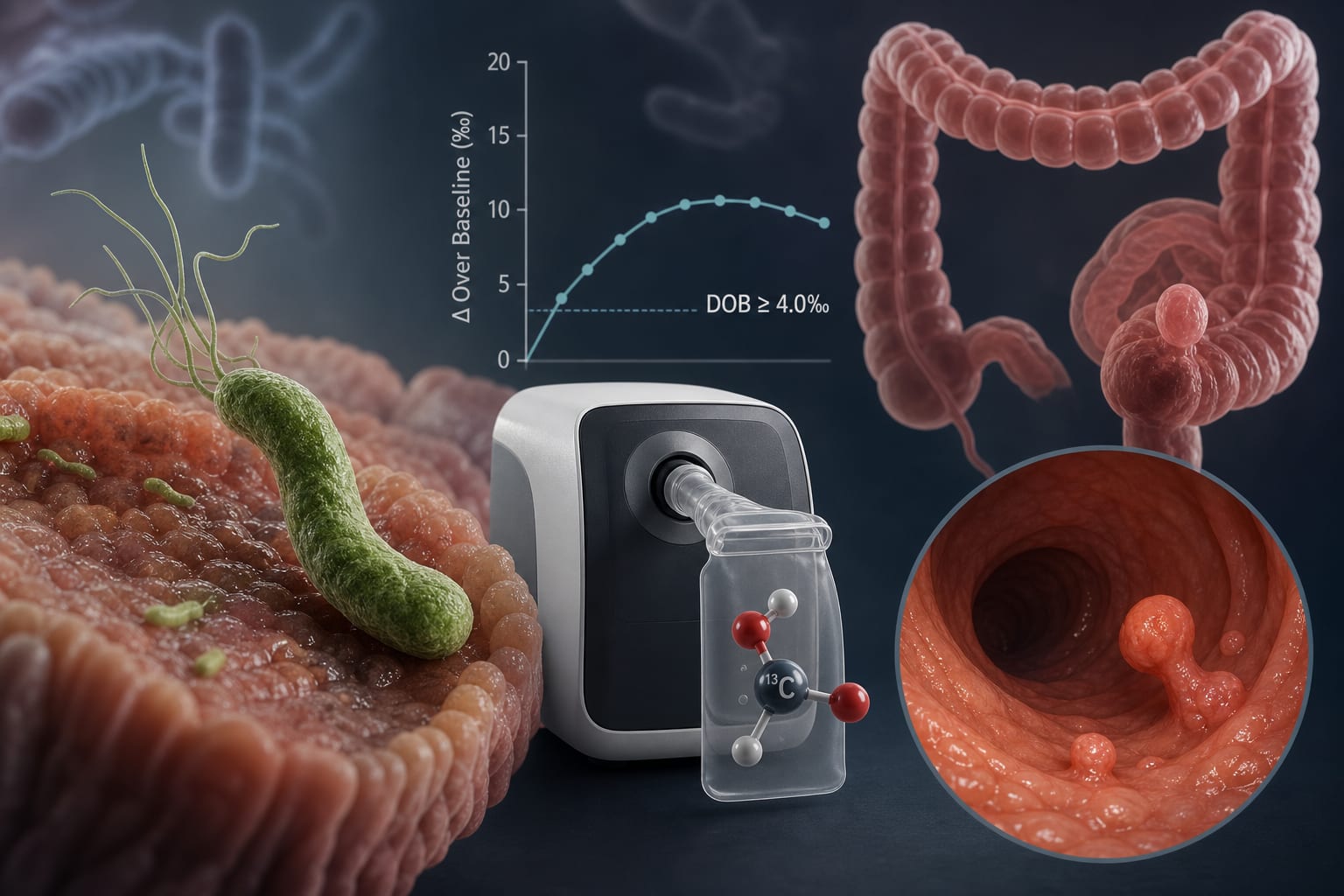
To investigate the associations of Helicobacter pylori (H. pylori) infection status and urea breath test-derived delta over baseline (DOB) values with colorectal polyp detection, including DOB-related associations among H. pylori-positive participants.
Key Findings:
Higher detection rate of colorectal polyps in H. pylori-positive group (68.75% vs 52.78%).
H. pylori positivity associated with increased odds of colorectal polyp detection (OR = 4.05, P<0.001).
Higher DOB levels correlated with colorectal polyp detection.
Adenomatous polyps more frequently detected in H. pylori-positive group (50.00% vs 35.42%, P = 0.017).
Exploratory ROC analysis showed an AUC of 0.713.
In the matched cohort, H. pylori positivity remained associated with colorectal polyp detection (adjusted OR = 1.91, P = 0.005).
Interpretation:
H. pylori positivity and higher DOB values are associated with increased odds of colorectal polyp detection.
Limitations:
Single-center study may limit generalizability; findings require validation in larger multicenter studies.
DOB alone showed limited discriminatory ability.
Conclusion:
H. pylori positivity and higher DOB values are linked to increased colorectal polyp detection, particularly adenomatous polyps.