Changes in ambient environmental conditions correspond to variations in in vitro fertilization outcomes during the COVID-19 pandemic - Summary - MDSpire

Changes in ambient environmental conditions correspond to variations in in vitro fertilization outcomes during the COVID-19 pandemic

  • By

  • Heeyon Kim

  • Hyun Jun Kim

  • Soyeong Park

  • Yun Soo Chung

  • Jin Kyung Baek

  • Yebon Kim

  • Jeongmi Yoon

  • Chungsoon Ryu

  • Bo Hyon Yun

  • Young Sik Choi

  • Daewoo Pak

  • Seok Kyo Seo

  • Yohan Ko

  • June 9, 2026

  • 0 min

Share

Objective:

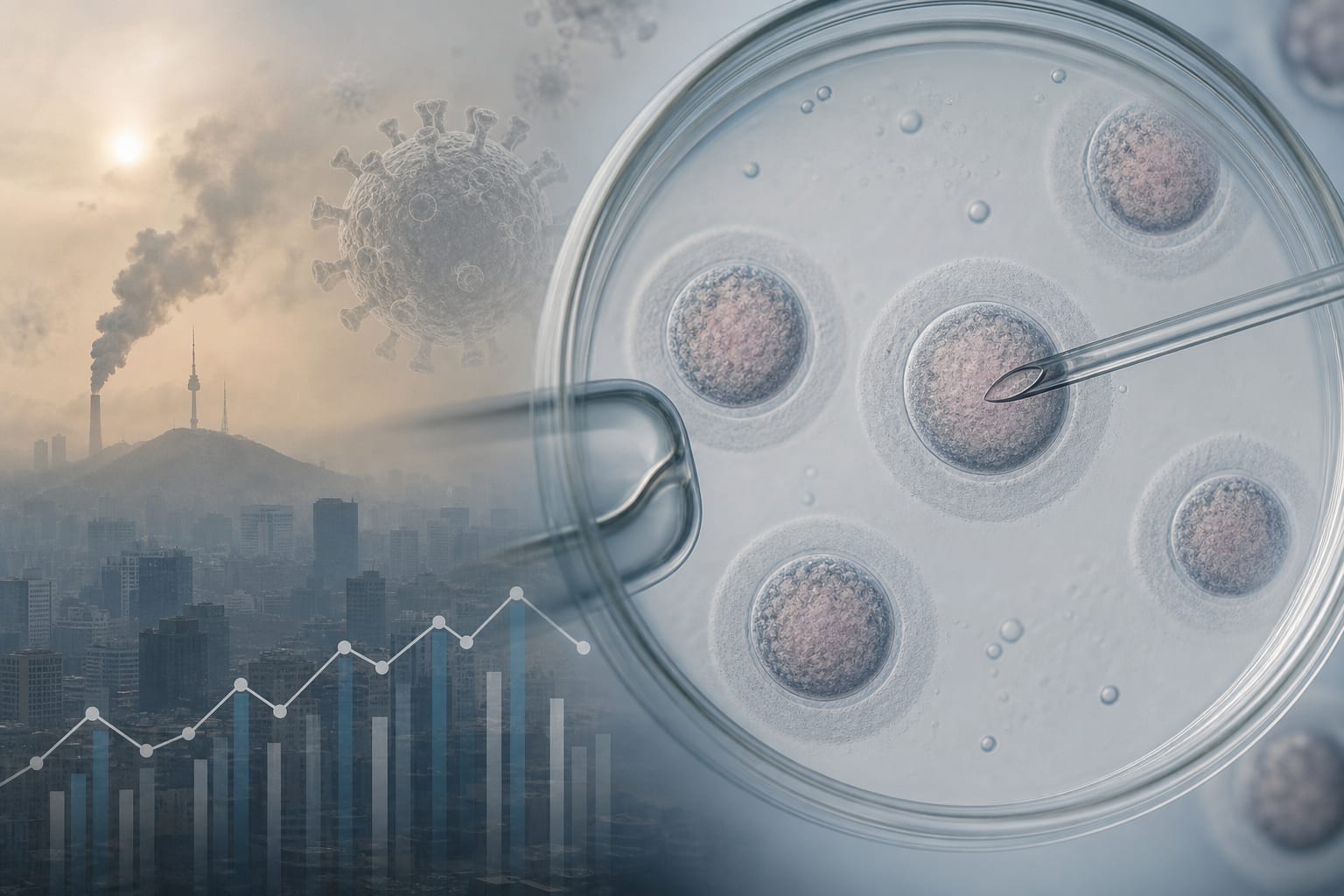
To examine whether IVF-related mature oocyte, fertilization, and pregnancy rates differ across the periods before, during, and after the COVID-19 pandemic, and to evaluate the modifying effects of ambient environmental exposures.

Key Findings:
  • Mature oocyte rate was significantly lower during (β = −0.32, 95% CI −0.45 to −0.19, p < 0.001) and post-COVID (β = −0.45, 95% CI −0.59 to −0.31, p < 0.001) compared to pre-COVID.
  • Fertilization rate was higher in the post-COVID group (β = 0.22, 95% CI 0.02 to 0.42, p = 0.030) compared to pre-COVID, but not during COVID (p = 0.637).
  • Pregnancy rate did not differ significantly across the three periods (Wald χ² = 2.12, p = 0.346).
  • Long-term environmental exposures showed significant interactions with COVID-19 on mature oocyte rate (O3: LRT p = 0.002; CO: LRT p = 0.008; NO2: LRT p = 0.009).
  • Nominal significance was observed for several environmental interactions affecting clinical pregnancy.
Interpretation:

Limitations:
  • Study conducted at a single center, which may limit generalizability.
  • Retrospective design may introduce biases.
Conclusion:

Original Source(s)

Related Content