Brucella proline racemase protein A targets Tpl2 to promote IL-10 secretion for establishment of chronic infection - Summary - MDSpire

Brucella proline racemase protein A targets Tpl2 to promote IL-10 secretion for establishment of chronic infection

  • By

  • Huan Zhang

  • Xueyu Tao

  • Yuanzhi Wang

  • Yueli Wang

  • Huilin Hou

  • Xiaoyu Deng

  • Zhenyu Xu

  • Xujin Xia

  • Mingguo Xu

  • Zhen Wang

  • Changsuo Zhang

  • Zhumanov Kairat Toksanbaevich

  • Jinliang Sheng

  • Zhongchen Ma

  • Jihai Yi

  • Chuangfu Chen

  • June 9, 2026

  • 0 min

Share

Objective:

To explore the functions of B. melitensis M5–90 PrpA in macrophages, investigate the specific mechanisms of IL-10 production induction, and assess the immune response induced by the B. melitensis M5–90 prpA mutant in mice.

Key Findings:
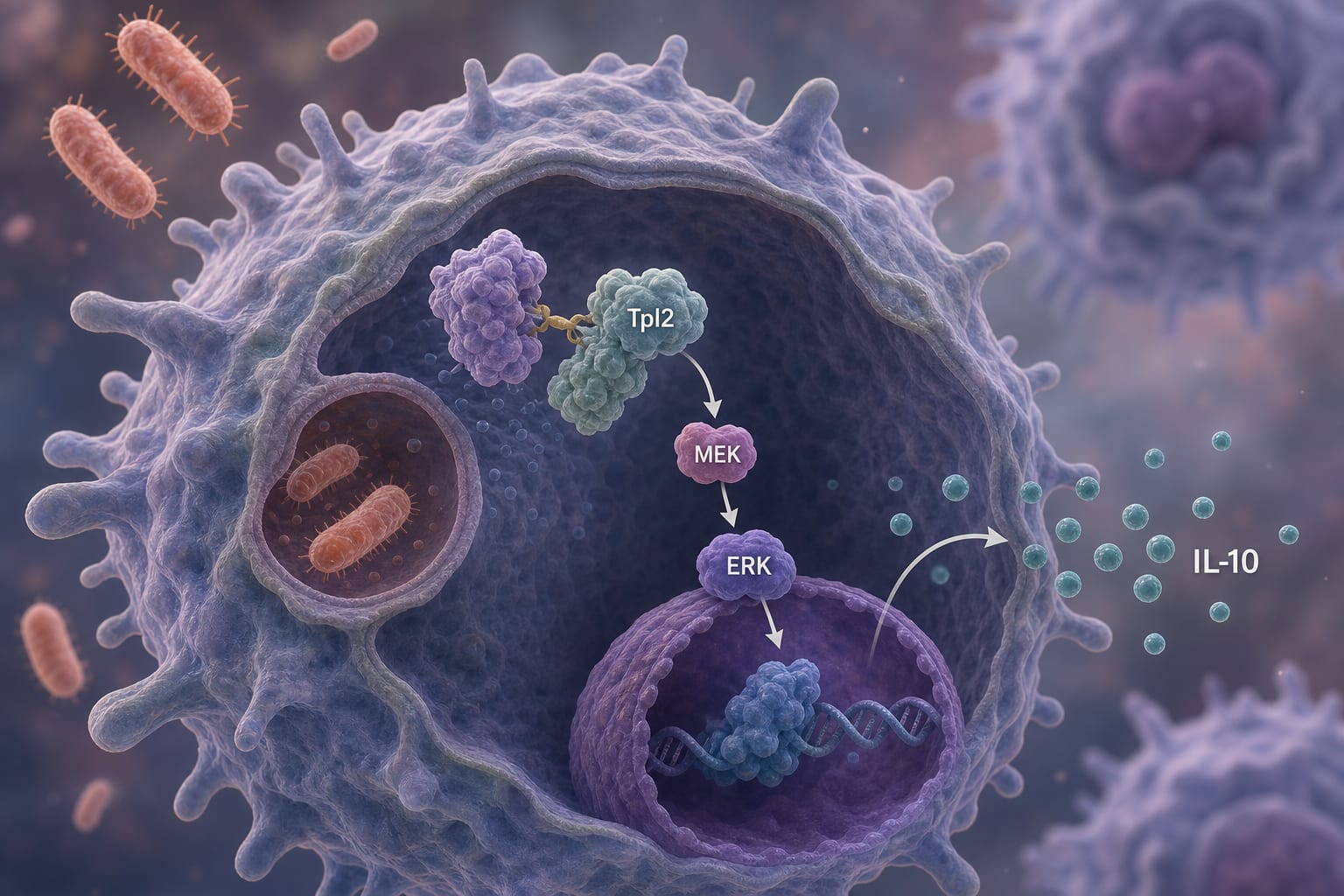
  • PrpA induces IL-10 secretion in macrophages via the Tpl2-ERK signaling pathway.
  • Tpl2 deletion reduces macrophage bactericidal ability and cytokine levels (TNF-α, IL-1β, IL-10).
  • PrpA deletion increases IFN-γ levels, anti-Brucella IgG, and T cell counts in mice.
  • The B. melitensis M5–90 prpA mutant offers better protection against virulent Brucella melitensis M28 infection.
Interpretation:

Brucella PrpA enhances IL-10 production in macrophages, promoting bacterial survival and facilitating chronic infection.

Limitations:
  • The specific mechanisms of PrpA interaction with Tpl2 remain partially understood, which may hinder targeted therapeutic strategies.
  • Further studies are needed to fully elucidate the role of PrpA in immune modulation and its potential as a vaccine target.
Conclusion:

The findings suggest that targeting PrpA may provide critical insights for developing effective vaccines against brucellosis, potentially improving public health outcomes.

Original Source(s)

Related Content