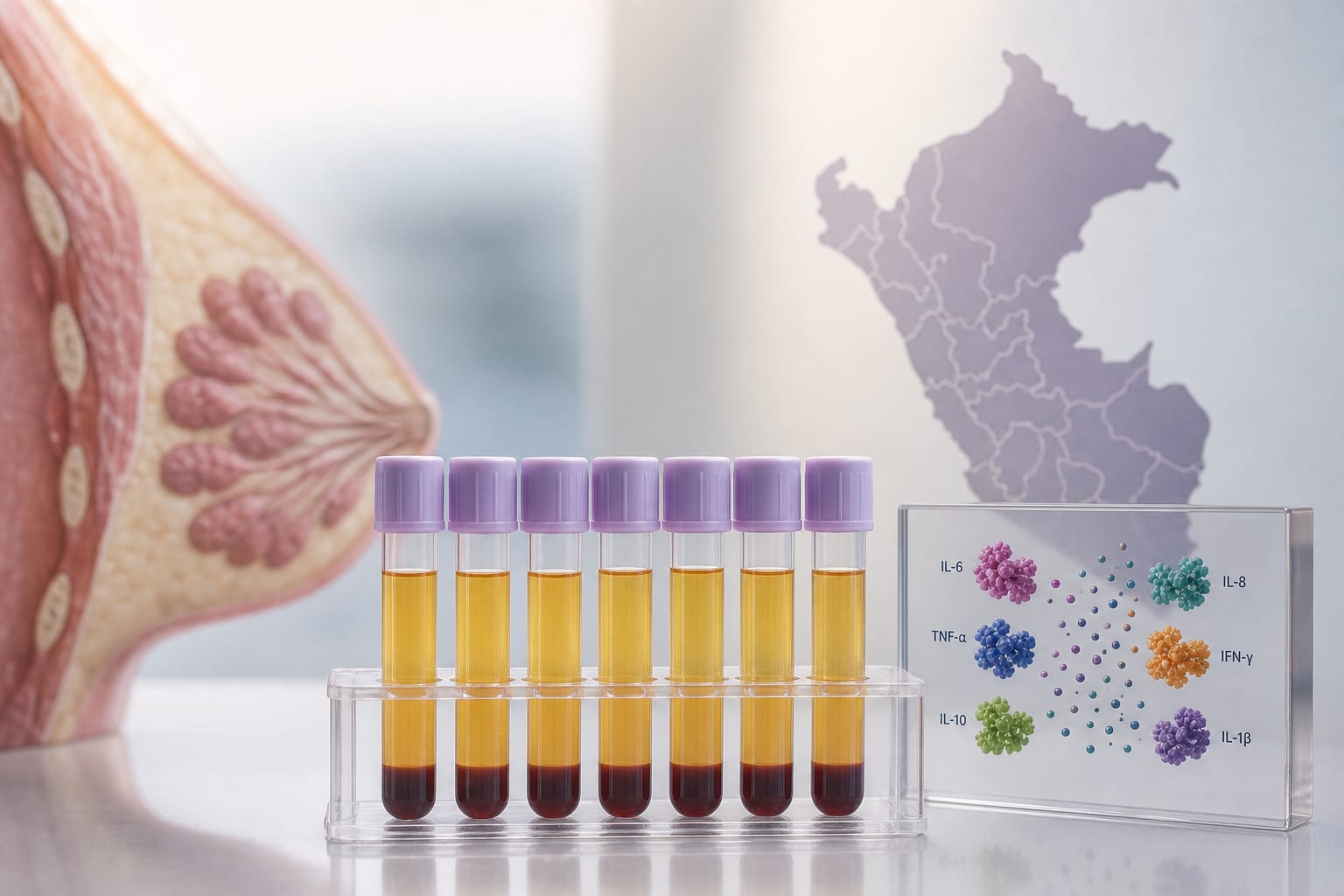
Plasma cytokine profiles in breast cancer patients and their association with therapeutic response in Peru: a prospective cohort study - Summary - MDSpire

Plasma cytokine profiles in breast cancer patients and their association with therapeutic response in Peru: a prospective cohort study

  • By

  • Jose M. Vela-Ruiz

  • Zaida Morante

  • Yomali Ferreyra

  • Marco A. Galvez-Villanueva

  • Fernando Valencia

  • J. Jhanina Campos-Tineo

  • Mariana Callapiña De Paz

  • Ariana Alessandra Córdova-Salazar

  • Pool Marcos-Carbajal

  • Joan M. Moreno Lujan

  • Andy R. Pantoja Lazaro

  • Laura G. Escobar Caipo

  • Gustavo A. Flores Trujillo

  • Teresa N. Cusma Quintana

  • Jhony A. De La Cruz-Vargas

  • Henry L. Gomez

  • Alonso Soto

  • June 9, 2026

  • 0 min

Share

Objective:

To characterize the plasma cytokine profile in Peruvian women with breast cancer, specifically focusing on molecular subtypes such as luminal A, luminal B, HER2-positive, and triple-negative, and evaluate its association with treatment response.

Key Findings:
  • Cytokine concentration differences were observed between breast cancer molecular subtypes, including MIP-1β, IL-9, GRO-α, and TNF-β.
  • Lower levels of circulating FGF BASIC were associated with an increased relative risk of achieving complete pathological response (pCR).
  • Decreased levels of FGF BASIC, PDGF BB, SDF-1, IL-12 P40, and IL-8 were linked to a higher chance of clinical responses to treatments.
  • Only FGF-BASIC, PDGF-BB, and IL-12 P40 remained independently associated with clinical response in multivariable analyses.
Interpretation:

The study identified specific plasma cytokines linked to breast cancer subtypes and treatment response in a Peruvian cohort, with FGF-BASIC showing a significant association that may inform treatment strategies.

Limitations:
  • The study was limited to a specific population in Peru, which may not be generalizable to other populations.
  • The sample size was relatively small, which may affect the robustness of the findings and introduce potential biases in sample collection or analysis.
Conclusion:

The findings enhance the understanding of the immunological mechanisms involved in breast cancer and identify potential prognostic biomarkers in this population.

Original Source(s)

Related Content