Case Study: Demyelination Associated with Tumor Necrosis Factor Inhibitors in Neuro-Behçet Disease
-
By
-
Eloise Norman
-
Gabor Major
-
September 24, 2026
Clinical Report: Demyelination Associated with TNF Inhibitors in Neuro-Behçet Disease
Overview
This case study presents a 34-year-old woman diagnosed with neuro-Behçet disease who developed new neurological symptoms after initiating treatment with adalimumab, a TNF inhibitor. MRI findings indicated new hyperintense lesions, prompting discontinuation of the TNF inhibitor.
Background
Neuro-Behçet disease (NBD) is a rare neurological manifestation of Behçet syndrome, often leading to significant neurological impairment. The use of TNF inhibitors, such as adalimumab, is common in treating Behçet disease, but paradoxical inflammatory responses, including demyelination, can occur.
Key Findings
A 34-year-old woman with neuro-Behçet disease developed new neurological symptoms after one year of adalimumab treatment.
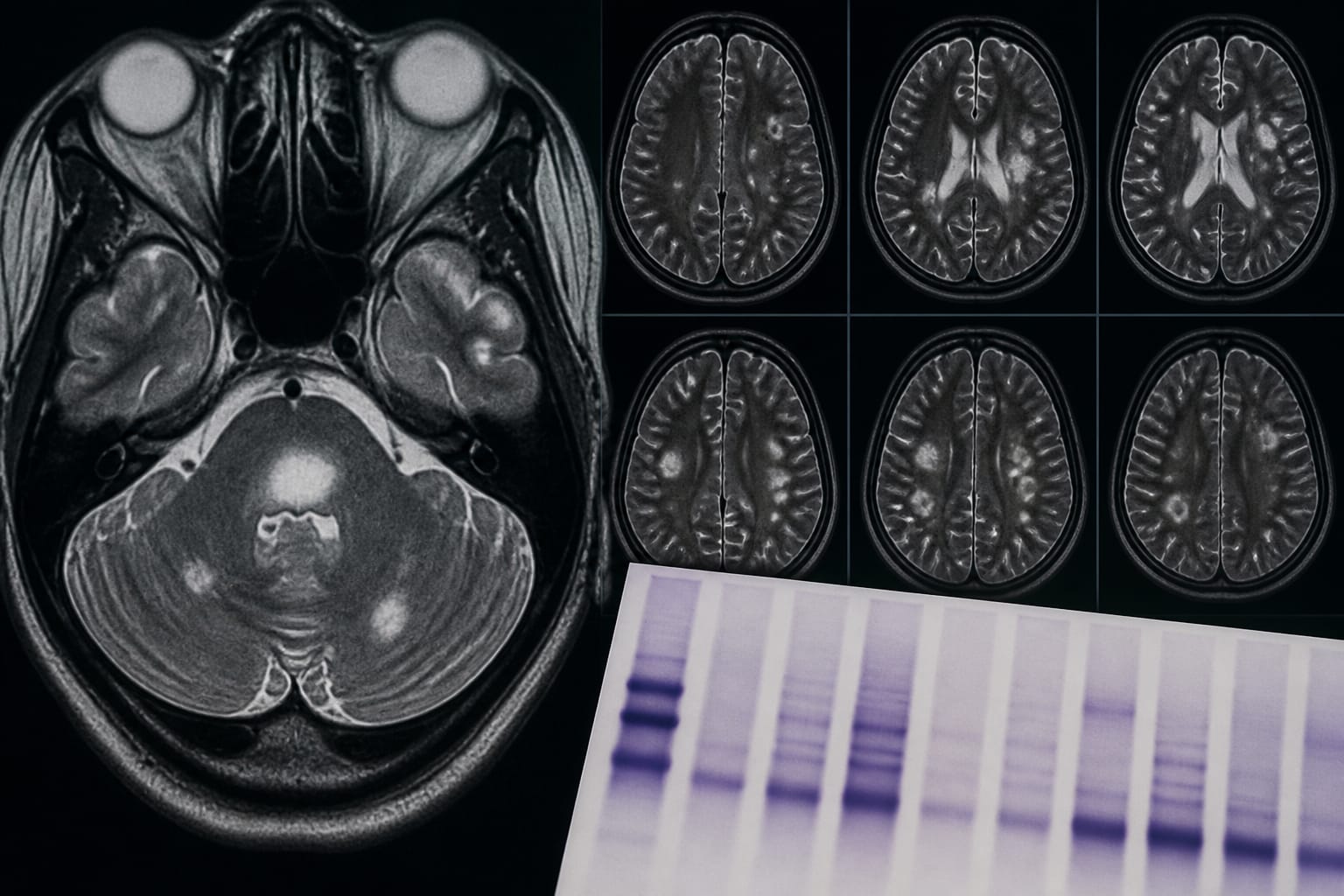
Follow-up MRI revealed additional hyperintense lesions in subcortical regions.
CSF analysis showed positive oligoclonal bands after three years.
TNF inhibitor-associated demyelination is uncommon, with an incidence below 13 per 10,000 person-years.
The changing distribution of lesions supports a transition from neuro-Behçet disease to a demyelinating disease pattern.
New neurologic symptoms in patients on TNF inhibitors necessitate clinical assessment and imaging.
Clinical Implications
New neurological symptoms in patients receiving TNF inhibitors for Behçet disease should prompt clinical assessment, including CSF analysis and MRI.
Conclusion
This case illustrates the diagnostic challenge of distinguishing neuro-Behçet disease from TNF inhibitor-associated demyelination. The authors emphasized that new or changing neurological symptoms and MRI lesions during TNF inhibitor treatment warrant careful evaluation, as the evolving clinical and imaging findings may indicate a demyelinating disease pattern and should prompt reconsideration of treatment.
Related Resources & Content
EULAR recommendations for the management of Behçet's syndrome: 2025 update - PubMed
The effectiveness of the anti-tumor necrosis factor therapy infliximab in neuro-Behçet’s disease: a systematic review and meta-analysis - PMC
Global burden of TNF-α inhibitors associated demyelinating diseases: A global disproportionality analysis - PubMed
Frontiers in Immunology — Two cases of probable Neuro-Behçet syndrome treated with autologous HSCT
Acta Neuropathologica — Altered Expression of Atypical NMDA Receptors in Diffuse Astrocytoma with MYB or MYBL1 Changes as a Potential Inducer of Autoimmune Encephalitis
Frontiers in Immunology — Severe cerebellitis as a manifestation of infliximab-associated overlap of neurosarcoidosis and myelin oligodendrocyte glycoprotein antibody-associated disease – case report
Frontiers in Oncology — Primary central nervous system lymphoma and tumefactive demyelinating lesions in multiple sclerosis: a retrospective observational cohort study
EULAR recommendations for the management of Behçet's syndrome: 2025 update - PubMed
The effectiveness of the anti-tumor necrosis factor therapy infliximab in neuro-Behçet’s disease: a systematic review and meta-analysis - PMC
Global burden of TNF-α inhibitors associated demyelinating diseases: A global disproportionality analysis - PubMed
Based on findings from:
Clinical Images: Tumor necrosis factor inhibitor–associated demyelination in a case of neuro-Behçet disease
Eloise Norman, Gabor Major. Acr Open Rheumatology, 2026.
https://acrjournals.onlinelibrary.wiley.com/doi/10.1002/acr2.90159
This content is an AI-generated, fully rewritten summary based on a published scholarly article. It does not reproduce the original text and is not a substitute for the original publication. Readers are encouraged to consult the source for full context, data, and methodology.