Short-term quantitative CT changes in synchronous ground-glass nodules during immune checkpoint inhibitor therapy in patients with lung cancer - Report - MDSpire
Advertisement
Short-term quantitative CT changes in synchronous ground-glass nodules during immune checkpoint inhibitor therapy in patients with lung cancer
Clinical Report: Quantitative CT Assessment of Short-term Changes in GGNs
Overview
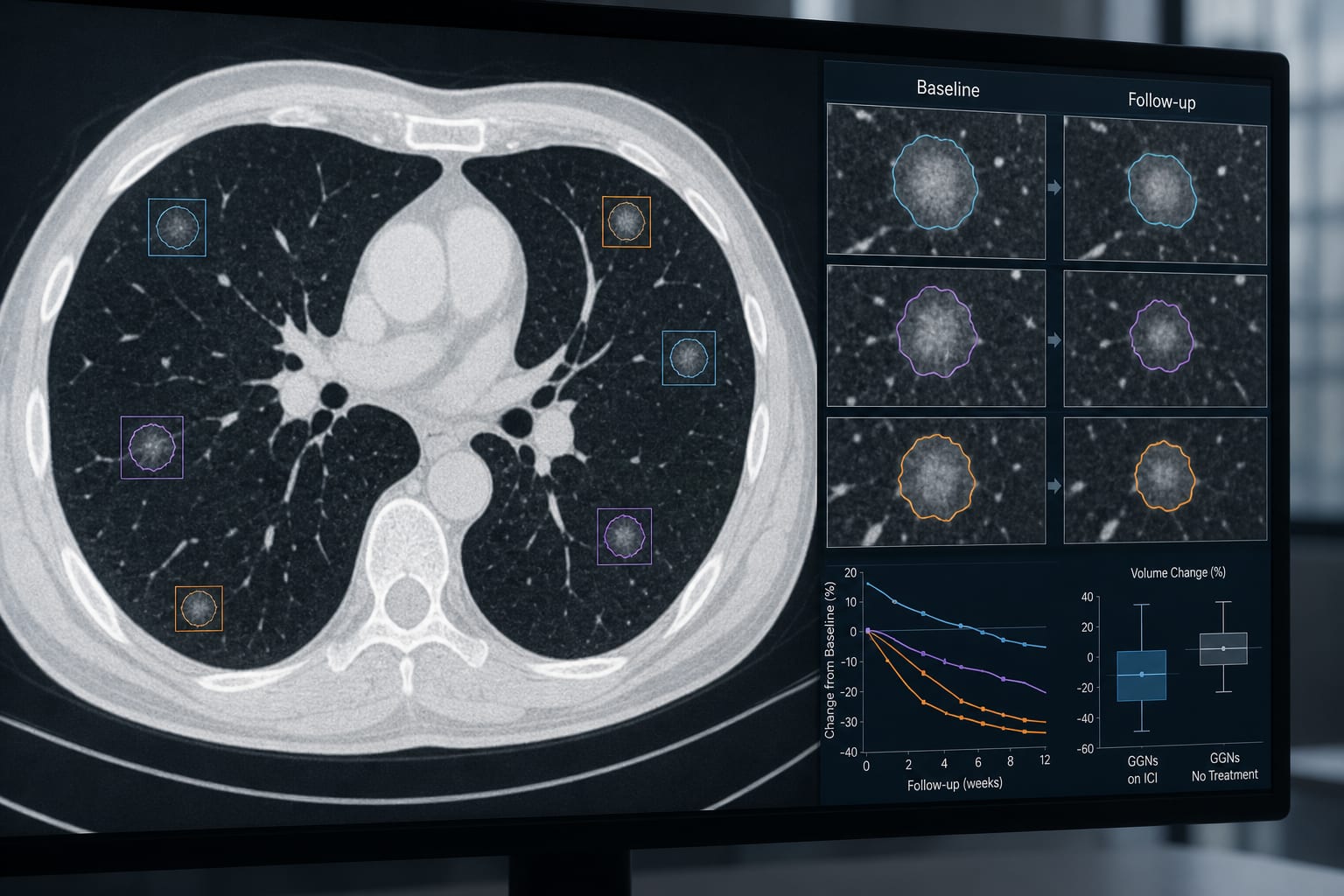
This study evaluates the short-term changes in synchronous ground-glass nodules (GGNs) in lung cancer patients undergoing immune checkpoint inhibitor (ICI) therapy. Findings indicate that GGNs in the ICI group showed regression compared to a control group, with shifts in volume change proportion and Lung-RADS categories.
Background
The detection of synchronous GGNs in lung cancer patients has increased due to the use of ICIs. Understanding the behavior of these nodules during treatment is crucial to avoid overtreatment while ensuring timely intervention for potentially malignant lesions. This study aims to provide insights into the longitudinal changes of GGNs during ICI therapy.
Data Highlights
Metric
ICI Group
Control Group
p-value
Volume Change Proportion (VCP)
23.6%
1.8%
< 0.001
Improvement in Lung-RADS Category
8.2%
1.8%
0.018
Key Findings
Nodules in the ICI group showed a higher regression rate compared to the control group (23.6% vs. 1.8%, p< 0.001).
Improvement in Lung-RADS category was more common in the ICI group (8.2% vs. 1.8%; p = 0.018).
GGNs in the ICI group had lower monthly increases in diameter, volume, surface area, and mass compared to controls.
Within the ICI group, nodules exhibited a significant reduction in diameter and increases in mean CT value and solid component proportion.
Part-solid nodules showed larger volume reductions than pure GGNs.
Nodules with Lung-RADS ≥ 4A demonstrated significant decreases in entropy.
Clinical Implications
The findings suggest that ICI therapy may lead to favorable changes in the growth patterns of synchronous GGNs, which could influence monitoring strategies. Clinicians should consider these changes when evaluating the management of GGNs in lung cancer patients receiving ICIs.
Conclusion
This study highlights the potential for ICI therapy to alter the growth dynamics of synchronous GGNs in lung cancer patients, indicating a need for further research in this area.