Ablative stereotactic MR-guided radiotherapy for >10 cm solid pseudopapillary tumor of the pancreas with liver oligometastases: a case report and literature review - Report - MDSpire
Advertisement
Ablative stereotactic MR-guided radiotherapy for >10 cm solid pseudopapillary tumor of the pancreas with liver oligometastases: a case report and literature review
Clinical Report: Magnetic Resonance-Guided Ablative Radiotherapy for Pancreatic SPT
Overview
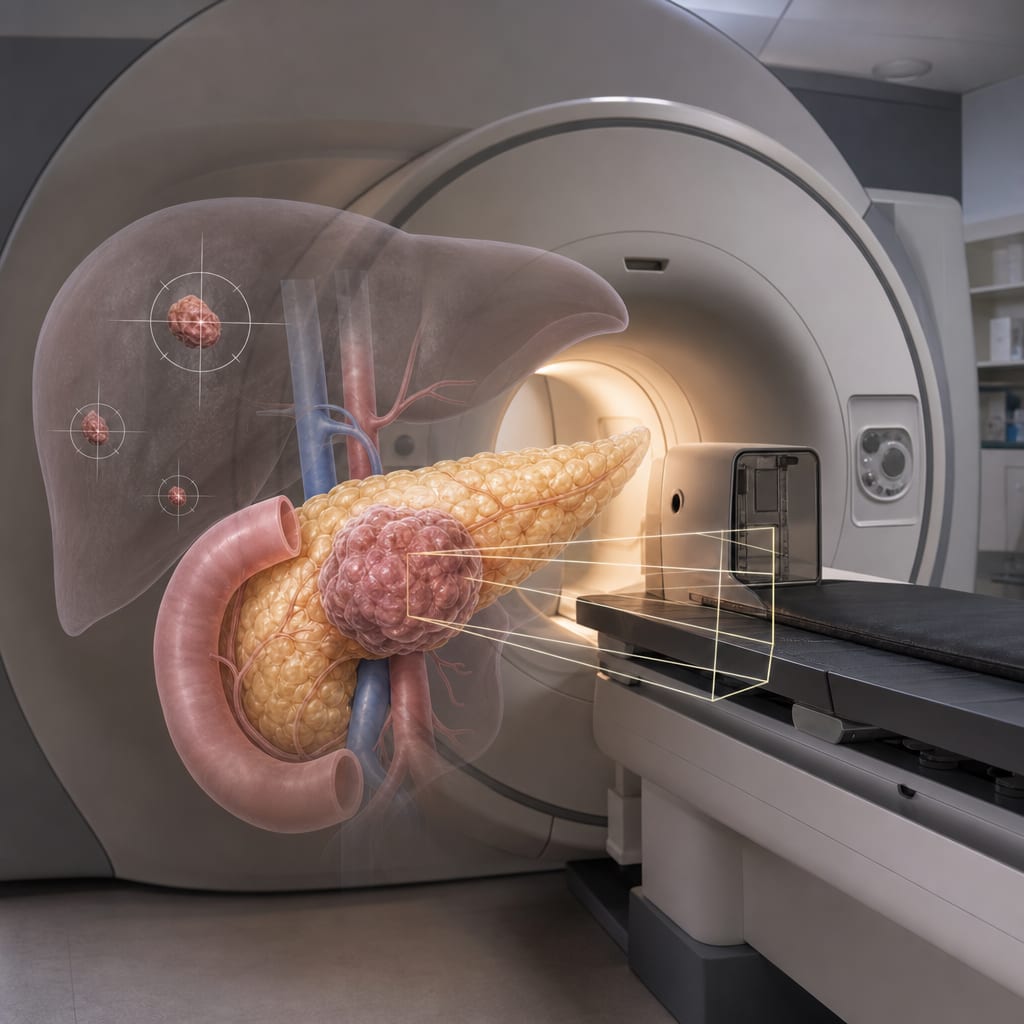
This case study demonstrates the effective use of dose-escalated magnetic resonance-guided radiotherapy (MRgRT) for a large solid pseudopapillary tumor (SPT) of the pancreas with liver oligometastases. The patient achieved a favorable long-term response without significant toxicity, highlighting the potential of MRgRT in treating anatomically challenging tumors.
Background
Solid pseudopapillary tumors (SPTs) of the pancreas are rare, low-grade malignancies that typically have favorable outcomes when resected early. However, treatment options for unresectable or metastatic SPTs are limited, and the role of radiotherapy is not well established. Advances in MRgRT may allow for safe dose escalation in challenging cases, potentially improving patient outcomes.
Data Highlights
No numerical data available in the provided source.
Key Findings
The patient was a 63-year-old female with a 10 cm pancreatic SPT and liver oligometastases.
MRgRT was delivered using a dose-painted, simultaneous integrated boost technique, achieving 50.4 Gy to the primary tumor and 75.6 Gy to a central tumor volume.
Two liver metastases received 40 Gy in five fractions, while a third was treated later with 35 Gy in one fraction.
All radiotherapy courses were well tolerated, with no grade ≥2 toxicity reported.
The patient remained asymptomatic and without evidence of disease progression nearly 36 months post-treatment.
Clinical Implications
This case underscores the potential of MRgRT as a viable treatment option for patients with large, anatomically unfavorable pancreatic SPTs. The ability to escalate doses safely while respecting organ-at-risk constraints may enhance local control and improve patient outcomes in similar cases.
Conclusion
The successful application of dose-escalated MRgRT in this case suggests a promising avenue for treating advanced pancreatic SPTs, warranting further investigation into its efficacy and safety in larger cohorts.
by Robert A. Herrera, Nikolai Strusberg-Fernandez, Eyub Y. Akdemir, Fernando De Zarraga, Horacio Asbun, James McCulloch, Nema Bassiri, Michael D. Chuong