Diagnosis and treatment progress of upper eyelid abnormalities in thyroid-eye disease
-
By
-
Cheng Gai
-
Bing Wang
-
July 13, 2026
Clinical Report: Advancements in the Diagnosis and Management of Upper Eyelid Abnormalities Associated with Thyroid Eye Disease
Background
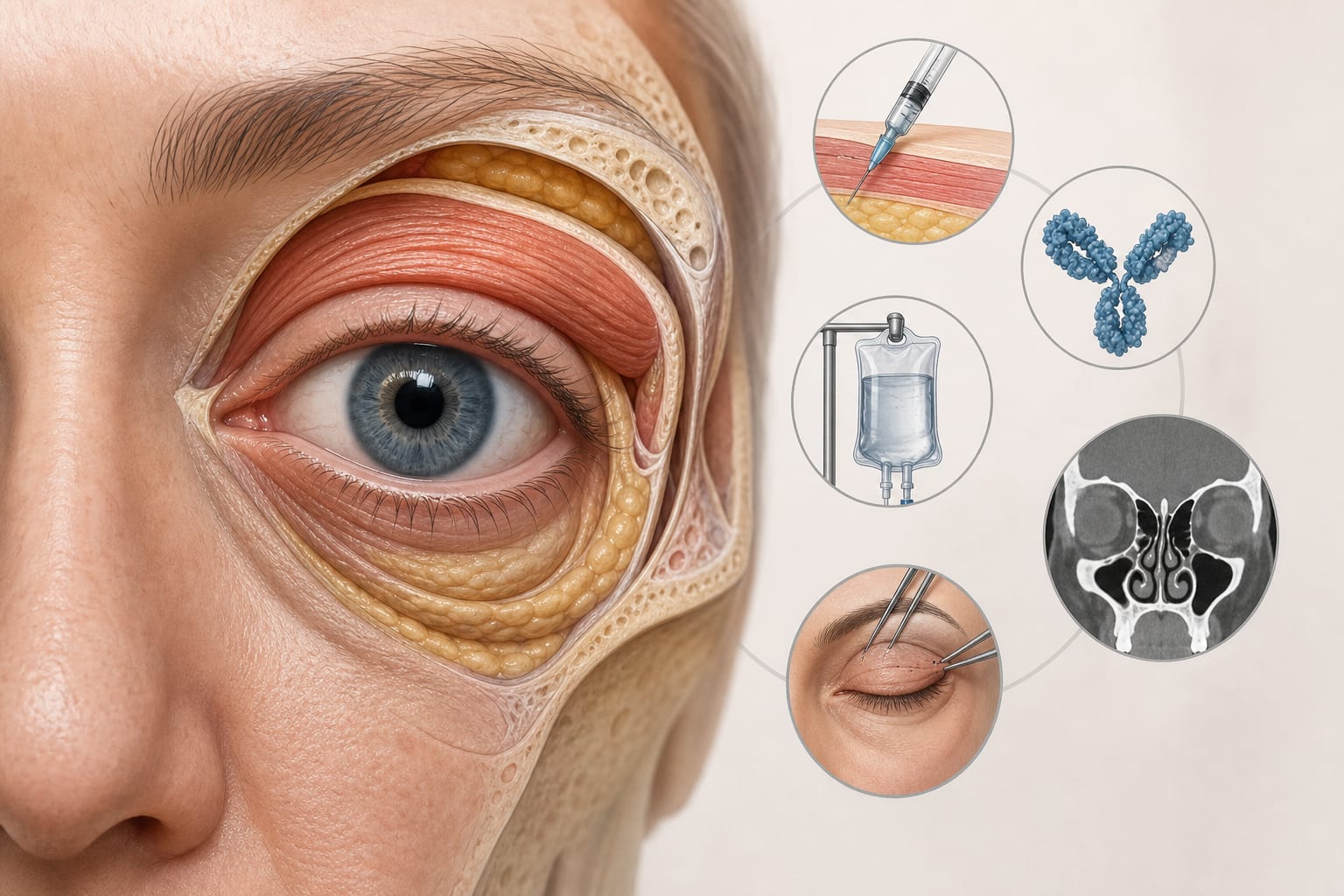
Thyroid eye disease (TED) is the most common orbital disorder among adults and is closely linked to thyroid dysfunction. Upper eyelid abnormalities, such as retraction and lag, significantly impact patients' visual function and quality of life. Understanding the pathogenesis and treatment options for these abnormalities is crucial for improving patient outcomes.
Data Highlights
Key findings indicate that upper eyelid abnormalities occur in 70%-90% of TED cases, significantly affecting quality of life. Teprotumumab has shown a better safety profile compared to traditional glucocorticoids in treating eyelid retraction. Upper eyelid retraction is defined as the eyelid margin being more than 2 mm above the limbus in primary gaze. Over 90% of TED patients exhibit eyelid retraction, which serves as a critical diagnostic indicator.
Key Findings
- Upper eyelid abnormalities occur in 70%-90% of TED cases, significantly affecting quality of life.
- Teprotumumab has shown a better safety profile compared to traditional glucocorticoids in treating eyelid retraction.
- Upper eyelid retraction is defined as the eyelid margin being more than 2 mm above the limbus in primary gaze.
- Future studies should incorporate artificial intelligence for quantitative assessment of eyelid abnormalities.
Clinical Implications
Clinicians should consider a range of treatment options for upper eyelid abnormalities in TED, including both local and systemic therapies. Individualized treatment plans are essential, given the variability in disease presentation and response to therapy.
Conclusion
Advancements in the understanding and management of upper eyelid abnormalities in TED provide a framework for improved patient care. Ongoing research is necessary to address remaining questions regarding optimal treatment strategies.
Related Resources & Content
- ANA CAROLINA VICTORIA, MD, FACS, Ophthalmology Management, 2022 -- DIAGNOSE AND MANAGE THYROID EYE DISEASE Recommendations
- The Journal of Clinical Endocrinology & Metabolism, 2025 -- Management of Hyperthyroidism in Graves' Disease with Concurrent Thyroid Eye Disease Complications
- Contact Lens Spectrum, 2026 -- Dry Eye Dx and Tx: Thinking About Thyroid Eye Disease
- Ophthalmology Management, 2026 -- A New Era of Targeted Treatment for TED
- Eye, 2024 -- The changing landscape of thyroid eye disease: current clinical advances and future outlook
- New England Journal of Medicine, 2020 -- Teprotumumab for the Treatment of Active Thyroid Eye Disease
- Management of Thyroid Eye Disease: A Consensus Statement by the American Thyroid Association and the European Thyroid Association - PMC
- The changing landscape of thyroid eye disease: current clinical advances and future outlook | Eye
- Teprotumumab for the Treatment of Active Thyroid Eye Disease | New England Journal of Medicine
- Management of Thyroid Eye Disease: A Consensus Statement by the American Thyroid Association and the European Thyroid Association - PMC
This content is an AI-generated, fully rewritten summary based on a published scholarly article. It does not reproduce the original text and is not a substitute for the original publication. Readers are encouraged to consult the source for full context, data, and methodology.