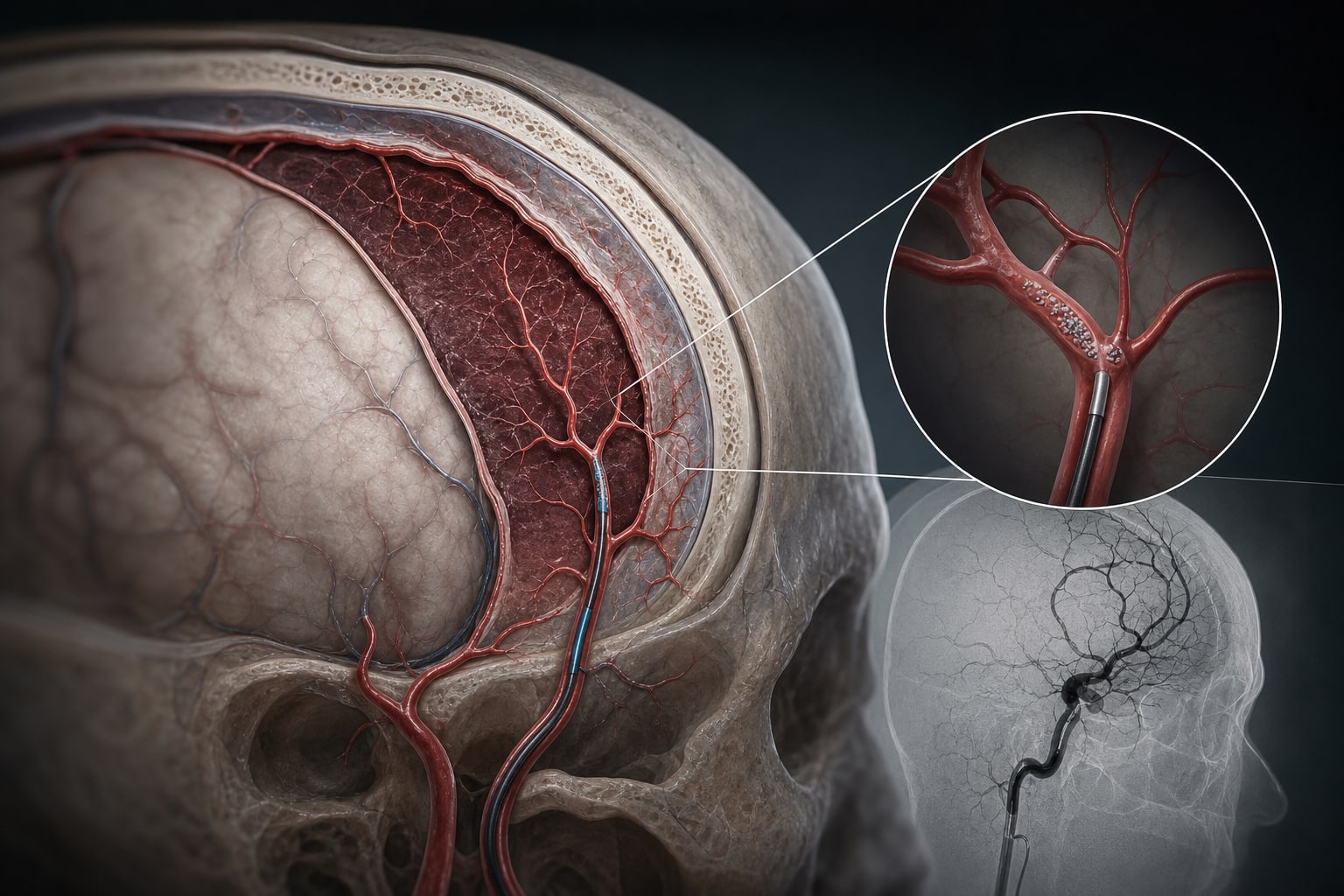
Embolization of the Middle Meningeal Artery for Chronic Subdural Hematoma: A New Approach?
Overview
Chronic subdural hematoma (cSDH) is a prevalent condition in older adults, with a significant recurrence rate post-surgery. Middle meningeal artery (MMA) embolization has emerged as a promising alternative, demonstrating lower recurrence rates compared to conventional surgical methods.
Background
Chronic subdural hematoma is increasingly common in aging populations, with an incidence that sharply rises with age. The high recurrence rate following surgical intervention poses a substantial challenge, leading to increased morbidity and healthcare costs. Understanding and addressing the underlying pathophysiology of cSDH is crucial for improving patient outcomes.
Data Highlights
The incidence of chronic subdural hematoma (cSDH) is approximately 8–17 per 100,000 persons per year, with a notable increase in older adults. Recurrence rates after surgical evacuation range from 10% to 20%, while MMA embolization has shown a recurrence rate of only 2.1%. Early studies suggest that MMA embolization may reduce the need for reoperations and is associated with lower rates of surgical rescue.
Key Findings
The incidence of cSDH is approximately 8–17 per 100,000 persons per year, increasing with age.
Recurrence rates after surgical evacuation of cSDH range from 10% to 20%.
MMA embolization has shown a recurrence rate of only 2.1%, significantly lower than the 27% seen with conventional management.
Early case reports and studies indicate MMA embolization may reduce the need for reoperations.
Meta-analyses have confirmed lower rates of cSDH recurrence and surgical rescue associated with MMA embolization.
Clinical Implications
MMA embolization presents a viable option for managing cSDH, particularly in patients at high risk for recurrence. This technique may reduce the need for repeated surgical interventions, potentially improving patient outcomes and decreasing healthcare costs.
Conclusion
MMA embolization represents a promising advancement in the management of chronic subdural hematoma, with evidence supporting its efficacy in reducing recurrence rates.
Related Resources & Content
Huang, Y., et al., Neurosurgery, 2022 -- Middle Meningeal Artery Embolization for Chronic Subdural Hematoma: A Systematic Review and Meta-Analysis
Frontiers in Neurology, 2026 -- Triple-modality management of complex septated chronic subdural hematoma: a preliminary technical note on feasibility and safety
Comparison of Middle Meningeal Artery Embolization and Surgical Reintervention in Managing Recurrent Chronic Subdural Hematomas: Treatment Outcomes and Volume Changes
Complementary Embolization of the Middle Meningeal Artery for Non-Acute Subdural Hematomas: A Meta-Analysis and Trial Sequential Analysis Evaluated by GRADE in Randomized Studies
Current state of the field and recommendations for middle meningeal artery embolization in chronic subdural hematoma: A Report of the SNIS Standards and Guidelines Committee, Endorsed by ANZSNR and ESMINT - PubMed
Embolization of the Middle Meningeal Artery for Chronic Subdural Hematoma - PubMed
Current state of the field and recommendations for middle meningeal artery embolization in chronic subdural hematoma: A Report of the SNIS Standards and Guidelines Committee, Endorsed by ANZSNR and ESMINT - PubMed
Embolization of the Middle Meningeal Artery for Chronic Subdural Hematoma - PubMed
Middle Meningeal Artery Embolization for Subdural Hematoma: Systematic Review and Meta-Analysis of Randomized Trials
by Yan Li, Johannes Haubold, Natalie van Landeghem, Cornelius Deuschl, Ramazan Jabbarli, Philipp Dammann, Ulrich Sure, Isabel Wanke, Luisa Strack, Michael Forsting