Locking plate fixation for proximal humerus fractures: are four proximal screws adequate? A clinical and radiological analysis of 105 consecutive cases - Report - MDSpire
Coming Soon: Introducing MDSpire News. Learn more
Conexiant’s news site is now MDSpire News. Learn more

Evaluation of Four Proximal Screws in Locking Plate Fixation for Proximal Humerus Fractures: A Clinical and Radiological Study of 105 Cases

  • By

  • Christian Michelitsch

  • Philipp Florian Stillhard

  • Christoph Zindel

  • Christoph Sommer

  • Yves Pascal Acklin

  • August 30, 2026

Share

Clinical Report: Evaluation of Four Proximal Screws in Locking Plate Fixation

Overview

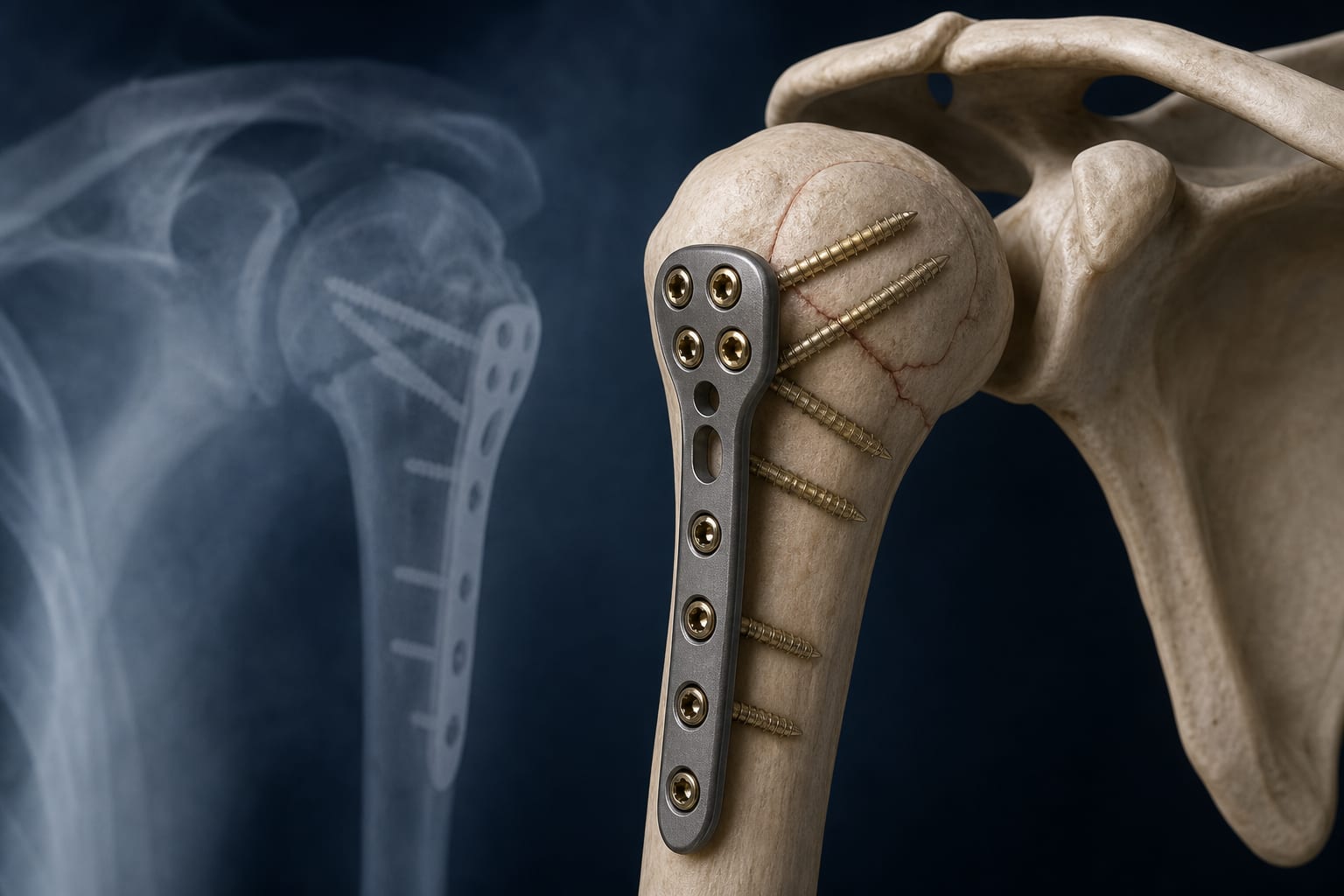
This study evaluates the adequacy of using four proximal screws in locking plate fixation for proximal humerus fractures. A total of 105 cases were analyzed to assess clinical and radiological outcomes.

Background

Proximal humerus fractures are common, particularly among the elderly, and often require surgical stabilization due to high complication rates associated with operative management. This study addresses a gap in clinical evidence regarding the use of four screws in the humeral head.

Data Highlights

No specific numerical data or trial results were provided in the source material.

Key Findings

  • Fractures were categorized using the AO fracture classification system.
  • Patients were divided into two groups based on the number of screws used during surgery.
  • Operative treatment was indicated for significant displacement patterns.
  • Postoperative complications were documented through routine outpatient follow-up.
  • The study emphasizes the importance of screw positioning for stable fixation.

Clinical Implications

The findings from this study may inform surgical practices regarding the fixation of proximal humerus fractures.

Conclusion

This study contributes to the understanding of surgical management in proximal humerus fractures.

Related Resources & Content

  1. Locking plate fixation for proximal humerus fractures: are four proximal screws adequate? A clinical and radiological analysis of 105 consecutive cases | Archives of Orthopaedic and Trauma Surgery | Springer Nature Link, 2026
  2. Evaluating Intramedullary Screws versus Plating for the Management of Proximal Phalangeal Fractures
  3. Optimizing Screw Placement in Lateral Clavicle Fractures: A Grid Pattern Approach to Minimize Cut-Out Risk
  4. Biomechanical Analysis of Screw Fixation Versus Anatomical Plates in Treating Coronoid Shear Fractures of the Ulna
  5. Efficacy of Distal Ulna Locking Plates in Treating Unstable Distal Ulna Fractures: A Prospective Case Study
  6. Consensus statement on the treatment of proximal humerus fractures: a Delphi approach by the Neer Circle of the American Shoulder and Elbow Surgeons.
  7. Position statement: management of proximal humerus fractures - PMC
  8. Reverse Shoulder Arthroplasty Is Superior to Plate Fixation for Displaced Proximal Humeral Fractures in the Elderly: Five-Year Follow-up of the DelPhi Randomized Controlled Trial.
  9. Reverse shoulder arthroplasty or nothing for patients with displaced proximal humeral fractures: a randomized controlled trial.
  10. The ProFHER (PROximal Fracture of the Humerus: Evaluation by Randomisation) trial - a pragmatic multicentre randomised controlled trial evaluating the clinical effectiveness and cost-effectiveness of surgical compared with non-surgical treatment for proximal fracture of the humerus in adults - PMC
  11. Locking plates versus intramedullary nails for the treatment of two- and three-part proximal humerus fractures in patients older than 60 years: a meta-analysis.
  12. The effects of augmentation choices for locking plate fixation in proximal humerus fracture osteosynthesis: a systematic review and meta-analysis
  13. Factors associated with failure of locking plate fixation in proximal humerus fractures
  14. Locking plate fixation for proximal humerus fractures: are four proximal screws adequate? A clinical and radiological analysis of 105 consecutive cases | Archives of Orthopaedic and Trauma Surgery | Springer Nature Link

Original Source(s)

Related Content