Clinical Report: Enhancing Mid-Trimester Prediction of Spontaneous Preterm Birth
Overview
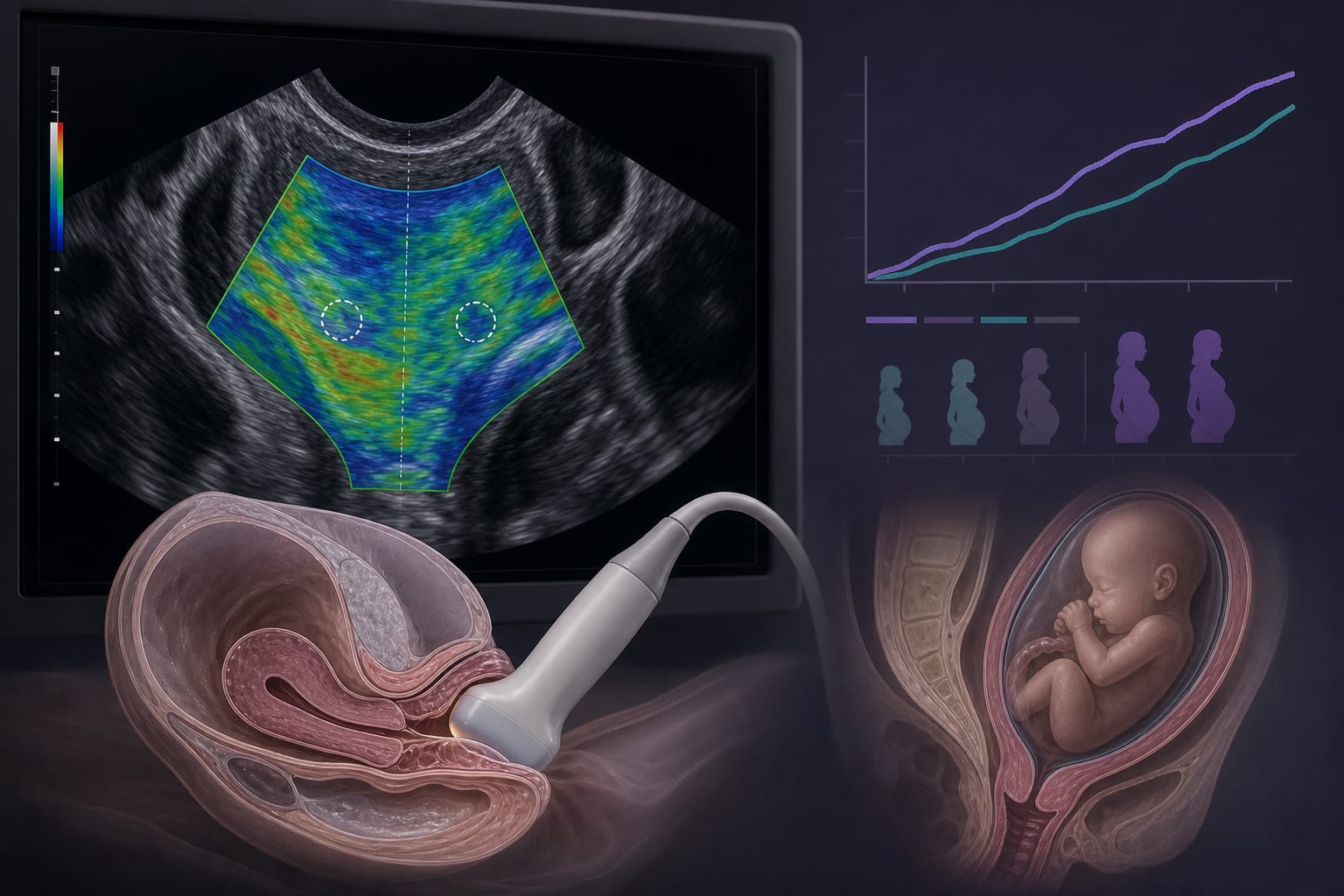
This study evaluates the predictive value of cervical strain elastography parameters, combined with cervical length, for spontaneous preterm birth (sPTB) in asymptomatic women. Results indicate that incorporating elastography significantly improves predictive accuracy compared to cervical length alone.
Background
Spontaneous preterm birth (sPTB) is a major contributor to neonatal morbidity and mortality, affecting millions of newborns globally. Current screening methods, primarily cervical length (CL) measurement, have limited predictive accuracy, necessitating the exploration of additional techniques such as cervical strain elastography to enhance risk stratification.
Data Highlights
Parameter
AUC
95% CI
IOS
0.797
0.715–0.878
IOS/EOS Ratio
0.758
0.671–0.846
CL + IOS/EOS
0.828
0.771–0.885
Key Findings
sPTB occurred in 13.5% of the studied cohort (37 of 275 women).
IOS demonstrated the highest discrimination for sPTB with an AUC of 0.797.
The combined model of CL and IOS/EOS achieved an AUC of 0.828, outperforming both CL alone and IOS/EOS alone.
The optimal cut-off for the combined model yielded a sensitivity of 73% and specificity of 82%.
Decision curve analysis indicated superior net benefit for the combined model across relevant threshold probabilities.
Clinical Implications
The findings suggest that mid-trimester cervical strain elastography can enhance the predictive accuracy for sPTB when used alongside cervical length measurements. Clinicians may consider integrating this approach into routine assessments to better stratify risk and manage pregnancies at risk for preterm birth.
Conclusion
Cervical strain elastography, particularly the IOS-related metrics, offers valuable predictive information for sPTB. Further validation is necessary before its routine clinical implementation.
Claims-based target trial emulation found no clear association between continued GLP-1 receptor agonist use in early pregnancy and nonlive birth, fetal growth abnormalities, or major congenital malformations.