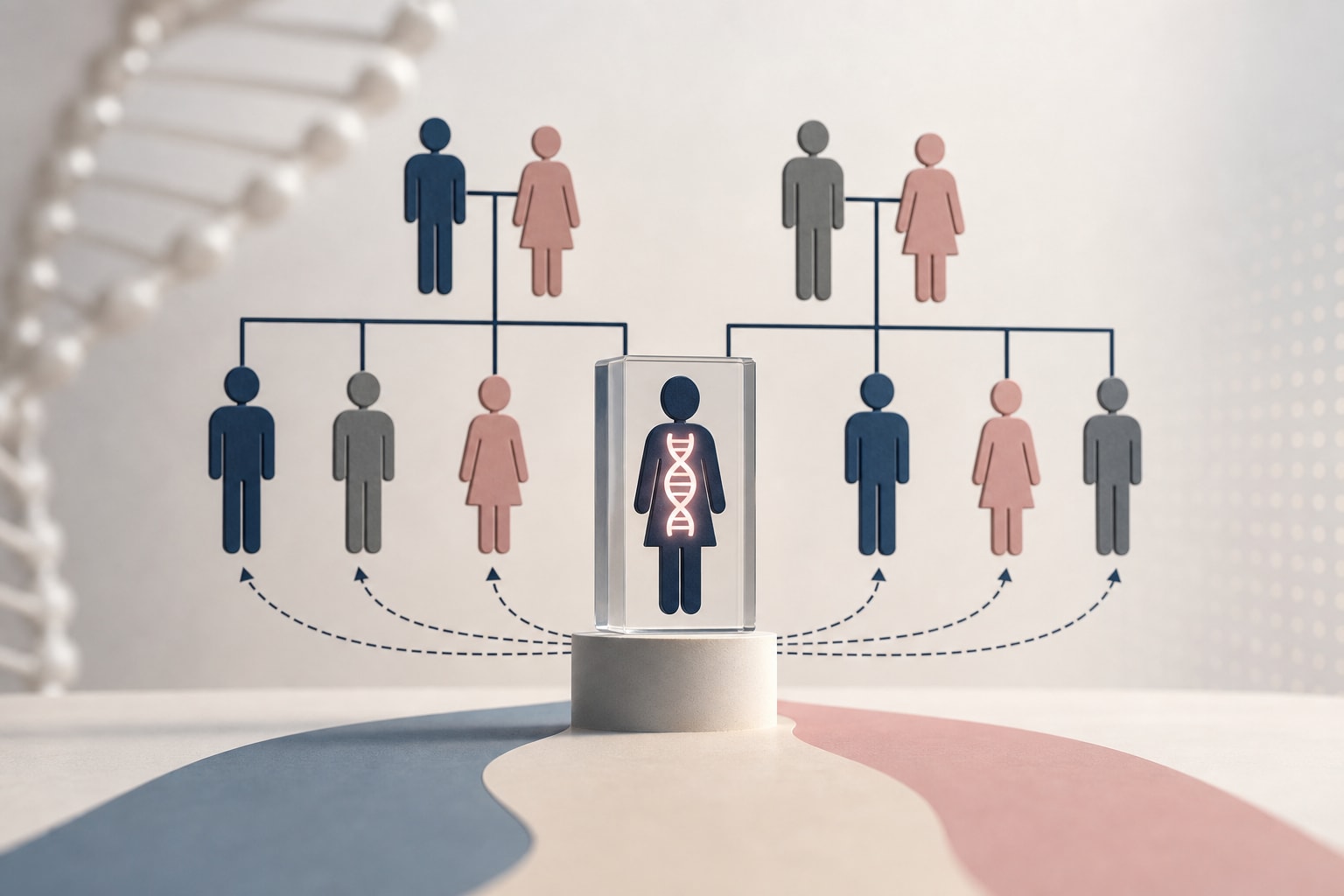
Exploring the Untapped Benefits of Cascade Genetic Screening
-
By
-
Miguel Barajas
-
Lainie Friedman Ross
-
June 30, 2026
Clinical Report: Exploring the Untapped Benefits of Cascade Genetic Screening
Overview
This study evaluates the uptake of cascade genetic screening among probands with hereditary breast and ovarian cancer (HBOC) and Lynch syndrome (LS). Findings indicate that less than 25% of probands had relatives undergo cascade testing.
Background
Cascade genetic screening is crucial for identifying asymptomatic relatives of individuals with hereditary conditions like HBOC and LS. These conditions are classified as tier 1 by the CDC, indicating their high actionability. Understanding the factors influencing cascade testing uptake is essential.
Data Highlights
No numerical data table available.
Key Findings
- Only 24.24% of probands had at least one relative undergo cascade testing.
- Female probands were more likely to have relatives tested compared to male probands (25.02% vs 20.62%).
- Non-Hispanic White probands had the highest rates of cascade testing (27.19%), while African American or Black probands had the lowest (16.15%).
- Offering free testing did not significantly increase cascade testing rates (23.39% before vs 24.59% after free testing).
- Direct contact with at-risk relatives resulted in a higher uptake of cascade testing (53%) compared to proband-led methods.
Clinical Implications
The low uptake of cascade genetic screening suggests a need for targeted interventions to improve awareness and facilitate communication among families. Healthcare providers may consider alternative methods of outreach to enhance screening rates and ensure at-risk individuals are informed about their genetic risks.
Conclusion
The findings from this study underscore the challenges in cascade genetic screening uptake, emphasizing the need for strategies that address barriers to testing and improve familial communication regarding genetic risks.
Related Resources & Content
- Namey et al, Source, Year -- Exploring the Untapped Benefits of Cascade Genetic Screening
- CDC, Tier 1 Genomics Applications and their Importance to Public Health
- NCCN Guidelines, Genetic/Familial High-Risk Assessment, Version 2.2026
- Uptake of Cascade Genetic Testing for Hereditary Breast and Ovarian Cancer: A Systematic Review and Meta-Analysis
- the pathologist — Beyond the Heel Prick
- The ASCO Post — Should Restrictions on Genetic Testing Be Loosened?
- Journal of Cardiac Failure — Real-world Genetic Testing Practices in Cardiomyopathy: National Insights From 1.7 Million Patients
- The ASCO Post — Should Oncologists Be Ordering Breast Cancer Gene Panels?
- Beyond the Heel Prick
- Should Restrictions on Genetic Testing Be Loosened?
- Real-world Genetic Testing Practices in Cardiomyopathy
- Tier 1 Genomics Applications and their Importance to Public Health | CDC
- NCCN Guidelines® Insights: Genetic/Familial High-Risk Assessment: Breast, Ovarian, Pancreatic, and Prostate, Version 2.2026 - PubMed
- Uptake of Cascade Genetic Testing for Hereditary Breast and Ovarian Cancer: A Systematic Review and Meta-Analysis - PubMed
Based on findings from:
The Unrealized Potential of Cascade Testing
Miguel Barajas, Lainie Friedman Ross. Jama Network Open, 2026.
https://jamanetwork.com/journals/jamanetworkopen/fullarticle/2850967
This content is an AI-generated, fully rewritten summary based on a published scholarly article. It does not reproduce the original text and is not a substitute for the original publication. Readers are encouraged to consult the source for full context, data, and methodology.