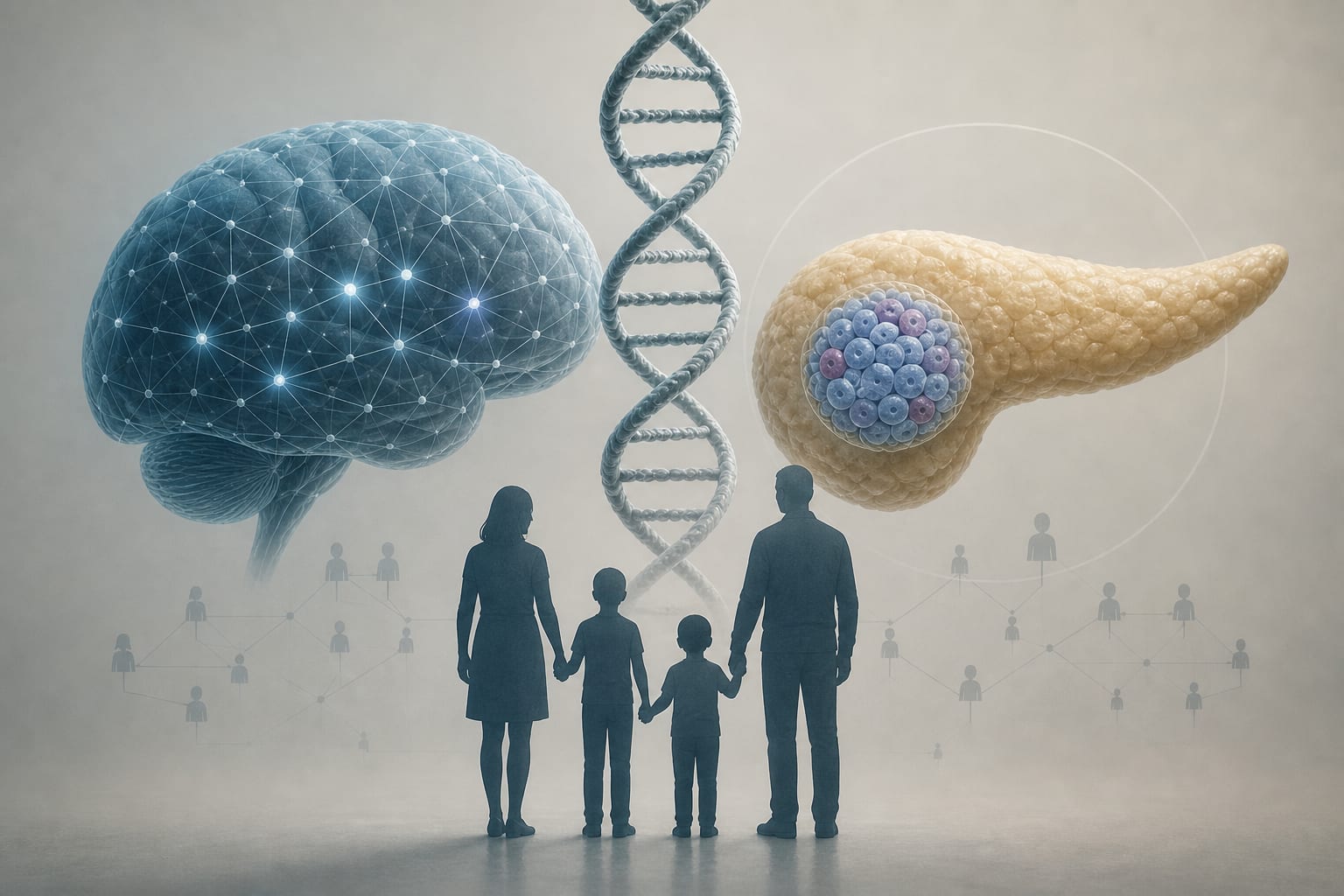
Familial Co-Aggregation of Neurodevelopmental Conditions and Childhood-Onset Type 1 Diabetes - Report - MDSpire
Coming Soon: Introducing MDSpire News. Learn more
Conexiant’s news site is now MDSpire News. Learn more

Co-Occurrence of Neurodevelopmental Disorders and Early-Onset Type 1 Diabetes in Families

  • By

  • Shengxin Liu

  • Gisele Magarotto Machado

  • Irzam Hardiansyah

  • Xinyue Gu

  • Jonas F. Ludvigsson

  • Paul Lichtenstein

  • Soffia Gudbjörnsdottir

  • Ebba Du Rietz

  • Brian D'Onofrio

  • Henrik Larsson

  • Mark J. Taylor

  • Ralf Kuja-Halkola

  • Agnieszka Butwicka

  • August 22, 2026

Share

Co-Occurrence of Neurodevelopmental Disorders and Early-Onset Type 1 Diabetes in Families

Overview

This study investigates the familial co-occurrence of neurodevelopmental disorders (NDCs) and childhood-onset type 1 diabetes (T1D) using a nationwide cohort from Sweden. It evaluates the contributions of shared genetic and environmental factors to this association.

Background

Type 1 diabetes is a prevalent chronic condition in childhood, and neurodevelopmental disorders affect millions globally, leading to significant lifelong challenges. Understanding the relationship between T1D and NDCs is crucial for early identification and intervention. The mechanisms underlying this co-occurrence remain unclear.

Data Highlights

No numerical data or trial data provided in the source material.

Key Findings

  • Childhood-onset T1D has been associated with an increased risk of NDCs.
  • Heritability estimates suggest a moderate to high genetic contribution to both T1D and NDCs.
  • Familial liability may underlie the co-occurrence of T1D and NDCs.
  • Disrupted glycemic control may increase vulnerability to neurocognitive difficulties.
  • Shared genetic and environmental factors could contribute to the relationship between T1D and NDCs.

Clinical Implications

Clinicians should be aware of the potential for co-occurring neurodevelopmental disorders in children with early-onset T1D.

Conclusion

The study highlights the importance of investigating the familial and genetic factors contributing to the co-occurrence of T1D and NDCs, which may inform future clinical practices and research directions.

Related Resources & Content

  1. The Journal of Clinical Endocrinology & Metabolism, 2023 -- Searching for Monogenic Autoimmune Etiology in Patients With Type 1 Diabetes Onset Before 30 Months of Age
  2. MDSpire News, 2023 -- Association Between COVID-19 Infection and Accelerated T1D Progression in Youth
  3. Frontiers in Endocrinology, 2026 -- Frequency of autoimmune diseases in children and adolescents with type 1 diabetes mellitus
  4. American Diabetes Association, 2026 -- Children and Adolescents: Standards of Care in Diabetes
  5. ScienceDirect, 2025 -- Association between maternal diabetes and neurodevelopmental outcomes in children: a systematic review and meta-analysis
  6. MDSpire News — EASD: Childhood Diet Linked to Type 1 Diabetes Risk
  7. Children and Adolescents: Standards of Care in Diabetes—2026
  8. ISPAD Clinical Practice Consensus Guidelines 2024
  9. 14. Children and Adolescents: Standards of Care in Diabetes—2026
  10. Association between maternal diabetes and neurodevelopmental outcomes in children: a systematic review and meta-analysis of 202 observational studies comprising 56·1 million pregnancies - ScienceDirect
  11. The association between maternal diabetes and the risk of attention deficit hyperactivity disorder in offspring: an updated systematic review and meta-analysis - PMC
  12. Neurodevelopmental Disorders, Glycemic Control, and Diabetic Complications in Type 1 Diabetes: a Nationwide Cohort Study - PMC
  13. Type 1 Diabetes in Parents and Risk of Attention Deficit/Hyperactivity Disorder in Offspring: A Population-Based Study in Sweden | Diabetes Care | American Diabetes Association
  14. Familial co-aggregation of attention-deficit/hyperactivity disorder and autoimmune diseases: a cohort study based on Swedish population-wide registers - PMC
  15. Familial aggregation and heritability of childhood-onset and adult-onset type 1 diabetes: a Swedish register-based cohort study - PubMed

Original Source(s)

Related Content