Telerehabilitation in Community Stroke Services: Mixed Methods Evaluation of Current Practice and Lessons for Sustained Use - Report - MDSpire

Telerehabilitation in Community Stroke Services: Mixed Methods Evaluation of Current Practice and Lessons for Sustained Use

  • By

  • Elizabeth Chandler

  • Charlotte Dorer

  • Valerie M Pomeroy

  • Nicola J Hancock

  • June 11, 2026

  • 0 min

Share

Clinical Report: Evaluation of Current Practices in Telerehabilitation for Stroke

Overview

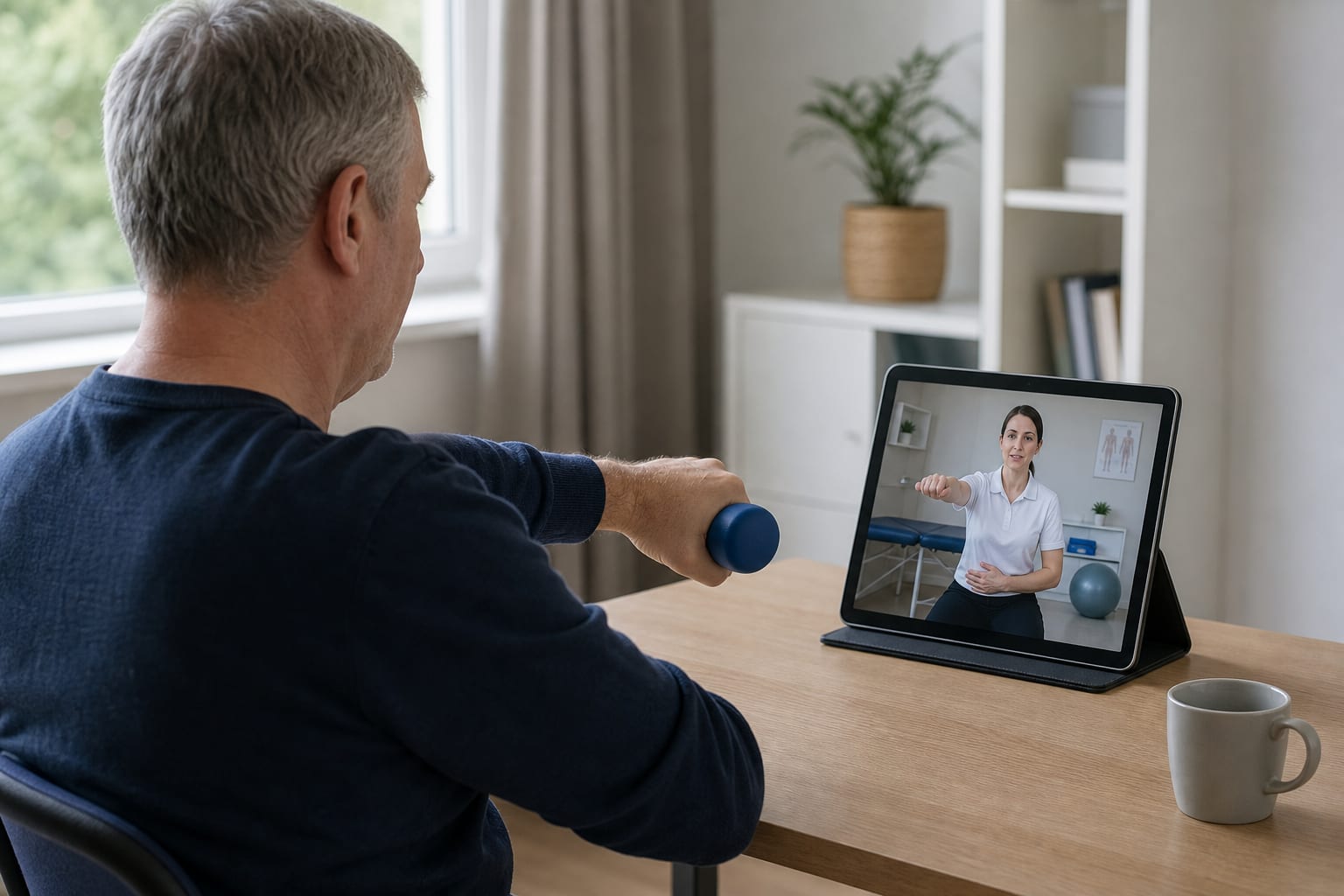
This report evaluates the implementation of telerehabilitation in community stroke services, highlighting its growing role post-COVID-19. It aims to understand current practices, patient experiences, and factors supporting its integration into routine care.

Background

Telerehabilitation has emerged as a significant method for delivering rehabilitation services remotely, particularly in stroke care. The COVID-19 pandemic accelerated its adoption, prompting a shift towards digital solutions in healthcare. Understanding the effectiveness and operationalization of telerehabilitation is crucial for enhancing stroke rehabilitation services.

Data Highlights

No numerical data available in the source material.

Key Findings

  • Telerehabilitation can be as effective as in-person care for certain rehabilitation outcomes.
  • The COVID-19 pandemic has increased the adoption of telerehabilitation in stroke rehabilitation.
  • Further evaluation of telerehabilitation's use is necessary to understand patient and provider experiences.
  • Successful integration of telerehabilitation requires understanding key components and enabling factors.
  • The evaluation was commissioned by NHS East of England to support the UK Integrated Community Stroke Service.

Clinical Implications

Healthcare providers should consider the integration of telerehabilitation into stroke rehabilitation services, ensuring that both patient and clinician experiences are evaluated. Continuous monitoring and engagement with service users are essential for improving digital rehabilitation services.

Conclusion

The evaluation of telerehabilitation practices in community stroke services is vital for understanding its effectiveness and operational challenges. Strengthening the evidence base will support its sustained use in rehabilitation.
Related Resources & Content

  1. NHS East of England, 2023 -- Evaluation of Current Practices in Telerehabilitation for Stroke
  2. Frontiers in Psychiatry — Telerehabilitation in children and adolescents with intellectual disability: a systematic review
  3. Frontiers in Neurology — Effects of remote transitional care on stroke patients: a meta-analysis
  4. Journal of Medical Internet Research (JMIR) — Online Community Support for Stroke Survivors and Caregivers: Scoping Review
  5. European Journal of Preventive Cardiology — A digitally supported shared decision-making approach for patients during cardiac rehabilitation: a randomized controlled trial
  6. Canadian Stroke Best Practice Recommendations
  7. American Telemedicine Association Principles for Delivering Telerehabilitation Services
  8. AHA Fact Sheet: Telehealth Waivers
  9. Frontiers | AI-driven cognitive telerehabilitation for stroke: a randomized controlled trial
  10. A randomized controlled Trial of telerehabilitation intervention for acute ischemic stroke patients Post-Discharge - ScienceDirect
  11. ORLA combined with telerehabilitation in patients with subacute Poststroke aphasia: a randomized controlled trial | Scientific Reports
  12. A comparative study of five telerehabilitation therapies for improving core symptoms in stroke patients: A network meta-analysis (2,833 patients) - ScienceDirect
  13. Effectiveness, Feasibility, Acceptability, and Safety of Digital Interventions in Post-Stroke Rehabilitation: A Systematic Review and Meta-analysis of Randomized Controlled Trials - ScienceDirect
  14. Costs and cost effectiveness of the use of telerehabilitation training for upper limb function in people after stroke: A systematic review - Daim Syukriyah, Jemma Perks, Phil McBride, Philip Clatworthy, Helen Dawes, Maedeh Mansoubi, Tristan Snowsill, Gordon Taylor, Claire Hulme, 2026

Original Source(s)

Related Content