Comparative analysis of myocardial strain parameters in acute decompensated heart failure phenotypes: a cross-sectional study - Report - MDSpire

Comparative analysis of myocardial strain parameters in acute decompensated heart failure phenotypes: a cross-sectional study

  • By

  • Zhizhou Lin

  • Songyuan Yu

  • Jiajie Yin

  • Hong Jiang

  • Mengru Liu

  • Xianlun Li

  • July 9, 2026

  • 0 min

Share

Clinical Report: Evaluation of Myocardial Strain Metrics Across ADHF Subtypes

Overview

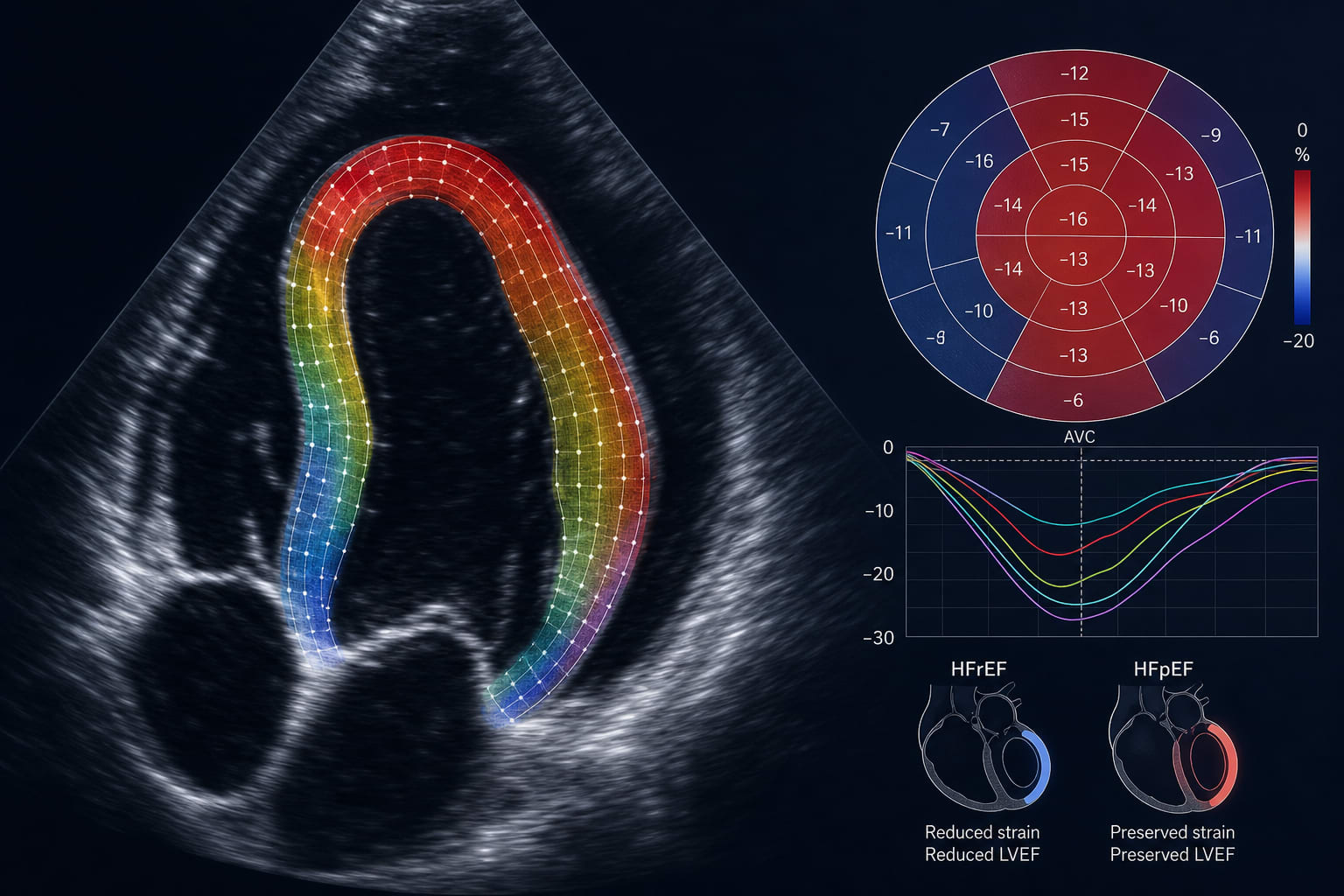
This study investigates differences in two-dimensional speckle tracking echocardiography (2D-STE) parameters among patients with acute decompensated heart failure (ADHF) subtypes and their correlation with left ventricular ejection fraction (LVEF). Significant differences were found between heart failure with reduced ejection fraction (HFrEF) and preserved ejection fraction (HFpEF) groups, with LVEF showing varying correlations with 2D-STE parameters.

Background

Acute decompensated heart failure (ADHF) presents significant clinical challenges, characterized by various symptoms and signs that can complicate management. Traditional assessment methods, such as left ventricular ejection fraction (LVEF), have limitations in accurately reflecting cardiac function. Two-dimensional speckle tracking echocardiography (2D-STE) offers a more nuanced evaluation of myocardial deformation.

Data Highlights

No numerical data table available.

Key Findings

  • The HFpEF group exhibited significantly higher values of GLSA4C, GLSA2C, GLSA3C, and LV-GLS compared to the HFrEF group (P < 0.05).
  • HFrEF patients had higher LAFI and LASI values than those in the HFpEF group (P < 0.05).
  • LVEF was negatively correlated with multiple 2D-STE parameters in the HFrEF subgroup (P < 0.05).
  • In HFpEF patients, LVEF was negatively correlated only with GLSA4C, GLSA2C, GLSA3C, and LV-GLS (P < 0.05).
  • After adjusting for LVEF, LV-GLS remained correlated with various parameters in both heart failure groups (P < 0.05).
  • Stronger correlations between right ventricular and left atrial mechanics were observed in HFpEF patients compared to HFrEF patients.

Clinical Implications

The findings highlight the importance of utilizing 2D-STE parameters in assessing myocardial function in ADHF patients.

Conclusion

This study identifies differences in myocardial strain metrics between HFrEF and HFpEF patients, with LVEF showing varying correlations with these metrics.
Related Resources & Content

  1. Clinical Research in Cardiology, 2017 -- Assessment of Longitudinal Strain via Cardiac Magnetic Resonance Relates to Hemodynamic Parameters in Severe Aortic Stenosis Patients and Forecasts Positive Remodeling Post-Transcatheter Aortic Valve Replacement
  2. European Radiology, 2023 -- Evaluation of Manual Versus AI-Driven Myocardial Strain Measurement Through Feature Tracking: A Cardiovascular MRI Investigation in Healthy and Diseased States
  3. European Radiology, 2024 -- Assessment of Atrial and Ventricular Strain via Cardiovascular Magnetic Resonance for Predicting Outcomes in Patients with Pericarditis: A Preliminary Investigation
  4. Clinical Research in Cardiology, 2023 -- Impaired Left Ventricular Strain Evaluated by Cardiac Magnetic Resonance Imaging Correlates with Chronic Kidney Disease in Individuals with Ischemic Cardiomyopathy
  5. 2024 ACC Expert Consensus Decision Pathway on Clinical Assessment, Management, and Trajectory of Patients Hospitalized With Heart Failure Focused Update - American College of Cardiology
  6. 2025 Joint ASE/EACVI Clinical Consensus Statement on Strain Echocardiography
  7. Definitions for a common standard for 2D speckle tracking echocardiography
  8. Left ventricular and atrial strain and the risk of mortality and rehospitalization in heart failure
  9. 2024 ACC Expert Consensus Decision Pathway on Clinical Assessment, Management, and Trajectory of Patients Hospitalized With Heart Failure Focused Update - American College of Cardiology
  10. ORIGINAL PAPER
  11. https://academic.oup.com/eschf/article/12/4/2921/8488089

Original Source(s)

Related Content