Rapid coma with bilateral basal ganglia involvement - Report - MDSpire

Rapid coma with bilateral basal ganglia involvement

  • By

  • Adam Celier

  • Delphine Leclercq

  • Augustin Boulet

  • Loic Le Guennec

  • July 2, 2026

  • 0 min

Share

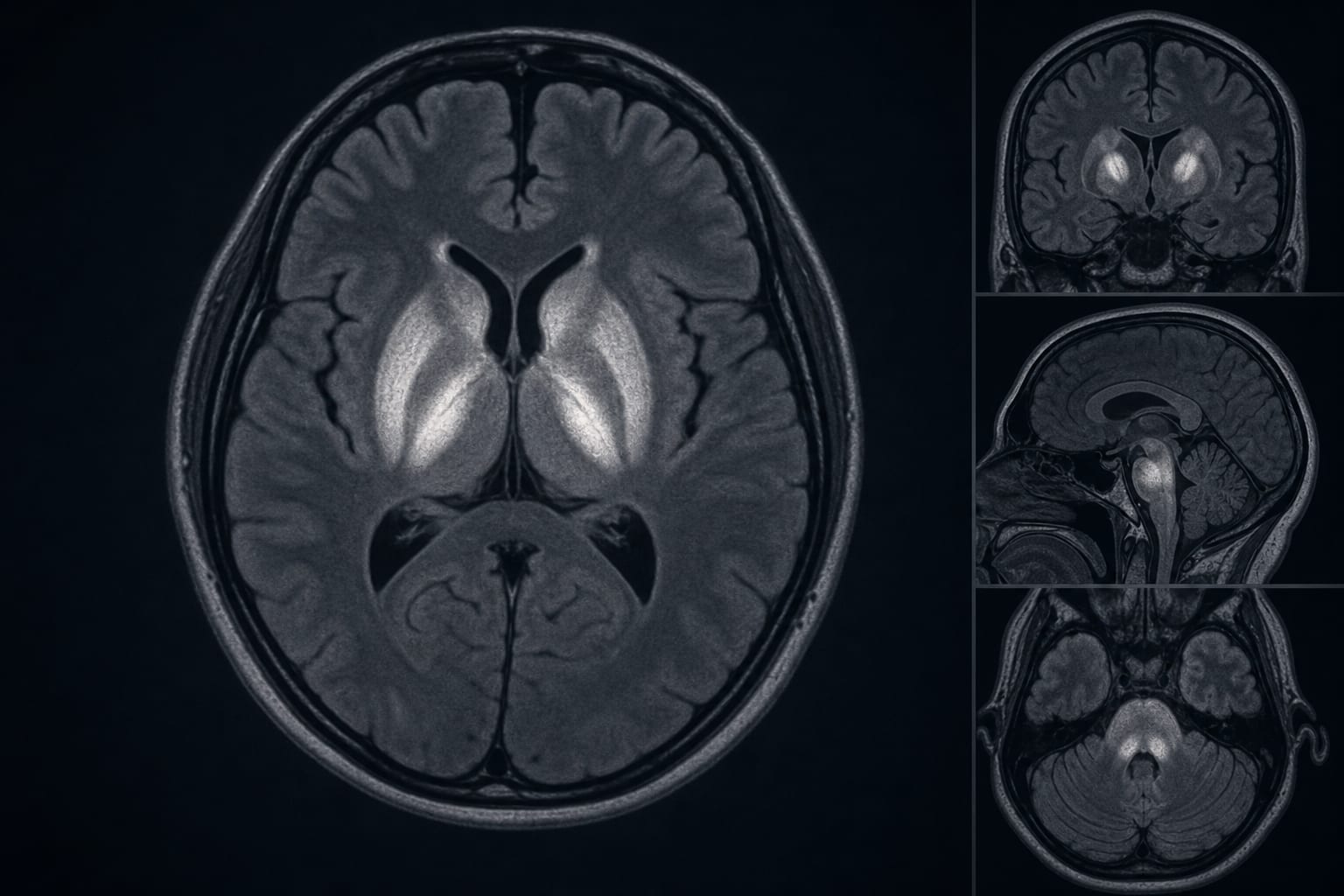
Clinical Report: Acute Coma Associated with Bilateral Basal Ganglia Abnormalities

Background

Acute severe encephalopathy with bilateral basal ganglia abnormalities presents a diagnostic challenge for clinicians. Identifying the underlying cause is crucial for appropriate management and prognosis. Disulfiram neurotoxicity is a rare complication related to oxidative stress induced by disulfiram metabolites, predominantly affecting metabolically active dopaminergic structures.

Data Highlights

No numerical data available in the source material.

Key Findings

  • Acute encephalopathy with bilateral basal ganglia abnormalities can result from various conditions including hypoxic-ischemic injury and disulfiram neurotoxicity.
  • Brain MRI may reveal characteristic patterns suggestive of disulfiram toxicity, particularly in patients with chronic exposure.
  • Disulfiram neurotoxicity primarily affects dopaminergic structures.
  • Withdrawal of disulfiram does not guarantee recovery, as severe cases can result in long-term neurological deficits.
  • Symmetric deep gray nuclei involvement should prompt consideration of disulfiram toxicity in unexplained encephalopathy.

Clinical Implications

Clinicians should consider disulfiram neurotoxicity in patients presenting with acute encephalopathy and characteristic MRI findings.

Conclusion

Disulfiram neurotoxicity is a consideration in the differential diagnosis of acute coma with bilateral basal ganglia abnormalities.

Related Resources & Content

  1. Intensive Care Medicine (Springer), 2026 -- Stepwise clinical and diagnostic strategy for coma of unknown origin
  2. Intensive Care Medicine, 2007 -- Full Recovery Following an Atypical Etiology of Coma
  3. Frontiers in Neurology -- Morphological and electroencephalographic correlates in patients with disorders of consciousness following primary brainstem hemorrhage: a retrospective analysis
  4. Neuroprognostication after cardiac arrest
  5. Frontiers in Neurology — Disrupted basal forebrain-cortical connectivity in amnestic mild cognitive impairment: unveiling circuit-level links to cognitive decline
  6. Neuroprognostication after cardiac arrest
  7. Pallidoreticular Wallerian Degeneration After Acute Carbon Monoxide Intoxication | Neurology
  8. Autoimmune encephalitis | Nature Reviews Disease Primers

Original Source(s)

Related Content