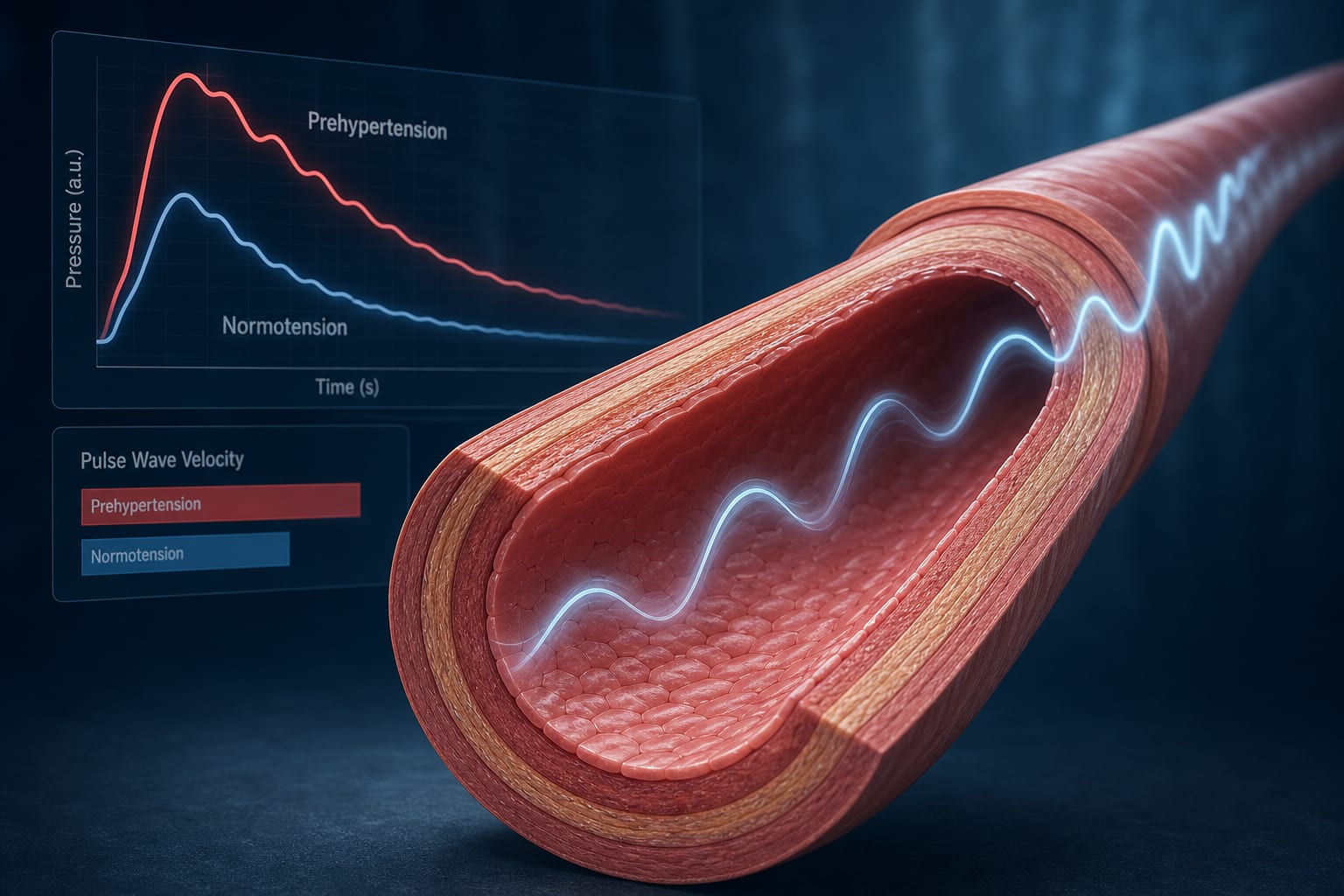
Prehypertension in Young Active Adults: Initial Vascular Changes and Their Impact on Exercise Intensity Recommendations
-
By
-
Gašper Turnšek
-
Simon Iskra
-
Armin Huso Paravlić
-
June 29, 2026
Prehypertension in Young Active Adults: Initial Vascular Changes
Overview
This study investigates early vascular changes in young, physically active adults with prehypertension and evaluates the accuracy of exercise intensity prescription methods.
Background
Prehypertension is a significant precursor to cardiovascular disease. Understanding its impact on young, active adults is important, as early vascular dysfunction can lead to health risks.
Data Highlights
| Parameter | Normotensive (n=26) | Prehypertensive (n=25) |
|---|---|---|
| Aortic Pulse Pressure | Lower | Higher (p < 0.001) |
| Carotid–Femoral Pulse Wave Velocity | Lower | Higher (p < 0.001) |
| Maximal Oxygen Uptake | Comparable | Comparable (p > 0.05) |
Key Findings
- Prehypertensive individuals showed higher aortic pulse pressure and carotid–femoral pulse wave velocity (both p < 0.001).
- Aerobic capacity and ventilatory thresholds were comparable between normotensive and prehypertensive groups (all p > 0.05).
- Fixed relative intensity anchors had limited accuracy in estimating exercise-intensity domains, particularly at the first ventilatory threshold (VT1).
- Population-derived % anchors had the lowest estimation error at VT1, while %HRmax anchors showed the best agreement at VT2.
- Prehypertension is associated with early central vascular alterations.
Clinical Implications
The findings indicate vascular changes associated with prehypertension in young adults, even when aerobic capacity appears normal.
Conclusion
Prehypertension in young, active adults is linked to early vascular changes.
Related Resources & Content
- European Journal of Preventive Cardiology, 2023 -- Exercise-Induced Blood Pressure Variations in Men and Women Across Different Ages and Fitness Levels
- Clinical Research in Cardiology, 2025 -- Emerging Trends and Obstacles in Sports Cardiology: The Relationship Between Blood Pressure Responses and Aortic Changes in Athletes
- Clinical Research in Cardiology, 2024 -- Relationship Between Aortic Root Size and Vascular Function in Elite Athletes with Enhanced Blood Pressure Response During Exercise
- 2025 High Blood Pressure (BP) Guideline - Professional Heart Daily | American Heart Association
- 2023 ESH Hypertension Guideline Update: Bringing Us Closer Together Across the Pond - American College of Cardiology
- Pediatric Cardiology — Early Life Cardiovascular Stress Response as an Indicator of Future Heart Health: Insights from Pediatric Population Studies—A Narrative Review
- 2025 High Blood Pressure (BP) Guideline - Professional Heart Daily | American Heart Association
- 2023 ESH Hypertension Guideline Update: Bringing Us Closer Together Across the Pond - American College of Cardiology
- Arterial stiffness and biochemical profiles in prehypertensive, normotensive, and controlled hypertensive individuals: a cross-sectional study
- 20-HETE, Blood Pressure, and Vascular Stiffness in Young Adults - PubMed
- Interactions of chronic stress exposure and stress appraisal on vascular endothelial function among young adults | Journal of Applied Physiology | American Physiological Society
- Flow-mediated dilation is modified by exercise training status during childhood and adolescence: preliminary evidence of the youth athlete’s artery | American Journal of Physiology-Heart and Circulatory Physiology | American Physiological Society
- Effects of different exercise modalities on blood pressure and endothelial function in prehypertension individuals: a systematic review and network meta-analysis - PMC
- Effect of exercise on endothelial function in prehypertensive and hypertensive individuals: A network meta-analysis of randomised controlled trials: Journal of Sports Sciences: Vol 43, No 21
- Frontiers | Effects of high-intensity interval exercise on arterial stiffness in individuals at risk for cardiovascular disease: a meta-analysis
Based on findings from:
Prehypertension in young physically active adults: early vascular alterations and implications for exercise-intensity prescription
Gašper Turnšek, Simon Iskra, Armin Huso Paravlić. Frontiers In Cardiovascular Medicine, 2026.
https://www.frontiersin.org/journals/cardiovascular-medicine/articles/10.3389/fcvm.2026.1853384/full
This content is an AI-generated, fully rewritten summary based on a published scholarly article. It does not reproduce the original text and is not a substitute for the original publication. Readers are encouraged to consult the source for full context, data, and methodology.