Meta-analysis of the predictive value of critical care echocardiography for weaning outcomes in patients with VA-ECMO-assisted cardiogenic shock - Report - MDSpire

Meta-analysis of the predictive value of critical care echocardiography for weaning outcomes in patients with VA-ECMO-assisted cardiogenic shock

  • By

  • Miao Niu

  • Yongshun Feng

  • June 25, 2026

  • 0 min

Share

Clinical Report: Critical Care Echocardiography in VA-ECMO Weaning Success

Overview

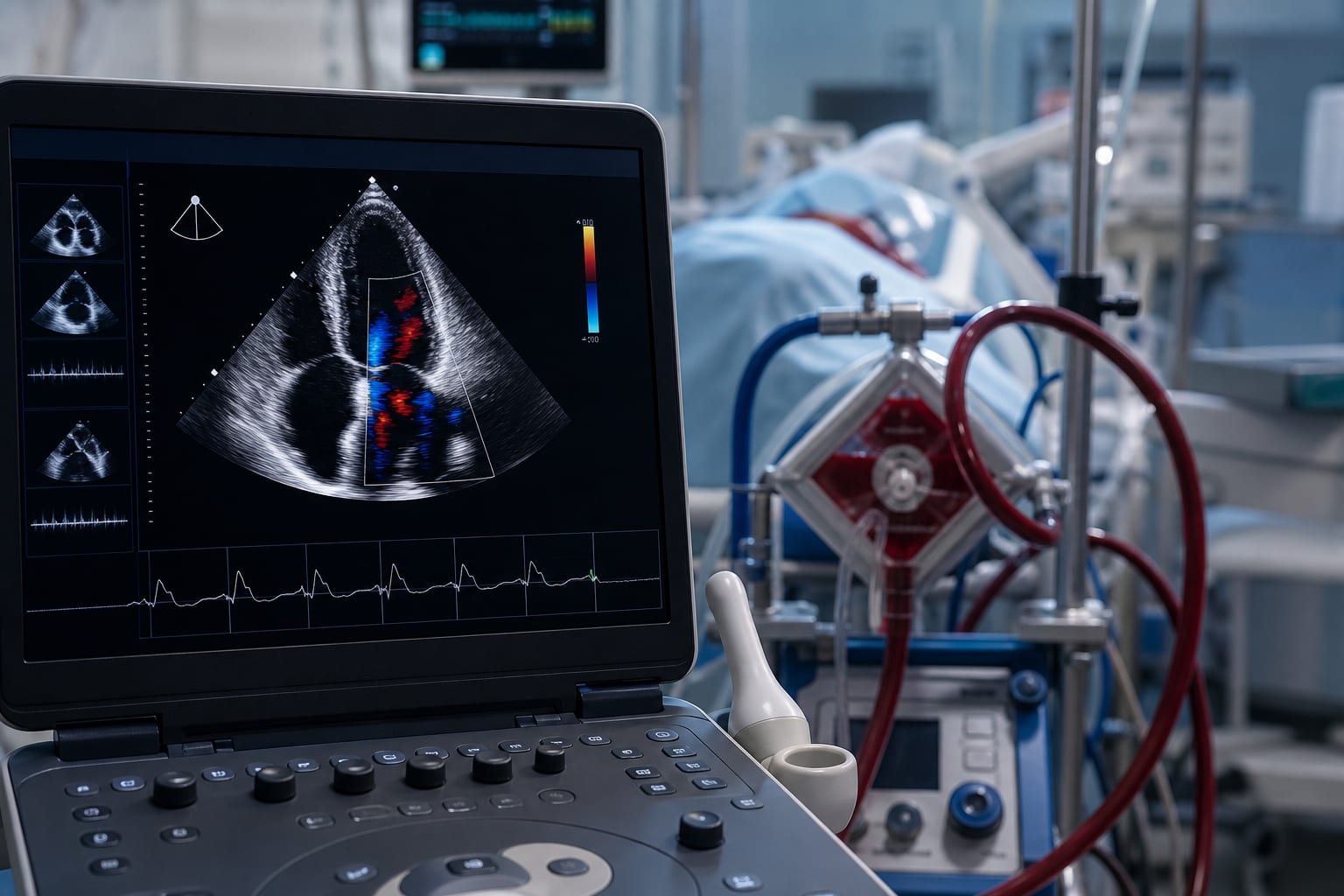
This systematic review evaluates the predictive value of echocardiographic parameters for weaning outcomes in patients undergoing VA-ECMO for cardiogenic shock. Key findings indicate that aortic valve opening status and left ventricular outflow tract velocity-time integral are among the most discriminative echocardiographic measures for predicting successful weaning.

Background

Cardiogenic shock is a critical condition characterized by severe cardiac dysfunction and high mortality rates. Venoarterial extracorporeal membrane oxygenation (VA-ECMO) serves as a vital support mechanism for patients with refractory cardiogenic shock.

Data Highlights

Echocardiographic ParameterAUC (95% CI)
Aortic Valve Opening Status0.88 (0.82–0.93)
Left Ventricular Outflow Tract Velocity-Time Integral0.85 (0.81–0.88)
Tissue Doppler-Derived Mitral Annular Systolic Velocity0.81 (0.76–0.86)
Left Ventricular Ejection Fraction0.79 (0.75–0.83)

Key Findings

  • Aortic valve opening status has the highest discriminative ability for predicting VA-ECMO weaning success (AUC = 0.88).
  • Left ventricular outflow tract velocity-time integral also shows strong predictive value (AUC = 0.85).
  • Tissue Doppler-derived mitral annular systolic velocity has moderate predictive accuracy (AUC = 0.81).
  • Left ventricular ejection fraction is a commonly used parameter with an AUC of 0.79.

Clinical Implications

Critical care echocardiography can provide insights into the likelihood of successful weaning from VA-ECMO.

Conclusion

This meta-analysis highlights the importance of echocardiographic parameters in predicting weaning success from VA-ECMO.

Related Resources & Content

  1. Critical Care (Springer), 2026 -- Performance of prognostic scores for patients with cardiogenic shock supported With VA-ECMO
  2. Intensive Care Medicine, 2024 -- Exploring the Role of Routine Venoarterial Extracorporeal Membrane Oxygenation in Cardiogenic Shock Due to Acute Myocardial Infarction: Current Insights and Knowledge Gaps
  3. Clinical Research in Cardiology, 2023 -- Impact of Combined VAV-ECMO, Impella CP, and Impella RP on Hemodynamics
  4. Frontiers, 2026 -- Meta-analysis of the predictive value of critical care echocardiography for weaning outcomes in patients with VA-ECMO-assisted cardiogenic shock
  5. Critical Care (Springer) — Machine learning models for predicting limb ischemia during VA-ECMO: an analysis of the Chinese extracorporeal life support registry
  6. 2025 ACC/AHA/ACEP/NAEMSP/SCAI Guideline for the Management of Patients With Acute Coronary Syndromes
  7. Frontiers | Meta-analysis of the predictive value of critical care echocardiography for weaning outcomes in patients with VA-ECMO-assisted cardiogenic shock
  8. https://www.biomedsimulation.com/wp-content/uploads/2025/04/ELSO_Adult_Cardiac_VA_ECMO_Guidelines_2021.pdf

Original Source(s)

Related Content