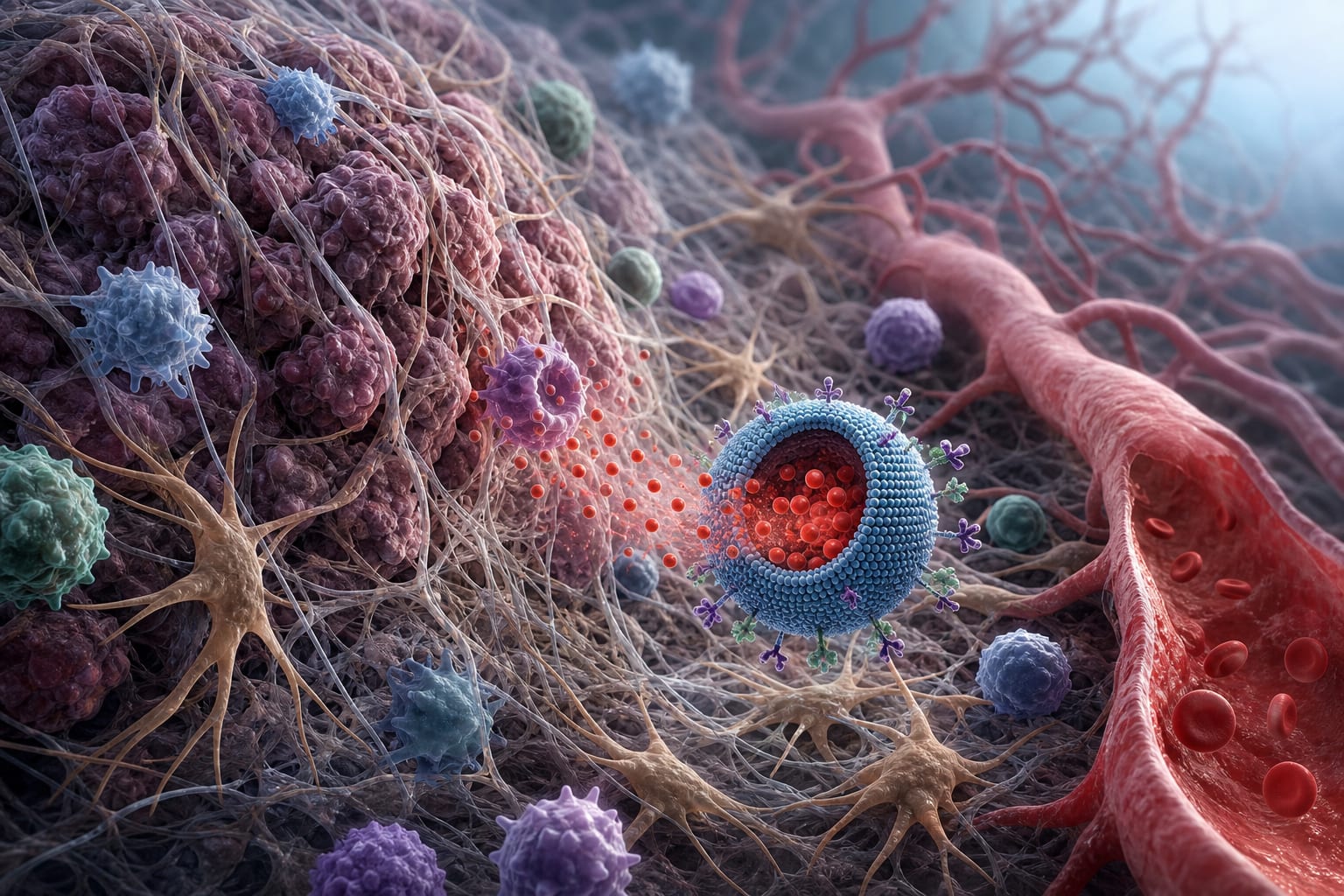
Tumor microenvironment conversion through intelligent nanomedicine: a paradigm shift in overcoming chemoresistance - Report - MDSpire

Tumor microenvironment conversion through intelligent nanomedicine: a paradigm shift in overcoming chemoresistance

  • By

  • Maliheh Hasannia

  • Mahdi Abounoori

  • Fatemeh Mahmoudian

  • Maryam Shirzad

  • Abbas Rahdar

  • Selamu Duguna

  • Sadanand Pandey

  • June 17, 2026

  • 0 min

Share

Clinical Report: Transforming the Tumor Microenvironment with Advanced Nanomedicine

Overview

This report discusses the role of the tumor microenvironment (TME) in chemoresistance and highlights how advanced nanomedicine can transform the TME to enhance therapeutic efficacy. Intelligent nanomedicine offers a promising approach to overcome barriers associated with conventional chemotherapy.

Background

Detail the mechanisms of chemoresistance, such as immune suppression and ECM composition.

Data Highlights

No numerical data provided in the article.

Key Findings

  • The TME plays a critical role in driving chemoresistance through complex biological barriers.
  • Intelligent nanomedicine can respond to stimuli such as pH and hypoxia for targeted drug delivery.
  • Stimuli-responsive nanocarriers enhance drug accumulation and penetration within tumors.
  • Advanced nanomedicine can actively remodel the TME, promoting immunomodulation and vascular normalization.
  • Multifunctional nanosystems can reverse chemoresistance by reprogramming the tumor environment.

Clinical Implications

Clinicians should consider the potential of intelligent nanomedicine in overcoming chemoresistance in cancer patients. By targeting the TME, these advanced therapies may improve drug delivery and enhance treatment efficacy while minimizing systemic toxicity.

Conclusion

Transforming the TME through advanced nanomedicine represents a significant advancement in cancer treatment strategies. This approach holds promise for improving therapeutic outcomes in patients facing chemoresistance.

Related Resources & Content

  1. Frontiers in Immunology, 2026 -- Overcoming chemoresistance in esophageal cancer with synergistic strategies
  2. The ASCO Post, 2024 -- Preclinical Study Examines Novel Pancreatic Cancer Treatment
  3. Frontiers in Immunology, 2026 -- Immune–tumor cell ligand–receptor axes driving metabolic reprogramming and therapeutic resistance in cancer
  4. Frontiers in Oncology, 2026 -- Application and Challenges of Smart Responsive Multifunctional Nanoplatforms in Integrated Diagnosis and Treatment of Bladder Cancer and Overcoming Therapeutic Resistance
  5. FDA -- FDA approves irinotecan liposome for first-line treatment of metastatic pancreatic adenocarcinoma
  6. ESMO Clinical Practice Guideline Express Update on the management of epithelial ovarian cancer - PMC
  7. Randomized Phase III Trial of Pegvorhyaluronidase Alfa With Nab-Paclitaxel Plus Gemcitabine for Patients With Hyaluronan-High Metastatic Pancreatic Adenocarcinoma - PMC
  8. FDA approves irinotecan liposome for first-line treatment of metastatic pancreatic adenocarcinoma | FDA
  9. ESMO Clinical Practice Guideline Express Update on the management of epithelial ovarian cancer - PMC
  10. Randomized Phase III Trial of Pegvorhyaluronidase Alfa With Nab-Paclitaxel Plus Gemcitabine for Patients With Hyaluronan-High Metastatic Pancreatic Adenocarcinoma - PMC

Original Source(s)

Related Content