Comparison of ultrasound-guided percutaneous radiofrequency ablation and reoperation for nerve-adjacent cervical lymph node recurrence of papillary thyroid carcinoma: a propensity score–matched study - Report - MDSpire
Advertisement
Comparison of ultrasound-guided percutaneous radiofrequency ablation and reoperation for nerve-adjacent cervical lymph node recurrence of papillary thyroid carcinoma: a propensity score–matched study
Clinical Report: Evaluation of RFA Versus Surgical Reoperation for R-PTC-SCLNM
Overview
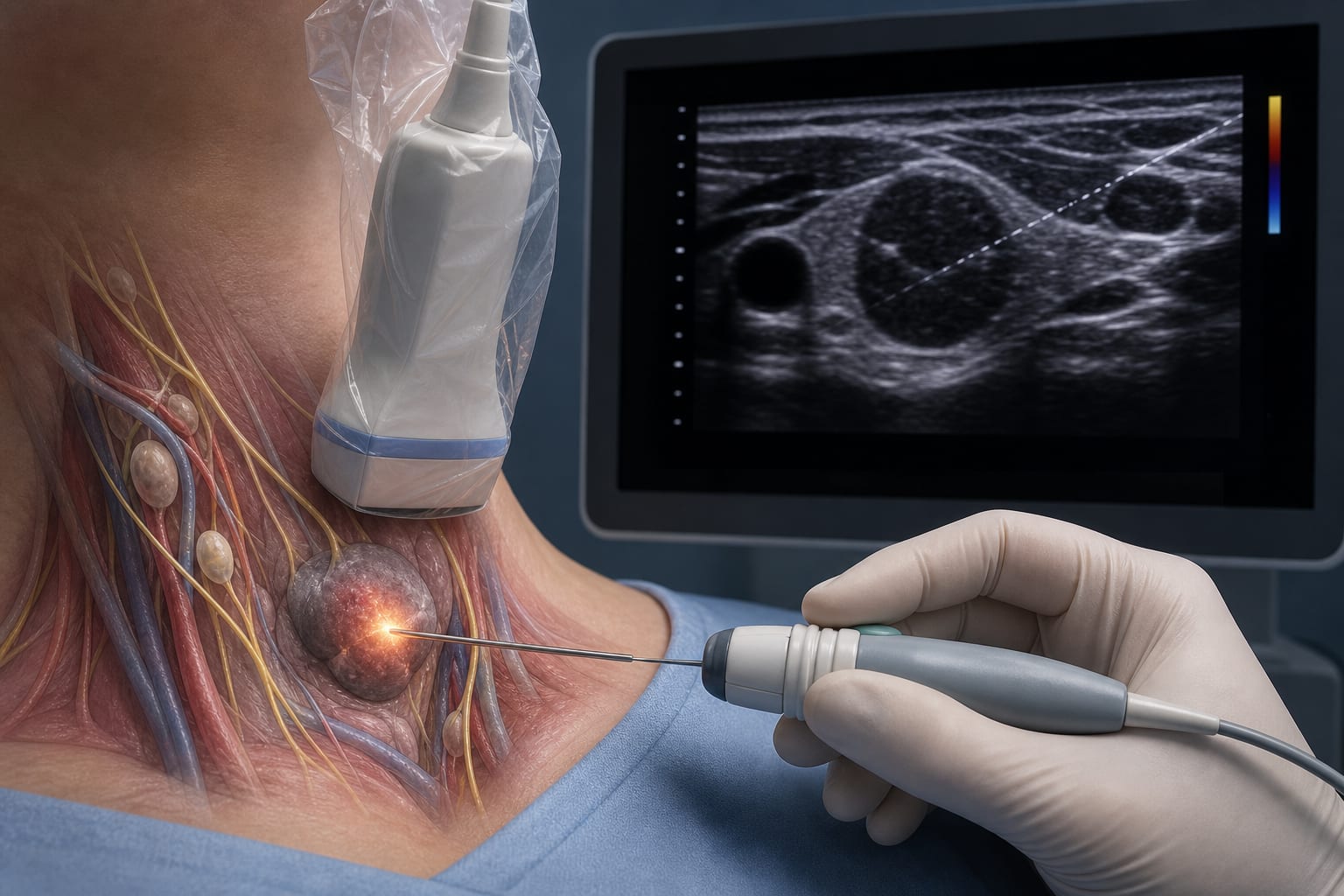
This study compares the efficacy and safety of ultrasound-guided percutaneous radiofrequency ablation (RFA) and surgical reoperation (RO) for recurrent papillary thyroid carcinoma in proximal cervical lymph nodes. RFA demonstrated lower complication rates and shorter recovery times compared to RO, suggesting it as a viable treatment option for selected patients.
Background
Recurrent papillary thyroid carcinoma (PTC) often presents as solitary cervical lymph node metastasis, particularly in challenging anatomical regions like perineural areas. Traditional surgical reoperation carries significant risks, including nerve injury and postoperative complications. The emergence of minimally invasive techniques like RFA offers potential benefits in terms of safety and recovery, warranting comparative evaluation.
RFA resulted in a mean VRR of 0.97 ± 0.04 at 24 months.
42.3% of lymph nodes in the RFA group completely disappeared.
Overall complication rates were significantly lower in the RFA group (P<0.001).
RFA had shorter procedure times and hospital stays compared to RO (all P<0.001).
The safety advantage of RFA was most pronounced in Type II lesions.
Clinical Implications
RFA presents a minimally invasive alternative to surgical reoperation for patients with recurrent PTC in perineural regions, offering reduced complication rates and faster recovery. Clinicians should consider RFA for patients who are at high surgical risk or prefer less invasive options.
Conclusion
RFA demonstrates comparable local control with enhanced safety and recovery profiles for recurrent PTC in selected patients, positioning it as a promising alternative to traditional surgical approaches.