Prognostic model for three-year postoperative local recurrence in cutaneous squamous cell carcinoma: a Chinese multicenter cohort study - Report - MDSpire
Conexiant’s news site is now MDSpire News. Learn more
Advertisement
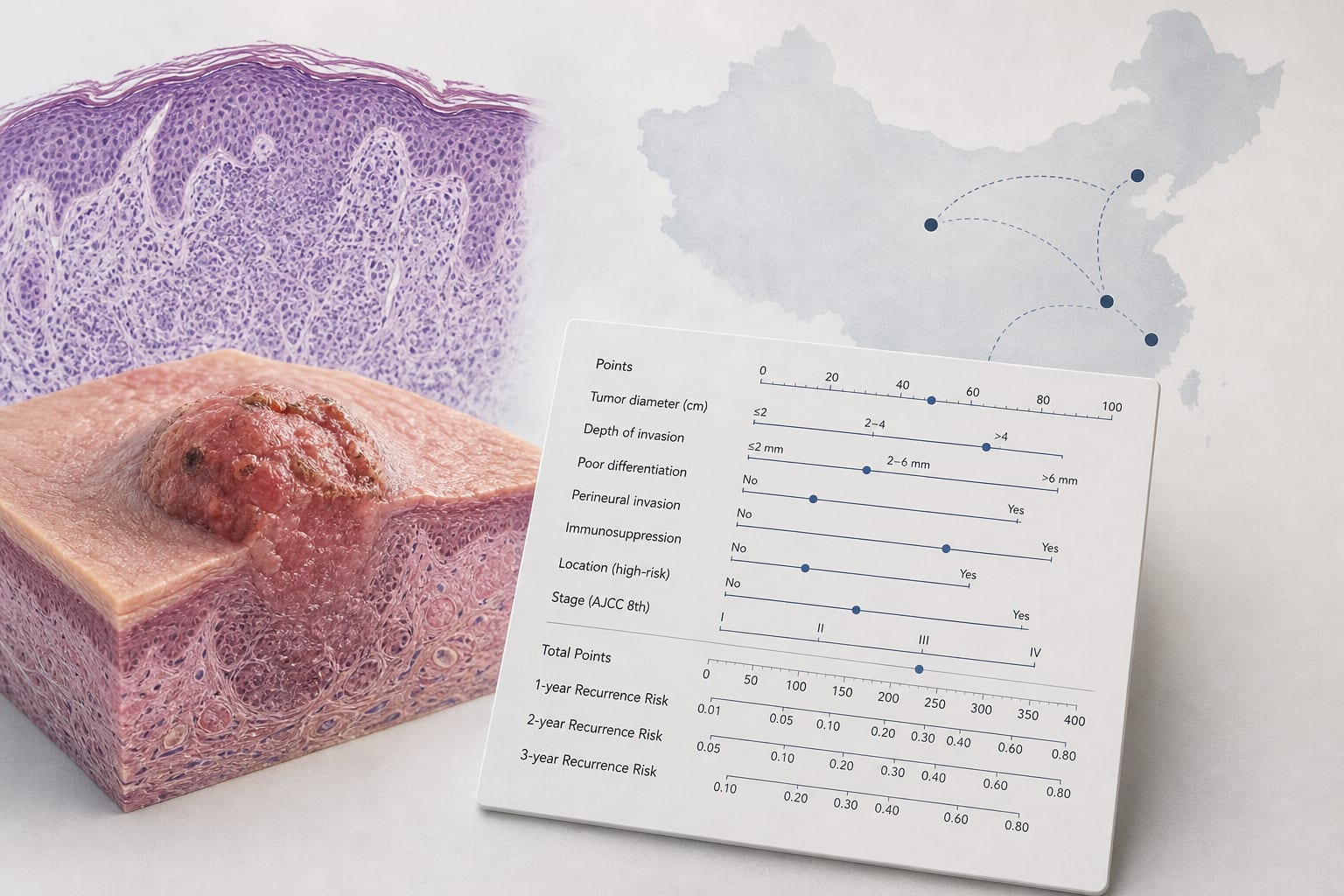
Development of a Prognostic Nomogram for Three-Year Local Recurrence Risk in Cutaneous Squamous Cell Carcinoma: Findings from a Multicenter Study in China
Clinical Report: Prognostic Nomogram for Local Recurrence in cSCC
Overview
This study developed a nomogram to predict the three-year local recurrence risk in cutaneous squamous cell carcinoma (cSCC) patients based on independent risk factors. The model demonstrated good discrimination and clinical utility, aiding in individualized patient management.
Background
Cutaneous squamous cell carcinoma (cSCC) is a prevalent skin cancer with a significant risk of local recurrence post-surgery, particularly within the first three years. Accurate prognostic tools are essential for stratifying patients based on their recurrence risk, especially in Asian populations where existing models are limited. This study addresses the need for tailored prognostic assessments to improve clinical decision-making and patient outcomes.
Data Highlights
Risk Factors
Hazard Ratio
Age
1.05
Tumor Size
1.03
Tumor Thickness
1.04
Histologic Differentiation
1.62
Regional Stage
1.78
AJCC Stage
1.45
Key Findings
Identified independent predictors of local recurrence: age, tumor size, tumor thickness, histologic differentiation, regional stage, and AJCC stage.
The nomogram stratified patients into low-risk, intermediate-risk, and high-risk groups based on total scores.
Significant differences in recurrence-free survival were observed among the risk groups (log-rank p < 0.0001).
The model showed good discrimination with AUC values ranging from 0.759 to 0.869.
Strong calibration and favorable clinical utility were demonstrated in decision curve analysis.
Clinical Implications
The developed nomogram offers a practical tool for clinicians to assess individual recurrence risks in cSCC patients, facilitating tailored follow-up and surveillance strategies. By identifying high-risk patients, healthcare providers can optimize management and improve patient outcomes.
Conclusion
The nomogram serves as a valuable resource for personalized prognostic assessment in cSCC, potentially enhancing clinical decision-making and patient care. Further validation in diverse populations is warranted to confirm its applicability.
An updated clinical practice guideline from the American Society for Radiation Oncology substantially expands and modernizes recommendations for the use of radiation therapy in pancreatic cancer.