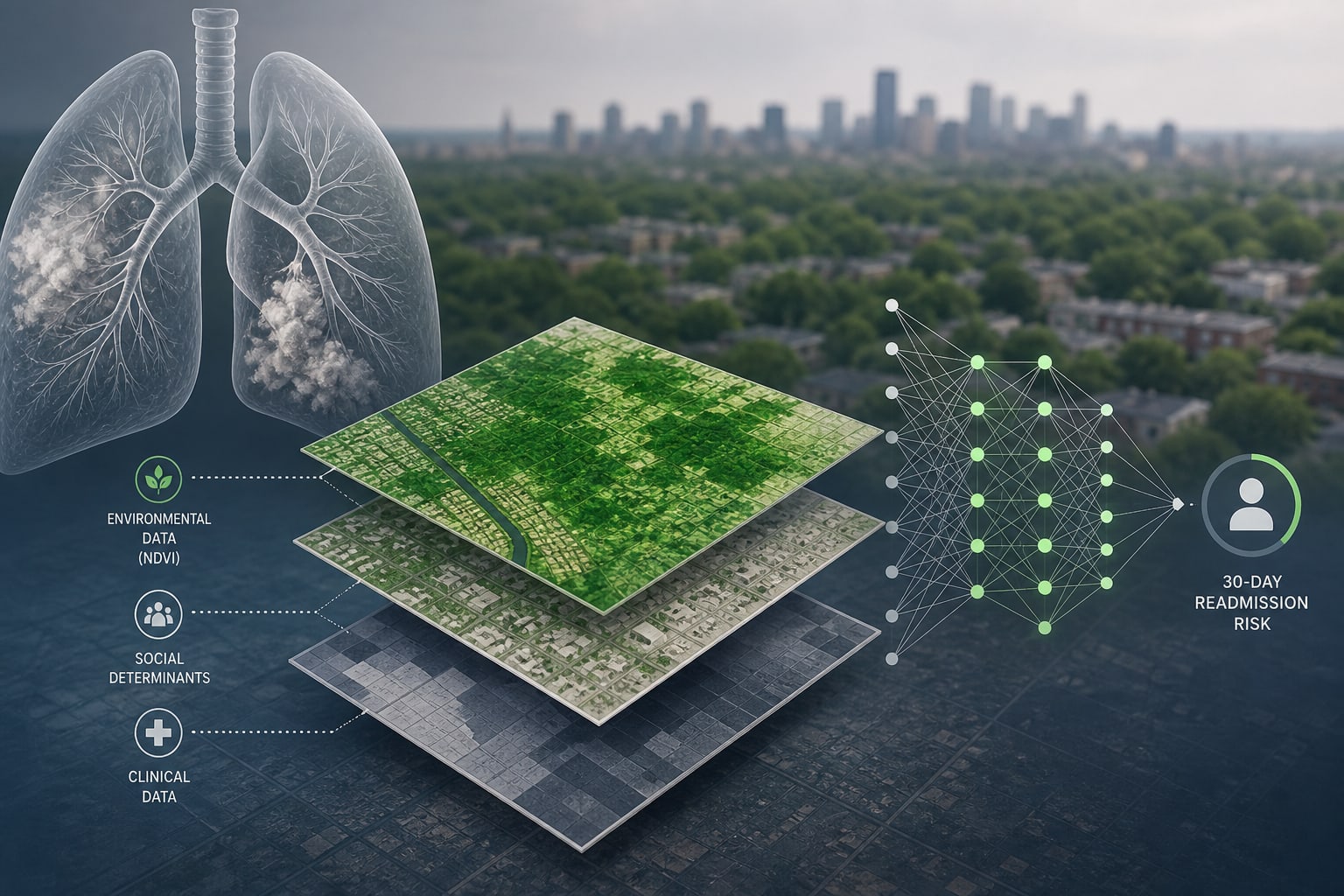
Incorporating Environmental and Social Factors Improves Machine Learning Predictions for Pneumonia Readmissions
-
By
-
Jack A. Cummins
-
Feifan Liu
-
June 15, 2026
Clinical Report: Incorporating Environmental and Social Factors Improves Machine Learning Predictions for Pneumonia Readmissions
Overview
Enhance the explanation of NDVI's role in improving predictive accuracy for pneumonia readmissions.
Background
Pneumonia readmissions pose significant challenges in healthcare, impacting patient outcomes and healthcare costs. Traditional predictive models often rely solely on electronic health records, which may overlook critical environmental and social determinants of health. Incorporating factors like residential greenness could improve model performance and address health disparities.
Data Highlights
No numerical data provided in the source material.
Key Findings
- NDVI was included among the final 21 predictors in a cohort of 22,600 patients.
- The study utilized a three-step feature selection pipeline to validate the inclusion of NDVI.
- Permutation importance analysis indicated the relative importance of NDVI in the model's decision-making process.
- Future research should explore the equity dimension of NDVI integration in predictive models.
- Ablation analysis could provide insights into the performance gain from NDVI integration.
Clinical Implications
Healthcare professionals should consider environmental factors like NDVI when developing predictive models for pneumonia readmissions. This approach may enhance model accuracy and contribute to reducing health disparities among different socioeconomic groups.
Conclusion
Integrating environmental and social factors into predictive models represents a promising advancement in healthcare analytics. Future research should focus on evaluating the impact of these factors on model performance across diverse populations.
Related Resources & Content
- Choi et al., Frontiers in Neurology, 2023 -- Incorporating Environmental and Social Factors Improves Machine Learning Predictions for Pneumonia Readmissions
- Development and validation of a machine learning model for predicting stroke-associated pneumonia in older patients with acute ischemic stroke, Frontiers in Neurology, 2026
- Identification of clinical phenotypes and prediction model for the mixed-infection phenotype of pediatric community-acquired pneumonia based on unsupervised machine learning, Frontiers in Pediatrics, 2026
- Synthetic data boosts readmission prediction, AACE Endocrine AI, 2026
- Critical Care (Springer) — Deep learning models for ICU readmission prediction: a systematic review and meta-analysis
- Community-Acquired Pneumonia in Adults - IDSA Guidelines
- Hydrocortisone in Severe Community-Acquired Pneumonia, NEJM
- TRIPOD+AI statement: updated guidance for reporting clinical prediction models, The BMJ
Based on findings from:
Environmental and social determinants of health enhance machine learning models for pneumonia readmission
Jack A. Cummins, Feifan Liu. Digital Health, 2026.
https://journals.sagepub.com/doi/10.1177/20552076261461355
This content is an AI-generated, fully rewritten summary based on a published scholarly article. It does not reproduce the original text and is not a substitute for the original publication. Readers are encouraged to consult the source for full context, data, and methodology.