Serum CA19.9 for Detecting High-Grade Dysplasia and Invasive Carcinoma in Patients With Intraductal Papillary - Report - MDSpire

Serum CA19.9 for Detecting High-Grade Dysplasia and Invasive Carcinoma in Patients With Intraductal Papillary

  • By

  • Charlotte A. Leseman

  • Alessandro M. Bonomi

  • Job Schuitema

  • Stefano Granieri

  • Margaret Sällberg Chen

  • Ajay V. Maker

  • Zeeshan Ateeb

  • Laura D. Wood

  • Rogier P. Voermans

  • Giovanni Marchegiani

  • Marco Del Chiaro

  • Johannes C. F. Ket

  • Anne Marie Lennon

  • Marc G. Besselink

  • Global Evidence-Based Guidelines for the Management of Pancreatic Cystic Neoplasms Group

  • June 26, 2026

  • 0 min

Share

Clinical Report: Evaluating Serum CA19.9 Levels for Identifying High-Grade Dysplasia

Overview

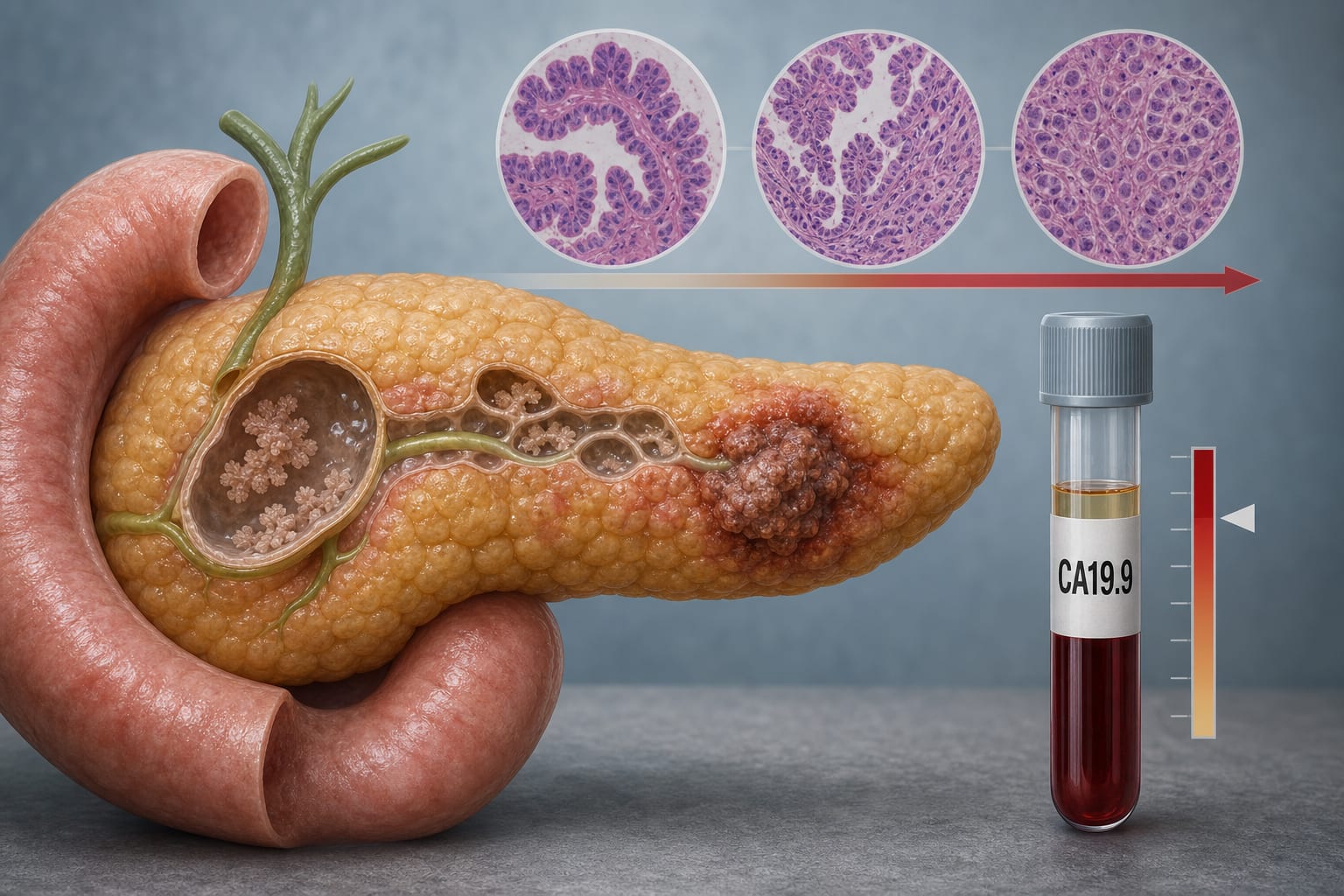
This meta-analysis evaluates the diagnostic accuracy of serum CA19.9 levels in identifying high-grade dysplasia (HGD) and invasive carcinoma (IC) in patients with intraductal papillary neoplasms (IPMN).

Background

Intraductal papillary mucinous neoplasm (IPMN) is a precursor to invasive carcinoma and a risk factor for pancreatic ductal adenocarcinoma (PDAC). Accurate identification of IPMN with HGD or IC is crucial for timely surgical intervention. Current guidelines suggest elevated serum CA19.9 levels (≥37 U/mL) as a marker for surgical consideration, but its reliability remains debated.

Data Highlights

No specific numerical data provided in the source material.

Key Findings

  • Serum CA19.9 levels ≥37 U/mL are considered a relative indication for surgery according to European guidelines.
  • The Kyoto guidelines classify elevated CA19.9 levels as a worrisome feature during diagnostic workup.
  • The role of CA19.9 in IPMN diagnosis is complicated by the biological heterogeneity of the lesions.
  • Current recommendations for CA19.9 use are primarily based on retrospective studies.
  • The study protocol was registered with PROSPERO and adheres to PRISMA-DTA guidelines.

Clinical Implications

The findings suggest that while serum CA19.9 is a commonly used tumor marker, its diagnostic accuracy for HGD and IC in IPMN may require further validation. Clinicians should consider the biological variability of IPMN when interpreting CA19.9 levels.

Conclusion

This meta-analysis evaluates the diagnostic utility of CA19.9 in IPMN.

Related Resources & Content

  1. Journal of Gastroenterology, 2023 -- Long-term Monitoring of Intraductal Papillary Mucinous Neoplasms and Their Progression to Pancreatic Carcinomas: Insights from a Prospective Study of 100 Cases
  2. Journal of Gastroenterology, 2022 -- Variability in Metabolic Adaptation Influences Prognostic Outcomes in Pancreatic Ductal Adenocarcinoma
  3. Journal of Gastroenterology, 2024 -- Patterns of Pancreatic Atrophy and Their Correlation with Intraductal Spread in Early Pancreatic Ductal Adenocarcinoma: A Retrospective Multicenter Analysis
  4. The ASCO Post — Appendiceal Cancer: Serum Tumor Marker Levels May Guide Treatment in Patients Undergoing Cytoreductive Surgery
  5. 2024 International Association of Pancreatology Guidelines
  6. Application of the 2024 International Association of Pancreatology Guidelines for Identifying (Pre)Malignancy Among Presumed Intraductal Papillary Mucinous Neoplasms via CT and MRI
  7. Preview
  8. Serum carbohydrate antigen 19-9 greater than 100 and risk of invasive carcinoma in pancreatic intraductal papillary mucinous neoplasms: Worrisome feature or high-risk stigmata? - PubMed
  9. Serum carcinoembryonic antigen and carbohydrate antigen 19-9 for prediction of malignancy and invasiveness in intraductal papillary mucinous neoplasms of the pancreas: A meta-analysis - PMC
  10. Frontiers | Emerging horizons on molecular and circulating biomarkers in pancreatic adenocarcinoma
  11. Liquid biopsy and biomarkers in pancreatic ductal adenocarcinoma: from concept to clinical translation—a narrative review - Allaham - Annals of Pancreatic Cancer
  12. Endoscopic Ultrasound-Guided Pancreatic Cystic Fluid Biochemical and Genetic Analysis for the Differentiation Between Mucinous and Non-Mucinous Pancreatic Cystic Lesions

Original Source(s)

Related Content