A self-perpetuating neuron-intrinsic GSDMD–mtDNA–AIM2 inflammasome axis drives neuronal pyroptosis and cognitive impairment after traumatic brain injury - Report - MDSpire

A self-perpetuating neuron-intrinsic GSDMD–mtDNA–AIM2 inflammasome axis drives neuronal pyroptosis and cognitive impairment after traumatic brain injury

  • By

  • Tian Li

  • Siyu Huang

  • Junjun Zhang

  • Xueer Liu

  • Lihong Zhu

  • Yue Li

  • Runmin Lin

  • Xiaoxuan Chen

  • Kangsheng Li

  • Weiqiang Chen

  • Jiangtao Sheng

  • June 19, 2026

  • 0 min

Share

Clinical Report: An Intrinsic Neuronal GSDMD–mtDNA–AIM2 Inflammasome Pathway

Overview

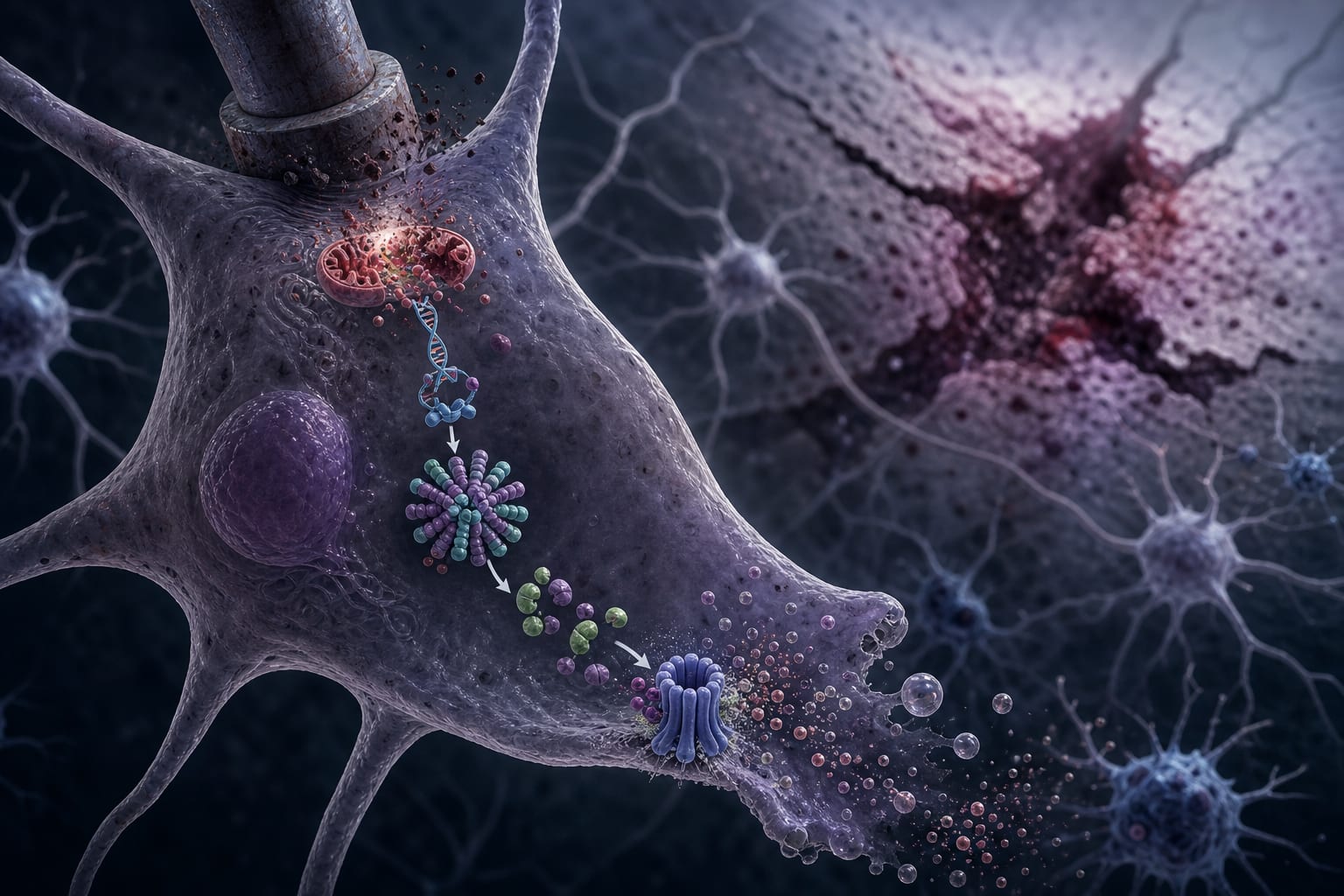
This study identifies a neuron-intrinsic GSDMD–mtDNA–AIM2 inflammasome pathway that promotes pyroptosis and cognitive decline following traumatic brain injury (TBI).

Background

Traumatic brain injury (TBI) is a significant cause of mortality and long-term disability, leading to acute neurological deficits and chronic cognitive impairment. Neuroinflammation is a critical factor in secondary damage following TBI, and understanding the underlying mechanisms is essential for developing effective treatments. The role of the AIM2 inflammasome in neurons post-TBI has not been well characterized, highlighting the need for further investigation.

Data Highlights

Time Post-InjuryOutcome
24 hAIM2 inflammasome activation in neurons
3–6 hRelease of mtDNA into cytosol
14 and 28 daysImproved cognitive performance with AIM2 knockdown

Key Findings

  • CCI induced AIM2 inflammasome activation in cortical and hippocampal neurons.
  • AIM2 knockdown reduced neuronal loss in the CA3 region and improved cognitive performance.
  • Mechanical injury led to early release of mtDNA, activating the AIM2 inflammasome.
  • GSDMD N-terminal fragments translocated to mitochondria, disrupting mitochondrial function.
  • Pharmacological inhibition of caspase-1 attenuated late-phase mtDNA release and neuronal damage.

Clinical Implications

Further research is needed to explore the role of the AIM2 inflammasome pathway in post-TBI neuroinflammation and cognitive decline.

Conclusion

The study elucidates a self-perpetuating GSDMD–mtDNA–AIM2 inflammasome axis that contributes to cognitive decline after TBI.

Related Resources & Content

  1. Frontiers in Immunology, 2026 -- A self-perpetuating neuron-intrinsic GSDMD–mtDNA–AIM2 inflammasome axis drives neuronal pyroptosis and cognitive impairment after traumatic brain injury
  2. Frontiers in Immunology — ANXA2 promotes NLRP3 inflammasome activation and neuronal pyroptosis after intracerebral hemorrhage
  3. Acta Neuropathologica — Tau Aggregation Promotes NLRP3–ASC Inflammasome Activation, Worsening Both Exogenously and Endogenously Induced Tau Pathology in Vivo
  4. Acta Neuropathologica — Tau Pathology in Neurons Exacerbates Late-Stage White Matter Degeneration Following Traumatic Brain Injury in Transgenic Mouse Models
  5. Acta Neuropathologica — Neuronal BAG3 Modulates Tau Hyperphosphorylation, Synaptic Impairment, and Cognitive Decline Following Traumatic Brain Injury Through Autophagy-Lysosome Pathway Regulation
  6. Best Practices Guidelines: The Management of Traumatic Brain Injury
  7. Action Collaborative on Traumatic Brain Injury Care: Adapted Clinical Practice Guideline - PMC
  8. Frontiers | A self-perpetuating neuron-intrinsic GSDMD–mtDNA–AIM2 inflammasome axis drives neuronal pyroptosis and cognitive impairment after traumatic brain injury

Original Source(s)

Related Content