Individualized physiological readiness over an admission-time denominator - a reply to comments on rapid sequence versus early surgical stabilization of severe chest wall injuries - Report - MDSpire
Coming Soon: Introducing MDSpire News. Learn more
Conexiant’s news site is now MDSpire News. Learn more

Tailored Physiological Readiness Based on Admission Timing - A Response to Discussions on Rapid Sequence Versus Early Surgical Stabilization for Severe Chest Wall Injuries

  • By

  • Christopher Spering

  • R. Lefering

  • W. Lehmann

  • S. Schulz-Drost

  • August 26, 2026

Share

Tailored Physiological Readiness Based on Admission Timing

Background

Severe chest wall injuries significantly impact patient outcomes following blunt trauma, with rib fractures being prevalent and associated with increased morbidity and mortality. Understanding the optimal timing for surgical stabilization is crucial for improving recovery and reducing complications.

Data Highlights

No numerical or trial data provided in the source material.

Key Findings

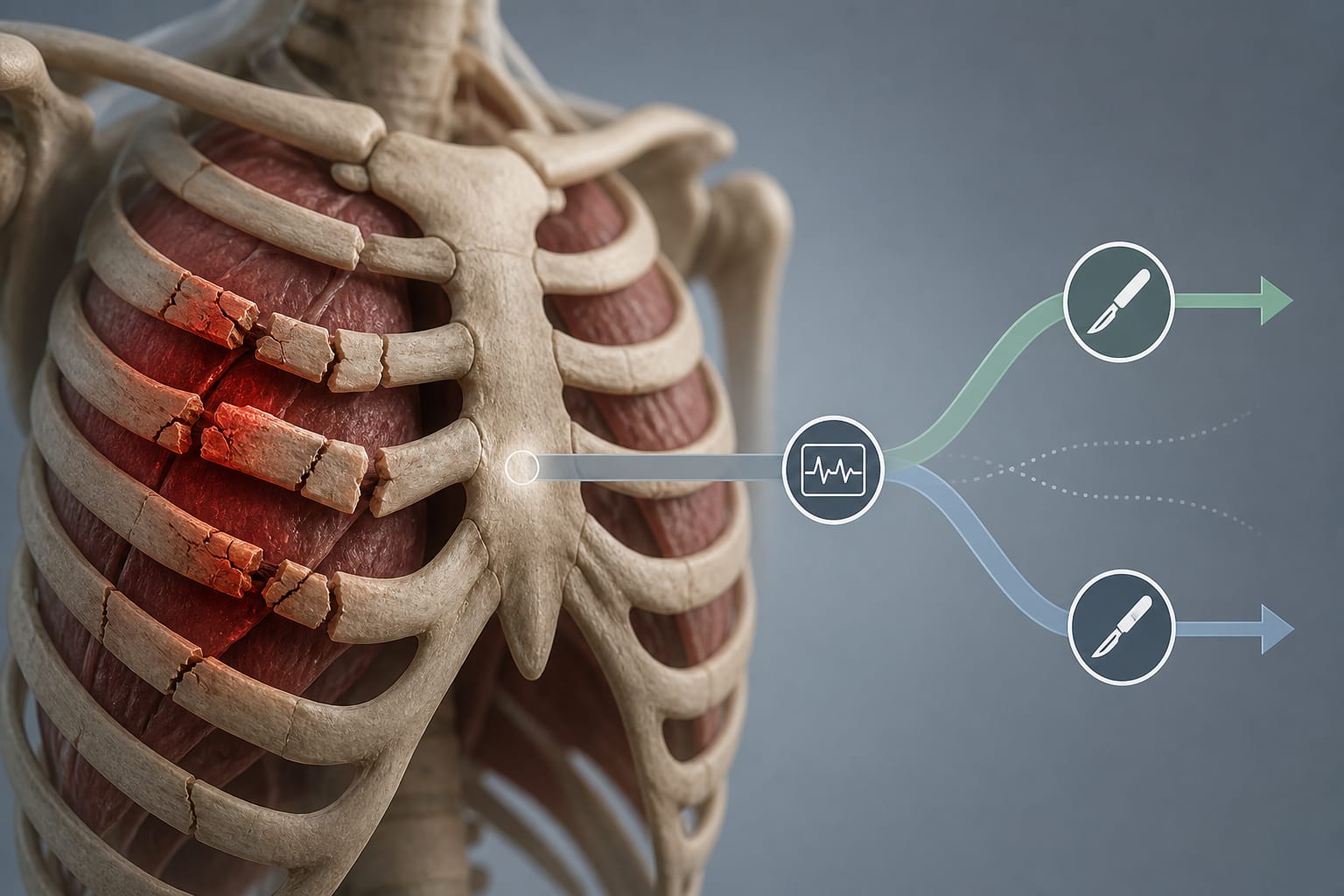
  • Day-0 CWR is often an adjunct to life-saving damage control, not a homogeneous strategy.
  • Survivorship bias exists, as patients undergoing delayed CWR must survive initial critical periods.
  • The TraumaRegister DGU® lacks specific data fields to define CWR eligibility and differentiate between rescue and planned stabilization.
  • Retrospective assessments of physiological readiness are complicated by registry limitations.
  • RISC III is intended for descriptive benchmarking rather than causal inference in treatment outcomes.

Clinical Implications

The findings suggest that surgical timing for chest wall injuries should be individualized based on patient stability and operative intent rather than strict adherence to temporal guidelines. Enhanced registry data collection could improve future research and clinical decision-making.

Conclusion

The discussion emphasizes the need for methodological improvements in evaluating CWR timing and highlights the complexities involved in assessing surgical readiness and outcomes.

Related Resources & Content

  1. Zhou et al., Critical Care, 2026 -- Rapid sequence versus early surgical stabilization of severe chest wall injuries: a propensity score-matched analysis from a multicenter trauma registry
  2. Fetz et al., Frontiers in Surgery, 2026 -- Biomechanics of chest wall injury: implications for surgical stabilization and failure prevention
  3. Lefering et al., Intensive Care Medicine, 2026 -- Tailored Approaches for Managing High-Risk Acute Pulmonary Embolism: A Response to the 'Catastrophic' Subgroup Discussion
  4. Surgical Endoscopy — Too fast or too slow?: Considerations in the era of enhanced recovery and FAST Track for upper GI surgery
  5. WSES-AAST guidelines for surgical stabilization of rib fractures
  6. American College of Surgeons Best Practices Guidelines for Chest Wall Injuries
  7. American Association for the Surgery of Trauma/American College of Surgeons-Committee on Trauma Clinical Consensus Statement on the management of patients with rib fractures - PubMed
  8. Surgical stabilization of internal pneumatic stabilization? A prospective randomized study of management of severe flail chest patients.
  9. Prospective randomized controlled trial of operative rib fixation in traumatic flail chest.
  10. Surgical stabilization of rib fractures (SSRF): the WSES and CWIS position paper - PMC
  11. Time to surgical stabilization of rib fractures: does it impact outcomes? - PMC
  12. Rapid sequence versus early surgical stabilization of severe chest wall injuries: a propensity score-matched analysis from a multicenter trauma registry | Critical Care | Springer Nature Link
  13. National Changes in Timing and Rates of Surgical Stabilization of Rib Fractures (SSRF): SSRF Occurring Early and More Often
  14. Benefits of Surgical Stabilization of Rib Fractures and Delayed Operation | Trauma and Injury | JAMA Surgery | JAMA Network

Original Source(s)

Related Content