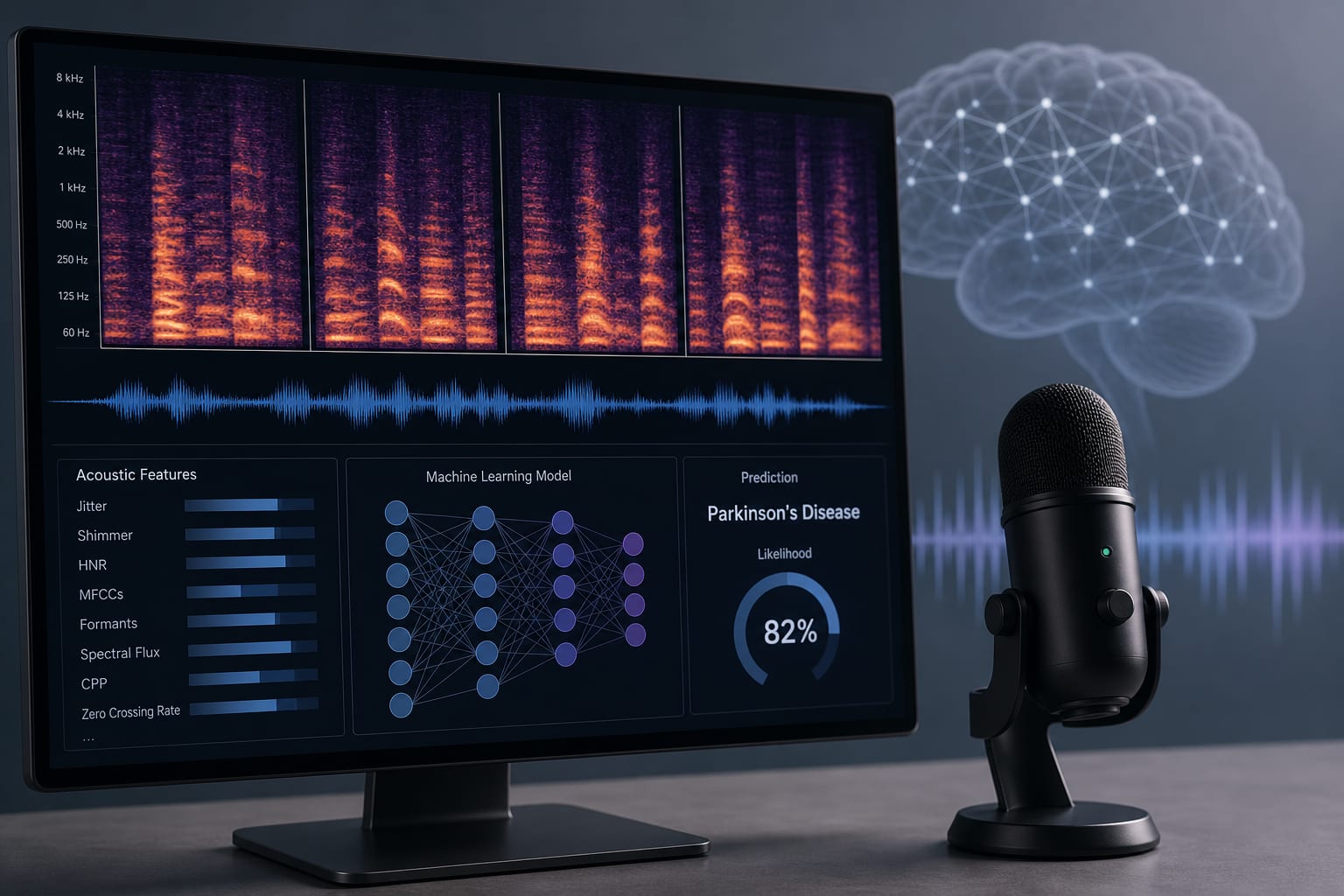
A Machine Learning Approach to Voice-Based Parkinson Disease Screening Using Multiview Spectrogram and Speech Recognition Features: Diagnostic Study - Report - MDSpire
Advertisement
A Machine Learning Approach to Voice-Based Parkinson Disease Screening Using Multiview Spectrogram and Speech Recognition Features: Diagnostic Study
Clinical Report: Utilizing Machine Learning for Voice-Driven Screening of Parkinson's Disease
Overview
This study investigates a multimodal machine learning framework for early detection of Parkinson's disease through voice analysis. By integrating multiple spectrogram representations and speech recognition features, the framework aims to enhance diagnostic accuracy and address challenges related to data scarcity.
Background
Parkinson's disease is a progressive neurological disorder that significantly impacts motor and nonmotor functions. Early detection is crucial for improving patient outcomes and facilitating timely interventions. Voice impairments are among the earliest symptoms, making voice-based assessments a promising area for research in identifying Parkinson's disease.
Data Highlights
No numerical data or trial data provided in the source material.
Key Findings
Vocal impairment is a prevalent early symptom of Parkinson's disease.
Speech and language abnormalities can emerge prior to prominent motor signs.
Multispectrogram fusion may yield more discriminative embeddings for diagnosis.
Existing models often rely on single spectrogram views, limiting their effectiveness.
Data scarcity and overfitting are significant challenges in current research.
Clinical Implications
The integration of voice analysis in Parkinson's disease screening could enhance early diagnosis and monitoring. Clinicians may consider adopting automated tools that utilize voice biomarkers to support their assessments.
Conclusion
The study highlights the potential of machine learning and voice analysis in improving the diagnostic process for Parkinson's disease. Continued research in this area may lead to more effective screening tools.