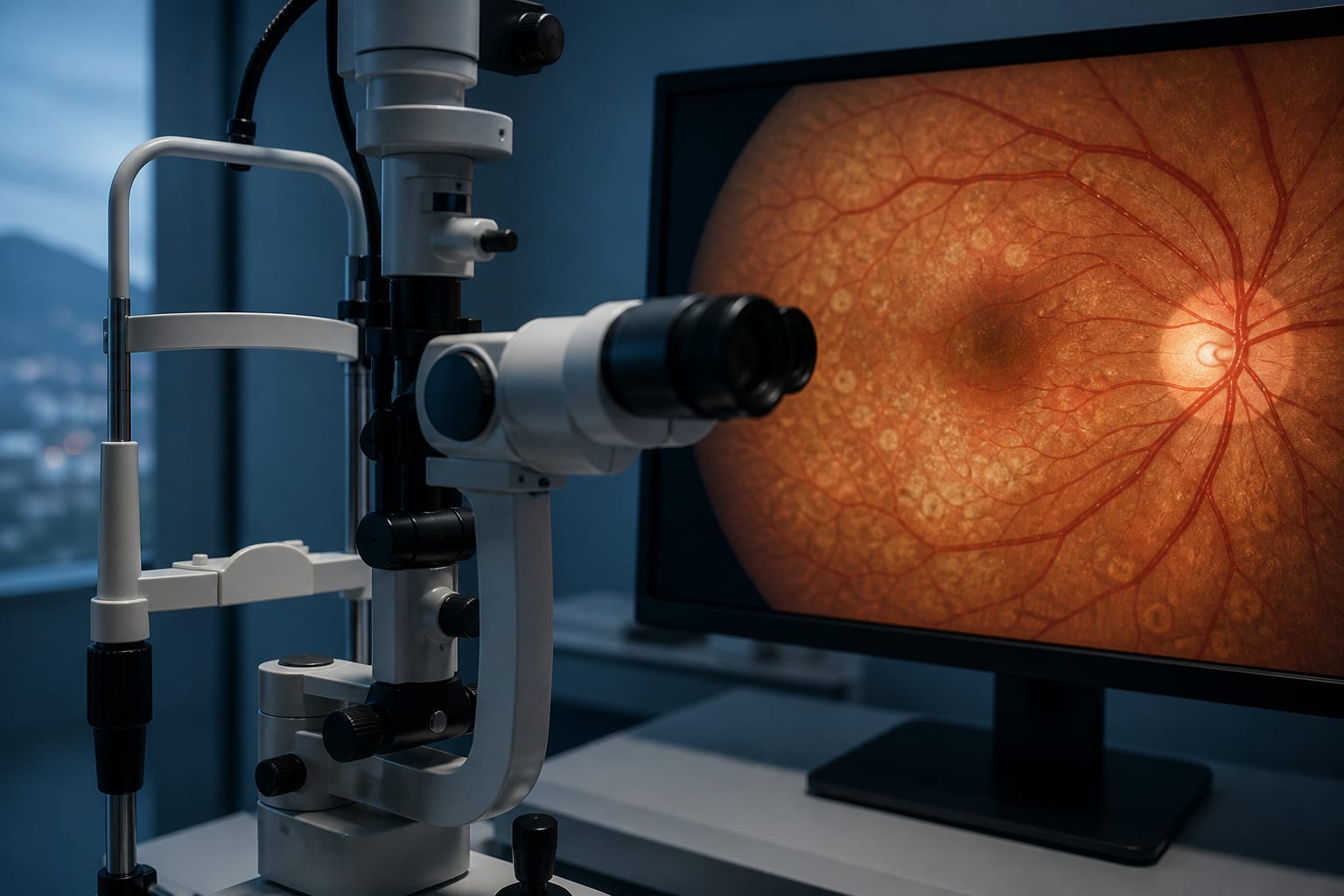
Clinical Report: Testing Atropine’s Posterior Effects
Overview
A randomized study found that low-concentration atropine does not significantly alter axial length, retinal thickness, or choroidal thickness in young adults. A transient reduction in superficial retinal perfusion was observed one hour post-dosing.
Background
Low-dose atropine is commonly used in myopia management, particularly in children. This study aims to clarify the short-term impacts of atropine on retinal and choroidal parameters.
Data Highlights
No significant changes were observed in axial length, retinal thickness, or choroidal thickness after atropine instillation. A transient reduction in superficial vascular complex perfusion density was noted at one hour post-dosing.Key Findings
- Atropine did not significantly alter axial length, retinal thickness, or choroidal thickness at one hour or 24 hours.
- A transient reduction in superficial vascular complex perfusion density was observed one hour after dosing.
- No concentration-dependent effects on structural parameters were detected.
- Previous studies reported inconsistent acute choroidal responses to atropine.
- The study included a small cohort of 20 young adults.
Clinical Implications
Single-dose low-concentration atropine has minimal acute effects on posterior segment structure in young adults.
Conclusion
This study highlights the need for further investigation into the long-term effects of atropine, particularly in pediatric populations, to better understand its role in myopia control.
Related Resources & Content
- Ophthalmology Management, 2026 -- Short Term Effects of Low Concentration Atropine on Ocular Structure
- Optometric Management, 2026 -- ShortTerm Effects of LowConcentration Atropine on Ocular Structure
- IMI—Interventions for Controlling Myopia Onset and Progression 2025 - PMC
- Efficacy and Safety of 0.01% and 0.02% Atropine for the Treatment of Pediatric Myopia Progression Over 3 Years: A Randomized Clinical Trial | Trials | JAMA Ophthalmology | JAMA Network
- Short-term effects of atropine on the retina and choroid in young adults - PMC
- Propiverine, a muscarinic receptor antagonist, demonstrates α1-adrenoceptor blocking activity in human prostate and porcine trigone tissues
- Contact Lens Spectrum — Ocular Safety of Atropine in Myopia Control
- IMI—Interventions for Controlling Myopia Onset and Progression 2025 - PMC
- Efficacy and Safety of 0.01% and 0.02% Atropine for the Treatment of Pediatric Myopia Progression Over 3 Years: A Randomized Clinical Trial | Trials | JAMA Ophthalmology | JAMA Network
- Short-term effects of atropine on the retina and choroid in young adults - PMC
Based on findings from:
Testing Atropine’s Posterior Effects
The Ophthalmologist, 2026.
https://theophthalmologist.com/issues/2026/articles/june/testing-atropines-posterior-effects/
This content is an AI-generated, fully rewritten summary based on a published scholarly article. It does not reproduce the original text and is not a substitute for the original publication. Readers are encouraged to consult the source for full context, data, and methodology.