Development and application of a prognostic model based on radiomics and artificial intelligence for patients with lung adenocarcinoma brain metastasis - Report - MDSpire

Development and application of a prognostic model based on radiomics and artificial intelligence for patients with lung adenocarcinoma brain metastasis

  • By

  • Congying Zheng

  • Xinyuan Yang

  • Musen Ye

  • Kai Tang

  • Shubin Wang

  • June 30, 2026

  • 0 min

Share

Clinical Report: Prognostic Framework for Lung Adenocarcinoma with Brain Metastases

Overview

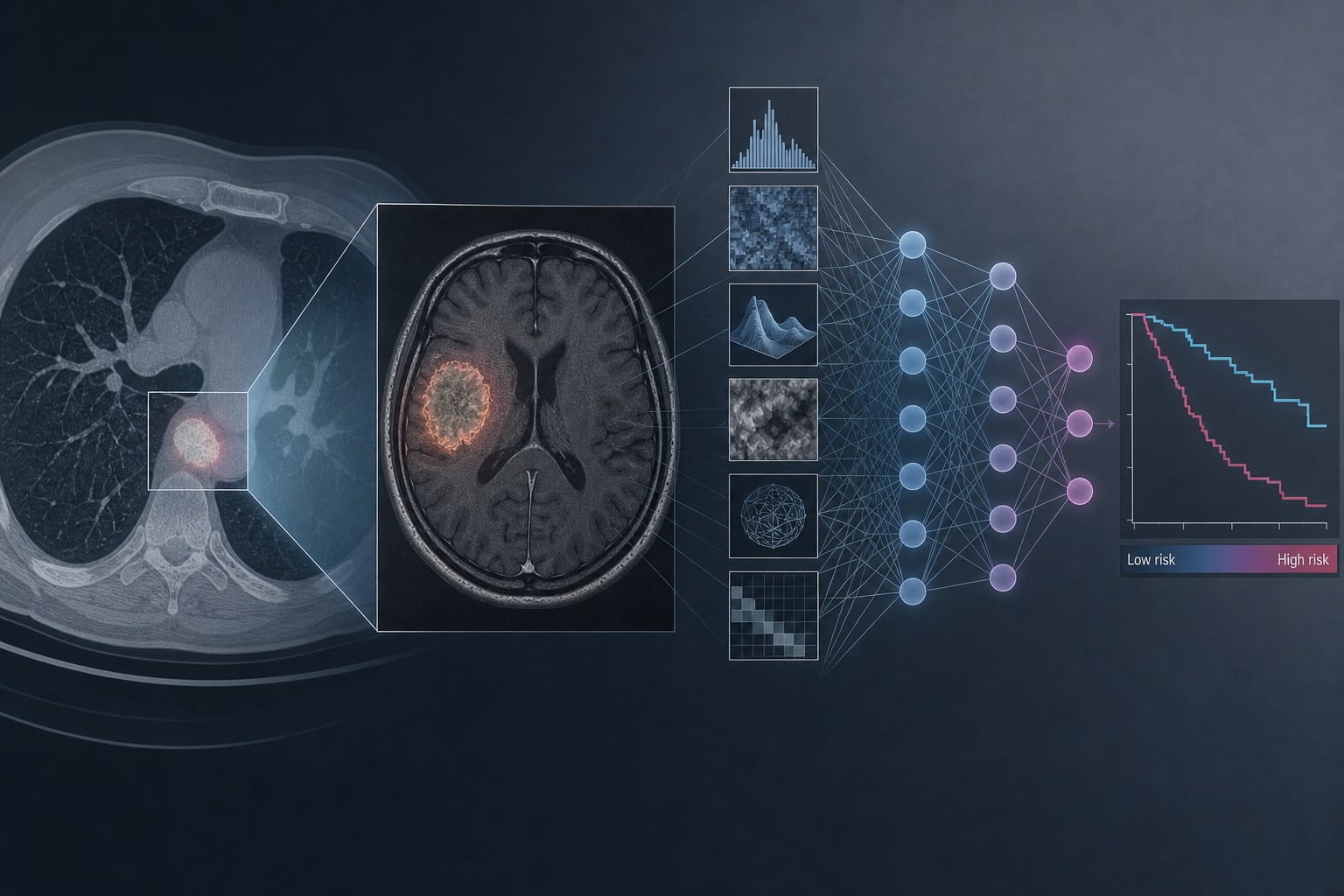
This study developed a prognostic model integrating radiomics and clinical factors to enhance survival predictions for lung adenocarcinoma patients with brain metastases.

Background

Lung cancer with brain metastasis significantly impairs survival, necessitating accurate prognostic tools. The study addresses the high postoperative recurrence rates and the limited efficacy of current diagnostic and therapeutic options. Integrating radiomics with clinical data offers a method to improve prognostic accuracy and patient stratification.

Data Highlights

ModelAUC (Training Set)AUC (Test Set)
Radiomics Model0.8620.829
Combined Nomogram0.9040.874

Key Findings

  • EGFR mutation status, number of brain metastases, and Lung-molGPA score are independent prognostic determinants.
  • The radiomics model achieved AUCs of 0.862 in the training set and 0.829 in the test set.
  • The combined nomogram showed AUC values of 0.904 and 0.874 in the training and test sets, respectively.
  • The integration of radiomics with clinical parameters enhances prognostic accuracy.

Clinical Implications

The findings indicate that incorporating radiomics into clinical practice may enhance survival predictions for lung adenocarcinoma patients with brain metastases.

Conclusion

The study presents a combined radiomics-clinical model to improve prognostic accuracy in lung adenocarcinoma patients with brain metastases.

Related Resources & Content

  1. Journal of Neuro-Oncology, 2023 -- Utilizing Radiomics to Predict PD-L1 Expression Non-Invasively in Patients with Brain Metastases from Non-Small Cell Lung Cancer
  2. European Radiology, 2025 -- CT-Based Radiogenomics Evaluation of Metastatic Lung Adenocarcinoma: A Study of Single and Multi-Site Analysis and Its Impact on Patient Outcomes
  3. Journal of Neuro-Oncology, 2024 -- Innovations in Artificial Intelligence for Neurosurgical Oncology: A Comprehensive Review
  4. Treatment for Brain Metastases: ASCO-SNO-ASTRO Guideline - PMC
  5. Journal of Clinical Oncology, 2024 -- Lorlatinib Versus Crizotinib in Patients With Advanced ALK-Positive Non–Small Cell Lung Cancer: 5-Year Outcomes From the Phase III CROWN Study
  6. asco ai in oncology — MRI-Based Foundation Model Predicts Key Molecular Biomarkers and Posttreatment Outcomes in Glioma
  7. Treatment for Brain Metastases: ASCO-SNO-ASTRO Guideline - PMC
  8. Lorlatinib Versus Crizotinib in Patients With Advanced ALK-Positive Non–Small Cell Lung Cancer: 5-Year Outcomes From the Phase III CROWN Study | Journal of Clinical Oncology
  9. External validation of the lung-molGPA to predict survival in patients treated with stereotactic radiotherapy for brain metastases of non-small cell lung cancer - ScienceDirect

Original Source(s)

Related Content