Nearly Four Million Medicare Beneficiaries Could Be Eligible for the Temporary Medicare GLP-1 Bridge Program Covering These Drugs for Weight Loss - Report - MDSpire
Advertisement
Nearly Four Million Medicare Beneficiaries Could Be Eligible for the Temporary Medicare GLP-1 Bridge Program Covering These Drugs for Weight Loss
Approximately 3.8 Million Medicare Recipients May Qualify for the New Temporary GLP-1 Bridge Program for Weight Loss Medications
Overview
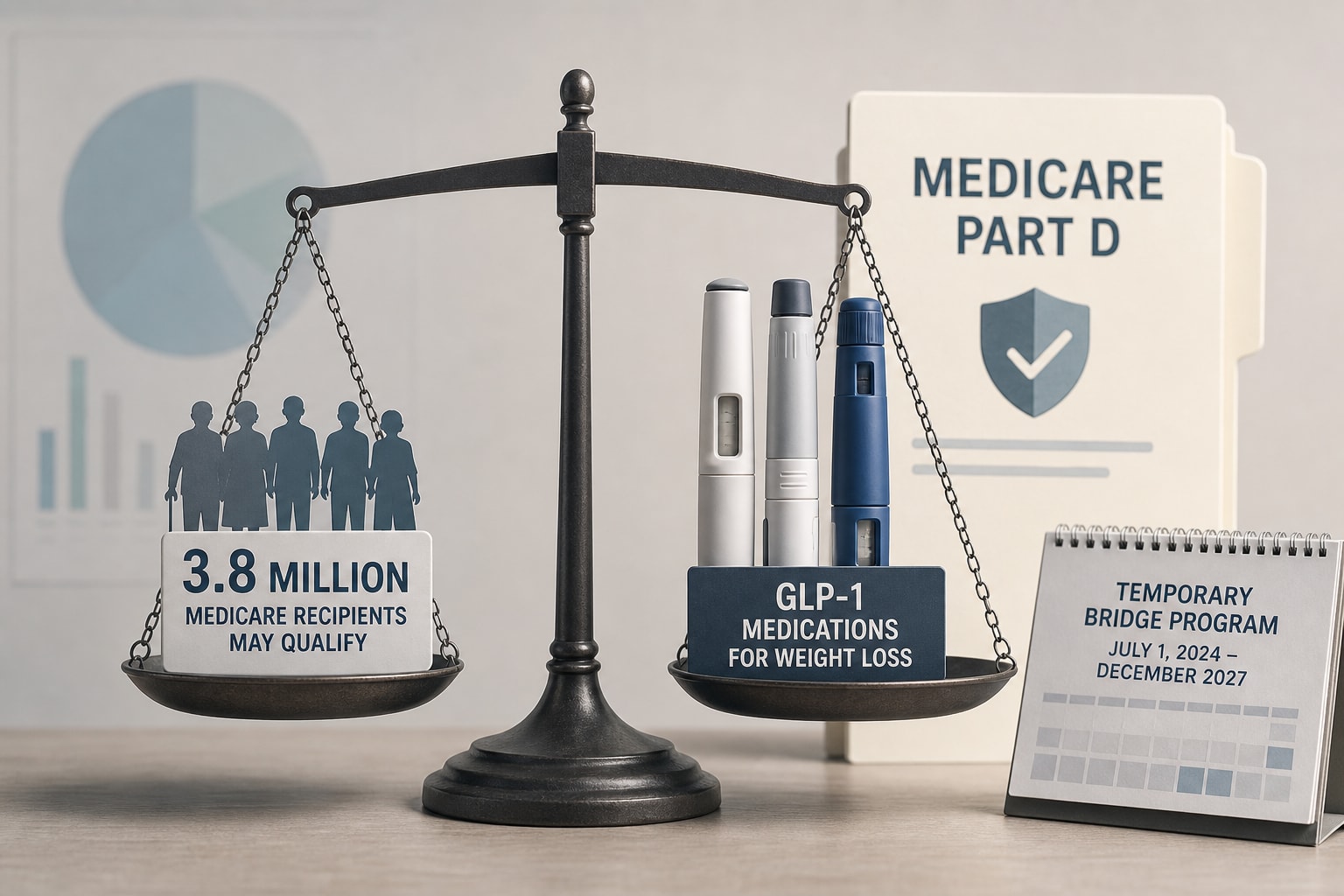
A KFF analysis indicates that 3.8 million Medicare beneficiaries are eligible for the new GLP-1 Bridge program, which will cover specific weight loss medications. The program is set to launch on July 1, 2026, and will last for 18 months.
Background
The GLP-1 Bridge program aims to provide access to effective weight management medications for eligible beneficiaries. Understanding the eligibility criteria and potential costs is crucial for healthcare providers and policymakers.
Data Highlights
3.8 million Medicare beneficiaries meet the eligibility criteria for the GLP-1 Bridge program.
Key Findings
3.8 million Medicare beneficiaries meet the eligibility criteria for the GLP-1 Bridge program.
The program will cover GLP-1 medications such as Wegovy, Zepbound, and Foundayo for weight management.
Eligibility requires a BMI of 35 or more, or a BMI of 27 or more with certain comorbid conditions.
The estimated cost to Medicare could range from $1.3 billion to $10 billion depending on participation rates.
Over 13 million Medicare beneficiaries met BMI thresholds for obesity or overweight, but only a subset qualifies for the program.
Clinical Implications
Healthcare providers should be aware of the eligibility criteria for the GLP-1 Bridge program.
Conclusion
The GLP-1 Bridge program is set to provide coverage for weight management medications for eligible Medicare beneficiaries.
A matched electronic health record study of more than 876,000 patients with type 2 diabetes found a low absolute incidence but higher relative hazard of documented smell and taste disturbances among patients prescribed glucagon-like peptide-1 receptor agonists.
In two population-based cohorts, metabolically unhealthy status generally showed higher dementia risk estimates, while metabolically healthy obesity was not associated with increased risk in primary analyses.