Accuracy of Artificial Intelligence in Diagnosing Obstructive Sleep Apnea Using Photoplethysmography: Systematic Review and Meta-Analysis - Report - MDSpire
Coming Soon: Introducing MDSpire News. Learn more
Conexiant’s news site is now MDSpire News. Learn more

Evaluating the Precision of AI in Diagnosing Obstructive Sleep Apnea Through Photoplethysmography: A Systematic Review and Meta-Analysis

  • By

  • Brian Sheng Yep Yeo

  • Esther Yanxin Gao

  • Joan Ern Xin Tan

  • Jun Yuan Koo

  • Yi Siang Lee

  • Nicole Kye Wen Tan

  • Adele Chin Wei Ng

  • Zhou Hao Leong

  • Thun How Ong

  • Leong Chai Leow

  • Guang-Bin Huang

  • Benjamin Kye Jyn Tan

  • Song Tar Toh

  • September 25, 2026

Share

Clinical Report: Evaluating the Precision of AI in Diagnosing OSA Through PPG

Overview

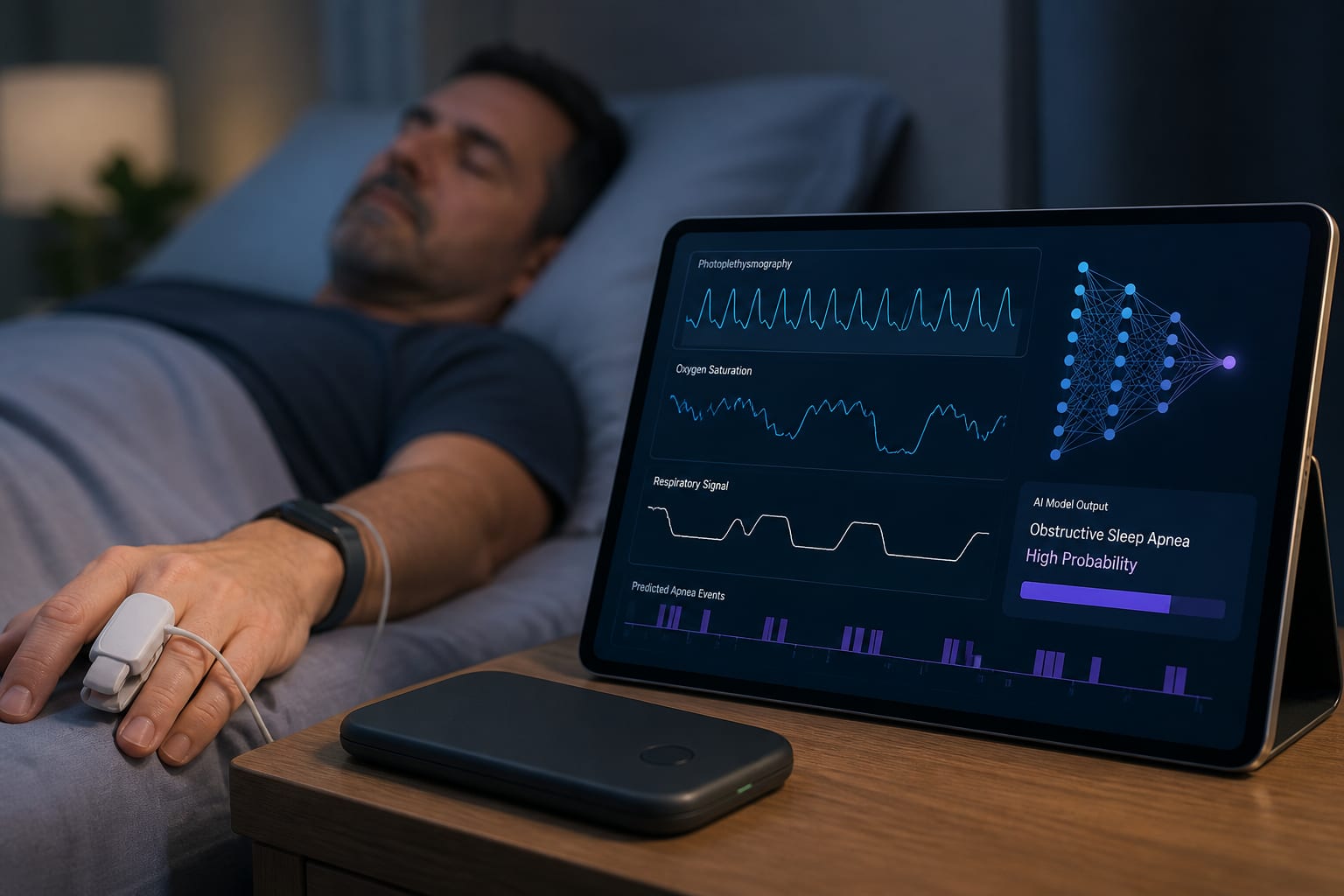
This systematic review and meta-analysis evaluates the diagnostic accuracy of AI models utilizing photoplethysmography (PPG) for detecting obstructive sleep apnea (OSA).

Background

Obstructive sleep apnea (OSA) affects approximately 1 billion people globally, leading to significant health risks if left undiagnosed. Traditional diagnostic methods, such as polysomnography, are often limited by cost and accessibility.

Data Highlights

No numerical data was provided in the source material.

Key Findings

  • AI models trained on PPG data have shown promise in diagnosing OSA.
  • PPG is a noninvasive and cost-effective method for measuring blood oxygen saturation.
  • Existing studies report varying accuracy levels for AI-based OSA diagnosis using PPG.
  • Comprehensive evaluation of AI models for OSA diagnosis is timely and clinically relevant.

Clinical Implications

Clinicians should remain informed about advancements in AI technologies in sleep medicine.

Conclusion

This meta-analysis highlights the need for systematic evaluation of AI models in diagnosing OSA using PPG.

Related Resources & Content

  1. Gottlieb DJ, Punjabi NM, JAMA, 2020 -- Diagnosis and management of obstructive sleep apnea: a review
  2. Benjafield AV, et al., Lancet Respir Med, 2019 -- Estimation of the global prevalence and burden of obstructive sleep apnoea: a literature-based analysis
  3. Kapur V, et al., Sleep Breath, 2002 -- Underdiagnosis of sleep apnea syndrome in U.S. communities
  4. Bazoukis G, et al., J Clin Sleep Med, 2023 -- Application of artificial intelligence in the diagnosis of sleep apnea
  5. Haug CJ, Drazen JM, N Engl J Med, 2023 -- Artificial intelligence and machine learning in clinical medicine
  6. Journal of Medical Internet Research — Evaluation of AI-Driven Screening Methods for Obstructive Sleep Apnea at Varying Apnea-Hypopnea Index Levels: A Systematic Review and Meta-Analysis
  7. Journal of Medical Internet Research (JMIR) — Artificial Intelligence Diagnosis of Obstructive Sleep Apnea Using Overnight Pulse Oximetry: A Systematic Review and Bayesian Meta-Analysis
  8. JMIR Medical Informatics — Machine Learning–Based Multidimensional Oximetry for Obstructive Sleep Apnea Screening: Development and External Validation
  9. DIGITAL HEALTH — Diagnosis model for obstructive sleep apnea combining artificial immune system and logistic regression: A case study in Taiwan
  10. Clinical Practice Guideline for Diagnostic Testing for Adult Obstructive Sleep Apnea
  11. Oximetry-based devices in diagnosis of obstructive sleep apnea: A systematic review and meta-analysis
  12. Samsung’s Sleep Apnea Feature on Galaxy Watch First of Its Kind Authorized by US FDA | Samsung Mobile Press

Original Source(s)

Related Content