Glycemic variability and muscle loss in elderly type 2 diabetes: insights from continuous glucose monitoring and chest CT in 303 patients - Report - MDSpire

Glycemic variability and muscle loss in elderly type 2 diabetes: insights from continuous glucose monitoring and chest CT in 303 patients

  • By

  • Xiao-le Zhang

  • Ning Bai

  • Chun-pu Mao

  • Chun-yan Liu

  • June 22, 2026

  • 0 min

Share

Association of Glycemic Fluctuations with Muscle Mass Loss in Older Adults

Overview

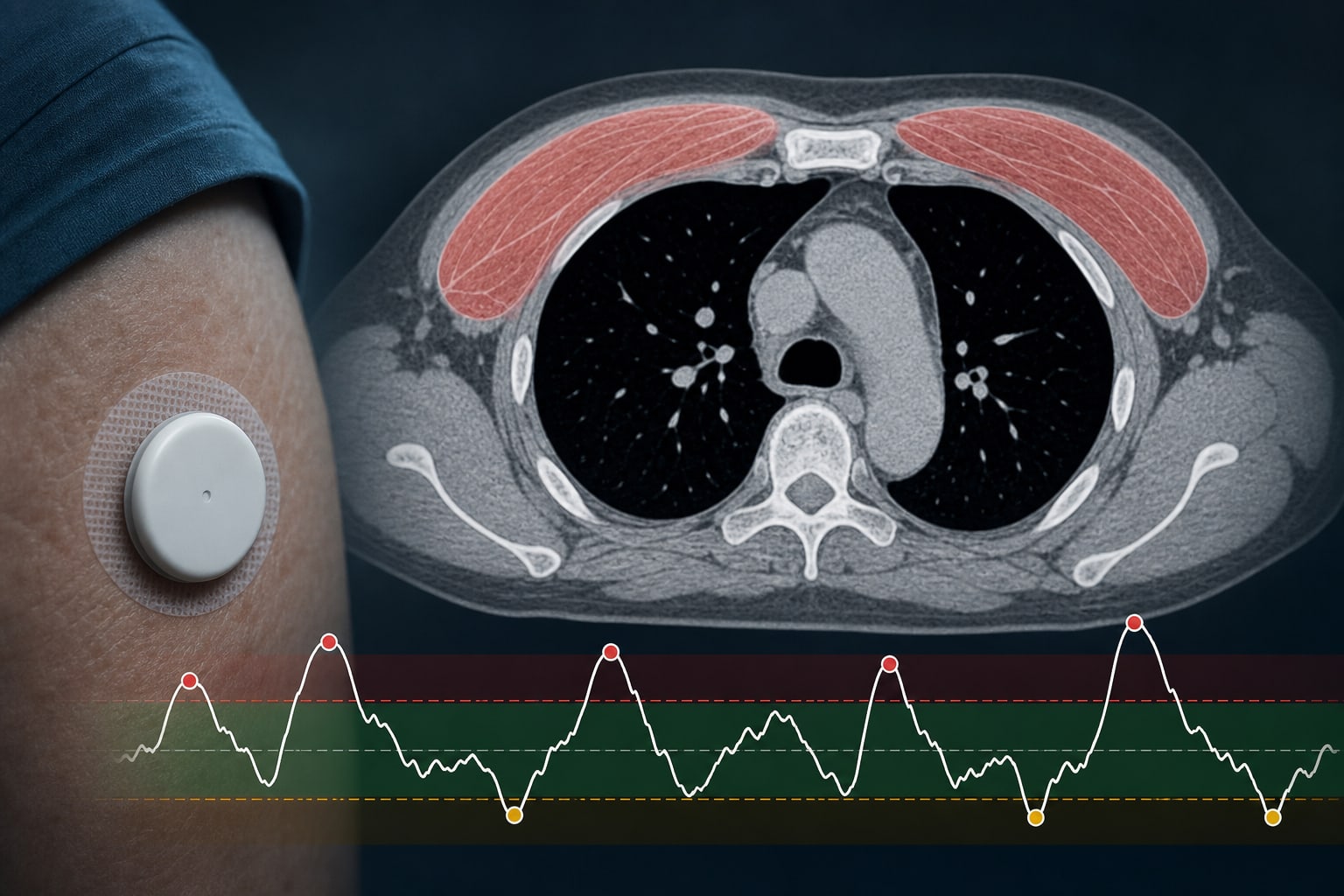
This study investigates the relationship between glycemic fluctuations and pectoralis muscle mass in older adults with type 2 diabetes mellitus (T2DM). Findings indicate that greater glycemic variability is independently associated with lower muscle mass, particularly in patients with longer diabetes duration or lower body mass index.

Background

Sarcopenia is prevalent among older adults with T2DM, leading to increased risks of frailty and functional decline. Traditional glucose monitoring methods do not capture short-term fluctuations, which may independently affect muscle health.

Data Highlights

Glycemic Variability MetricAdjusted R²
Coefficient of Variation (CV)0.22
Time Below Range (TBR)0.21
Standard Deviation (SD)0.20
Mean Amplitude of Glycemic Excursions (MAGE)0.19

Key Findings

  • Four glycemic variability indicators (CV, SD, MAGE, TBR) were linked to lower pectoralis muscle mass (PMI) (P < 0.05).
  • CV explained the largest variance in PMI (adjusted R² = 0.22).
  • A linear dose-response relationship was observed between CV and PMI (P for trend < 0.001).
  • The inverse association was stronger in patients with diabetes duration ≥ 10 years (β = –0.18, P < 0.001).
  • Significant interactions were noted for patients with BMI < 24 kg/m² (β = –0.18, P < 0.001).

Clinical Implications

Monitoring glycemic variability may be essential for preserving muscle mass in older adults with T2DM.

Conclusion

The study highlights the importance of glycemic variability in relation to muscle mass loss in older adults with T2DM.
Related Resources & Content

  1. American Diabetes Association, Diabetes Care, 2026 -- Older Adults: Standards of Care in Diabetes—2026
  2. American Diabetes Association, Diabetes Care, 2026 -- Glycemic Goals, Hypoglycemia, and Hyperglycemic Crises: Standards of Care in Diabetes—2026
  3. Nature Aging, 2025 -- A focus shift from sarcopenia to muscle health in the Asian Working Group for Sarcopenia 2025 Consensus Update
  4. Wiley Online Library, 2026 -- Interpretation of A Focus Shift From Sarcopenia to Muscle Health in the Asian Working Group for Sarcopenia 2025 Consensus Update
  5. ScienceDirect, 2025 -- Diabetes is associated with impaired skeletal muscle quality, not quantity, in older adults, based on CT-derived chest muscle metrics
  6. Obesity Surgery — Monitoring Glycemic Variability During Fasting After Sleeve Gastrectomy Using Continuous Glucose Measurement
  7. The Journal of Clinical Endocrinology & Metabolism — Bone Microstructure in Elderly Men with Type 2 Diabetes: Significance of Bone Dimensions
  8. The Journal of Clinical Endocrinology & Metabolism — Altered Glucagon Release Plays a Role in the Progressive Deterioration of Glucose Tolerance
  9. The Journal of Clinical Endocrinology & Metabolism — A Longitudinal Analysis of Glucose Tolerance in Cystic Fibrosis: The Key Role of Beta Cell Functionality
  10. Monitoring Glycemic Variability During Fasting After Sleeve Gastrectomy Using Continuous Glucose Measurement
  11. Bone Microstructure in Elderly Men with Type 2 Diabetes: Significance of Bone Dimensions
  12. Altered Glucagon Release Plays a Role in the Progressive Deterioration of Glucose Tolerance
  13. 13. Older Adults: Standards of Care in Diabetes—2026 | Diabetes Care | American Diabetes Association
  14. 6. Glycemic Goals, Hypoglycemia, and Hyperglycemic Crises: Standards of Care in Diabetes—2026 | Diabetes Care | American Diabetes Association
  15. A focus shift from sarcopenia to muscle health in the Asian Working Group for Sarcopenia 2025 Consensus Update | Nature Aging
  16. Interpretation of A Focus Shift From Sarcopenia to Muscle Health in the Asian Working Group for Sarcopenia 2025 Consensus Update - Jianghan - 2026 - AGING MEDICINE - Wiley Online Library
  17. Diabetes is associated with impaired skeletal muscle quality, not quantity, in older adults, based on CT-derived chest muscle metrics - ScienceDirect
  18. Frontiers | Glycemic variability and muscle loss in elderly type 2 diabetes: insights from continuous glucose monitoring and chest CT in 303 patients
  19. Continuous glucose monitoring-derived glycemic variability and low skeletal muscle mass in middle-aged and older adults with type 2 diabetes mellitus: an analysis using AWGS 2025 criteria | Diabetology & Metabolic Syndrome | Springer Nature Link
  20. The efficacy of resistance exercise training on metabolic health, body composition, and muscle strength in older adults with type 2 diabetes: A systematic review and Meta-Analysis - ScienceDirect
  21. Validation for measurements of skeletal muscle areas using low-dose chest computed tomography | Scientific Reports

Original Source(s)

Related Content